World Heritage Identification Number: 805
World Heritage since: 1997
Category: Cultural Heritage
WHE Type: Religious Sites & Sacred Architecture
Transboundary Heritage: No
Endangered Heritage: No
Country: 🇪🇸 Spain
Continent: Europe
UNESCO World Region: Europe and North America
Map
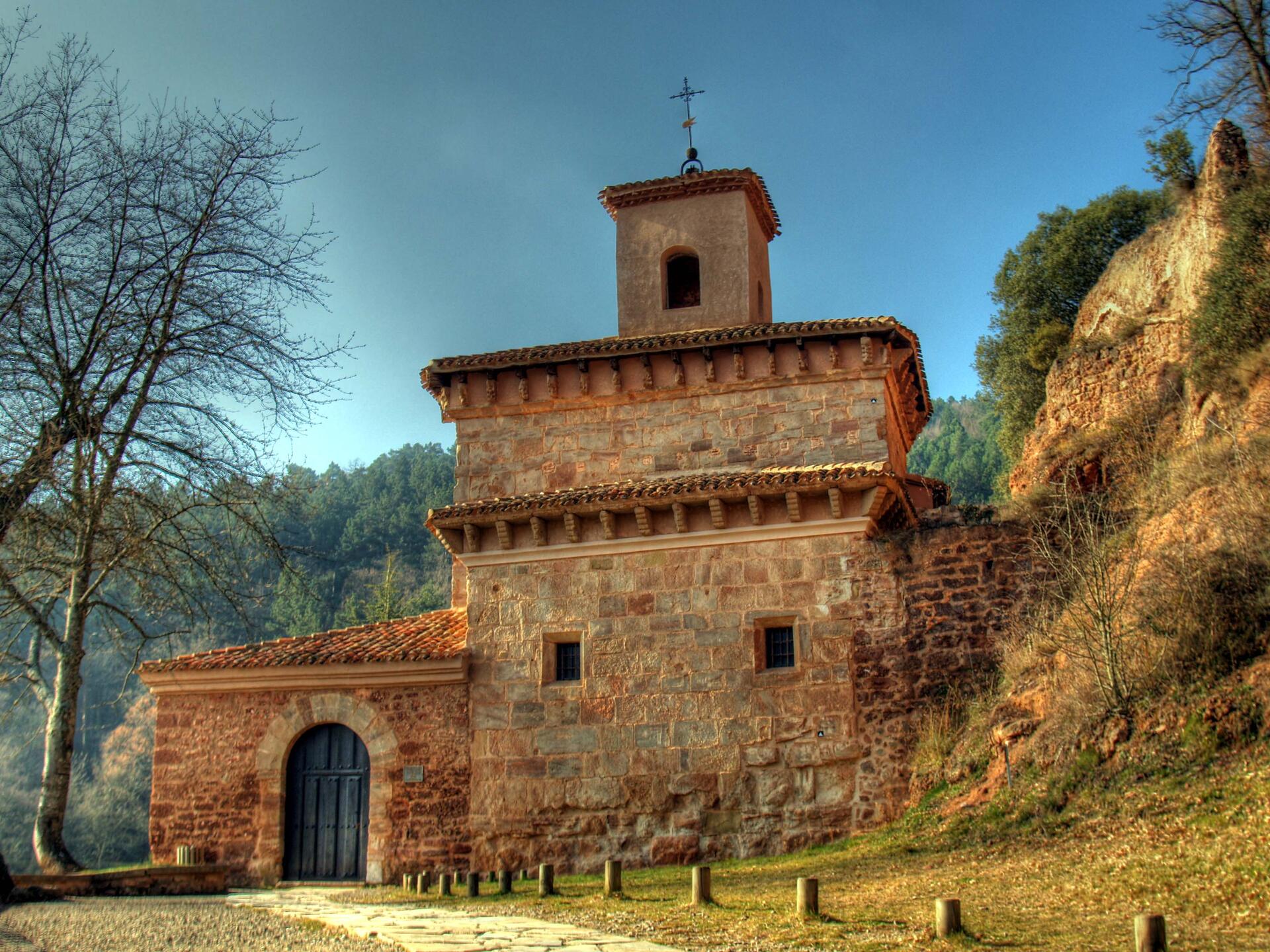
San Millán Yuso and Suso Monasteries: A Testament to the Birthplace of Castilian Literature
The San Millán Yuso and Suso Monasteries, located in the picturesque village of San Millán de la Cogolla in La Rioja, Spain, stand as a testament to the rich history and cultural significance of the region. These twin monasteries were inscribed as a UNESCO World Heritage Site in 1997, acknowledging their unique role in the development of Castilian literature and their architectural and artistic merits.
More to come…UNESCO Description of the World Heritage Site
The monastic community founded by St Millán in the mid-6th century became a place of pilgrimage. A fine Romanesque church built in honour of the holy man still stands at the site of Suso. It was here that the first literature was produced in Castilian, from which one of the most widely spoken languages in the world today is derived. In the early 16th century the community was housed in the fine new monastery of Yuso, below the older complex; it is still a thriving community today.
UNESCO Justification of the World Heritage Site
Criterion (ii): The monasteries of Suso and Yuso at San Millán de la Cogolla are exceptional testimony to the introduction and continuous survival of Christian monasticism, from the 6th century to the present day.
Criterion (iv): Because of the identification and relationship of the two monasteries with elements of the Moorish, Visigothic, Mediaeval, Renaissance and Baroque styles, the architecture and the natural landscape exemplify highly significant periods in the history of Spain.
Criterion (vi): The property is also of outstanding associative significance as the birthplace of the modern written and spoken Spanish language.
Encyclopedia Record: Monasteries of San Millán de la Cogolla
The monasteries of San Millán de Suso and San Millán de Yuso are two monasteries situated in the village of San Millán de la Cogolla, La Rioja, Spain. They have been designated a World Heritage Site by UNESCO since December 1997.Additional Site Details
Area: 19.01 hectares
Number of Components: 2
(iv) — Outstanding example of a type of building or landscape
(vi) — Directly associated with events or living traditions
Coordinates: 42.32586 , -2.86496
World Heritage Research
Discover scientific research and academic studies that deepen our understanding of San Millán Yuso and Suso Monasteries from its history and significance to its conservation, management, and contemporary challenges.
-
Anthropological History of Medieval Castile
The anthropological history of medieval Castile reveals that the Castilian vowel system emerged as a confluence of multiple cultural influences, including Basque-Iberian, Roman, and Christian traditions. This finding challenges traditional narratives of linguistic origins and deaths by emphasizing continuous cultural adaptation and reinterpretation. The study focuses on significant textual artifacts like the Emilian Glosses (950) and Silos Glosses (second half of the 10th century), particularly folio 72r of Em 60, which provide critical insights into Iberian proto-Romance. Additionally, the research examines the social hierarchy established during the repopulation efforts led by medieval monarchs, highlighting the contrast between favorable legal conditions for inhabitants and feudal dependencies in northern regions. The study also underscores the role of education in preserving Roman antiquity, noting Visigoth Spain as a notable manifestation of ancient culture.
Menéndez, F. G. (2026). Anthropological History of Medieval Castile. IOSR Journal of Humanities and Social Science, 31(5), 42–61. https://doi.org/10.9790/0837-3105014261
View Publication Record | Read Publication -
After al-Manṣūr
A significant shift in Castilian art and governance emerged after the death of Muslim general al-Manṣūr in 1002, marking a period of relative isolation from Europe due to sustained conflict within the Iberian Peninsula. This study reveals how Count Fernán González's hereditary rule and autonomous yet subservient position to León laid the foundation for Castile's distinct identity. The research focuses on art produced between c. 970–1030, analyzing surviving sites in Burgos—such as Cardeña, Covarrubias, and San Millán de la Cogolla—and comparing them with neighboring regions like Soria and the Kingdom of León. Sculptural fragments provide evidence of additional structures, offering insights into Castile's unique artistic and political development during this transformative era.
del Álamo, E. V. (2025). After al-Manṣūr. Romanesque and the Year 1000, 105–120. https://doi.org/10.4324/9781003571476-8
View Publication Record | Read Publication -
Order and Disorder through the Eyes of Scribes and Illuminators in the Kingdom of Pamplona c. 970–c. 1000
Scribes and illuminators in the Kingdom of Pamplona (c. 970–1000) crafted illuminated manuscripts that reflected a deliberate imposition of order amid political instability, particularly during Córdoba's frequent attacks. Two notable legal codices—Codex Albeldensis (976) and Codex Aemilianensis (c. 992)—alongside exegetical works like the Beatus Apocalypse and Expositio psalmorum, embodied a neo-Visigothic identity through structured visual and textual elements. The study reveals that representations of natural order, such as cosmographical maps, contrasted with serpentine or hybrid creatures, interpreted as transgressions. These transgressions likely stemmed from deliberate distortions, symbolizing disorder. The analysis also explores divergent illumination styles—ranging from plastic to abstract—through the lens of Cassiodorus' textual framework, offering insights into how visual art and textual authority interacted in this turbulent period.
Walker, R. (2025). Order and Disorder through the Eyes of Scribes and Illuminators in the Kingdom of Pamplona c. 970–c. 1000. Romanesque and the Year 1000, 85–104. https://doi.org/10.4324/9781003571476-7
View Publication Record | Read Publication -
New Perspectives and Usual Challenges: Present Technologies for Document Management in Architectural Heritage Conservation-Restoration Works
A structured approach to document management in architectural heritage conservation, integrating a Catalogue of Document Typologies (CDT), Heritage Building Information Modelling (HBIM), and semantic knowledge graphs, significantly enhances the organization, visualization, and interrelation of dispersed documents. This method, demonstrated through a case study at the UNESCO-listed San Millán de la Cogolla Monasteries, improves standardization, collaboration across disciplines, and the formalization of conservation knowledge. However, challenges such as interoperability, dissemination, and reuse remain critical to fully realizing its potential.
Korro, J., Valle-Melón, J. M., Zornoza-Indart, A., & Rodriguez Miranda, A. (2025). New Perspectives and Usual Challenges: Present Technologies for Document Management in Architectural Heritage Conservation-Restoration Works. Journal on Computing and Cultural Heritage, 18(2), 1–28. https://doi.org/10.1145/3723455
View Publication Record | Read Publication -
Network and Radial Layouts for Visual Representation of Knowledge Graphs for Cultural Heritage Conservation-Restoration Activities
A novel approach to analyzing knowledge graphs for cultural heritage conservation reveals that combining network and radial layouts enhances the visibility of critical links, aiding decision-making. This study applied adjacency matrix analysis to count indirect relationships between nodes, providing deeper insights into the graph's communicative, semantical, and mathematical dimensions. The methodology compared these layouts using the San Millán Yuso and Suso Monasteries as a case study, demonstrating their complementarity in uncovering meaningful patterns within conservation-restoration data.
(Ed.). (2025). Network and Radial Layouts for Visual Representation of Knowledge Graphs for Cultural Heritage Conservation-Restoration Activities. Tehnicki Vjesnik - Technical Gazette, 32(4). https://doi.org/10.17559/tv-20240927002023
View Publication Record | Read Publication -
The Bullary as a New Type of Cartulary: The Example of Becerro III of San Millán de la Cogolla
Research identifies the Becerro III of San Millán de la Cogolla as a groundbreaking 'proto-bullary,' an early example of a cartulary type dedicated to preserving papal documents. This manuscript, dating back to the 13th or 14th century, predates the widespread use of bullaria by several centuries and represents a precursor to this specialized cartulary form. The study reveals that despite its artificial nature, the monks' compilation of papal privileges in the Becerro III can be recognized as an innovative approach to documenting ecclesiastical authority, foreshadowing the later diffusion of bullaria across the Iberian Peninsula. This finding advances our understanding of the typological diversity and evolution of cartularies during the medieval period.
Agúndez San Miguel, L. (2024). The Bullary as a New Type of Cartulary: The Example of Becerro III of San Millán de la Cogolla. Studia Historica. Historia Medieval, 42(1), 71–92. https://doi.org/10.14201/shhme20234217192
View Publication Record | Read Publication -
Three Men in the Fire (×3)
Research reveals that the liturgy for Córdoban saints Faustus, Januarius, and Martialis deliberately associates them with the biblical three men in the furnace (Daniel 3) to emphasize their martyrdom under Islamic rule. The study identifies anti-Islamic polemical elements in the saints' passio, suggesting that the liturgical choices were designed to frame their story within contemporary Muslim-Christian tensions. By analyzing chants and prayers borrowed from another Iberian saintly trio, the research demonstrates how cultural associations with Daniel 3 were strategically leveraged. This finding sheds light on the political and religious motivations behind liturgical practices at San Millán de la Cogolla, a key site in the development of this tradition.
Shaffer, M. (2024). Three Men in the Fire (×3). The Journal of Musicology, 41(2), 221–261. https://doi.org/10.1525/jm.2024.41.2.221
View Publication Record | Read Publication