World Heritage Identification Number: 316
World Heritage since: 1984
Category: Cultural Heritage
WHE Type: Religious Sites & Sacred Architecture
Transboundary Heritage: No
Endangered Heritage: No
Country: 🇪🇸 Spain
Continent: Europe
UNESCO World Region: Europe and North America
Map
A Gothic Masterpiece: The Burgos Cathedral
The Burgos Cathedral, officially known as the Holy Metropolitan Cathedral Basilica Church of St Mary of Burgos, stands as a testament to the rich architectural heritage of Spain. Inscribed as a UNESCO World Heritage Site in 1984, this magnificent structure embodies the evolution of Gothic art spanning from the 13th to the 16th century.
More to come…UNESCO Description of the World Heritage Site
Our Lady of Burgos was begun in the 13th century at the same time as the great cathedrals of the Ile-de-France and was completed in the 15th and 16th centuries. The entire history of Gothic art is summed up in its superb architecture and its unique collection of works of art, including paintings, choir stalls, reredos, tombs and stained-glass windows.
UNESCO Justification of the World Heritage Site
Criterion (ii): Burgos Cathedral has exerted, at different times throughout history, a considerable influence on the evolution of architecture and the arts. The Cathedral played an important role in the diffusion of the forms of 13th-century, French Gothic art in Spain. The internationally important Cathedral’s workshop in the 15th and 16th centuries, where artists from the Rhineland, Burgundy, and Flanders trained Spanish architects and sculptors, created one of the most flourishing schools at the end of the Middle Ages. The Cathedral’s also served as a model throughout the 19th century, i.e. the French architect Garnier was inspired by the staircase of Diego de Siloe when he created that of the Opera in Paris.
Criterion (iv): Burgos offers a celebrated example of an integral Gothic cathedral with its chapels, cloister, and annexes. Built over more than four centuries, the Cathedral bears testimony to the creative genius of architects, sculptors, and craftsmen throughout these periods.
Criterion (vi): Burgos Cathedral, with the tomb of El Cid and his wife Doña Jimena, is intimately linked to the history of the Reconquista and Spanish unity. Several members of the early royal house of Castile rest beneath the main altar. The memory of Saint Ferdinand is linked to the construction of this symbolic monument of the Spanish monarchy.
Encyclopedia Record: Burgos Cathedral
The Cathedral of Saint Mary of Burgos is a Catholic church dedicated to the Virgin Mary located in the historical center of the Spanish city of Burgos. Its official name is the Holy Metropolitan Cathedral Basilica Church of St Mary of Burgos.Additional Site Details
Area: 1.03 hectares
Number of Components: 1
(iv) — Outstanding example of a type of building or landscape
(vi) — Directly associated with events or living traditions
Coordinates: 42.3407333333 , -3.7040111111
Image
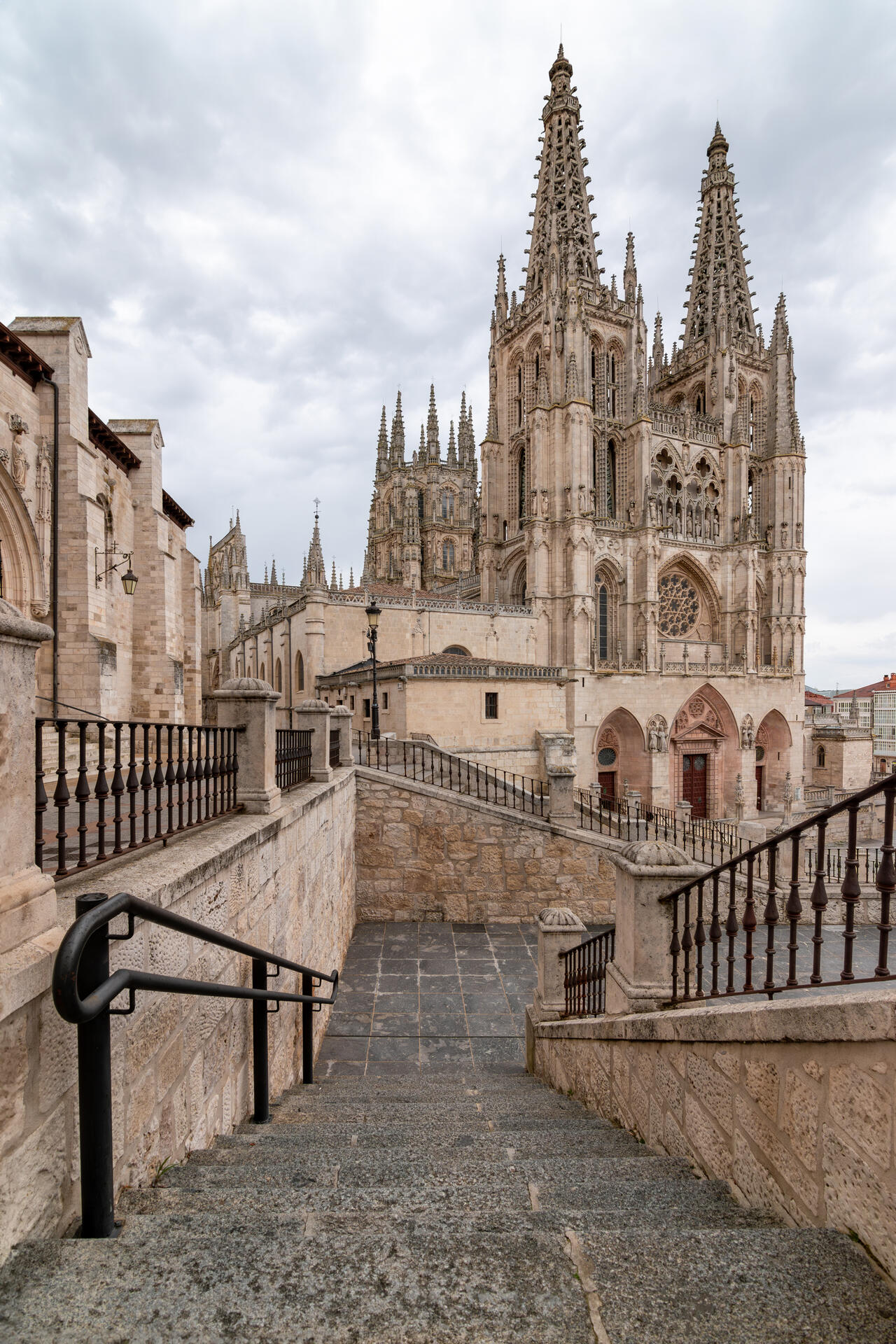
© Jose María Ligero Loarte, CC BY-SA 4.0 Resized from original. (This derivative is under the same CC BY-SA license.)
World Heritage Research
Discover scientific research and academic studies that deepen our understanding of Burgos Cathedral from its history and significance to its conservation, management, and contemporary challenges.
-
A hidden history in the Burgos Cathedral (Spain): virtual reconstruction of the lighting effects generated in the 15th century Chapel of the Conception or Saint Anne
Virtual reconstruction reveals that the 15th-century Chapel of the Conception in Burgos Cathedral (Spain) generated 'miracles of light'—special lighting effects visible at solstices or equinoxes—similar to those documented in nearby medieval churches. These phenomena, linked to the architectural style of the 'taller de los Colonia,' were likely obscured after the 18th-century construction of the Chapel of Santa Tecla. Using solar simulation software, researchers analyzed the chapel's design and methods behind these effects, offering new insights into the sophistication of medieval architectural engineering.
Uson Guardiola, E., Gárate Alcalde, J. A., Jørgensen-Mínguez, V., & Espuny Camacho, E. (2025). A hidden history in the Burgos Cathedral (Spain): virtual reconstruction of the lighting effects generated in the 15th century Chapel of the Conception or Saint Anne. Architectus, (2(82)). https://doi.org/10.37190/arc250203
View Publication Record | Read Publication -
Optimization of a Standalone VR Experience Through User Perception: A Journey to the Hidden Spaces of the Burgos Cathedral
A novel virtual reality (VR) experience optimizes the exploration of inaccessible areas within Burgos Cathedral by leveraging photogrammetry and user perception data. This standalone VR application enhances resolution in frequently observed regions, ensuring a seamless and immersive experience. The approach sets a new benchmark for cultural heritage dissemination through VR technology, offering both academic and practical advancements in digital preservation and interactive tourism.
Checa, D., & Alaguero, M. (2024). Optimization of a Standalone VR Experience Through User Perception: A Journey to the Hidden Spaces of the Burgos Cathedral. 2024 IEEE Conference on Virtual Reality and 3D User Interfaces Abstracts and Workshops (VRW), 893–894. https://doi.org/10.1109/vrw62533.2024.00243
View Publication Record | Read Publication -
Touching Female Memories in the Purification Funerary Chapel in Burgos (c. 1482–1531)
Late medieval women, such as the Countess of Haro Mencía de Mendoza, crafted sophisticated funerary ensembles that blended architecture, art, and sensory elements to shape memory and experience. The Purification Chapel in Burgos Cathedral (c. 1482–1531), commissioned by Mencía, exemplifies this interplay between gender, perception, and cognition. Through art historical analysis, the study reveals how intersensorial design—combining visual, tactile, and liturgical elements—created immersive spaces that challenged textual-centric interpretations of medieval thought. This work highlights the nuanced ways women like Mencía leveraged sensory manipulation to assert influence, offering new insights into the cognitive and perceptual models of the era.
Paulino Montero, E. (2024). Touching Female Memories in the Purification Funerary Chapel in Burgos (c. 1482–1531). Nuncius, 39(2), 275–304. https://doi.org/10.1163/18253911-bja10104
View Publication Record | Read Publication -
Unsacred Monarchy: The Kings of Castile in the Late Middle Ages
A significant ritual innovation emerged during the coronation of Alfonso XI (1312–50), King of Castile, León, and other territories, in 1332. Unlike traditional anointing ceremonies, Alfonso was knighted by a mechanical arm of St. James' statue in Santiago de Compostela's cathedral before returning to Burgos for the royal unction. This deviation from sacred norms—combining pilgrimage symbolism with secular monarchy—challenges conventional narratives about late medieval kingship and religious authority. The study reconstructs this event through historical documentation, highlighting how Alfonso XI strategically integrated chivalric and religious elements to legitimize his rule, thereby reshaping the ceremonial landscape of Castile's monarchy.
Ruiz, T. F. (2024). Unsacred Monarchy: The Kings of Castile in the Late Middle Ages. The City and the Realm: Burgos and Castile, 1080-1492, XIII–X109. https://doi.org/10.4324/9781003555018-13
View Publication Record | Read Publication -
Building Episcopal Authority in Medieval Castile: The Bishops of the Diocese of Burgos (11th–13th Centuries)
The consolidation of episcopal authority in the Diocese of Burgos, central to the Kingdom of León's eastern region (modern-day Castile), was achieved through strategic territorial delimitation and recovery of jurisdictional rights from powerful Benedictine monasteries and lay figures between the 11th and 13th centuries. This study identifies three key periods: defining diocesan boundaries, reclaiming lost churches and ecclesiastic taxes, and asserting hierarchical dominance over other diocesan potestates. Bishops employed tactics such as dispute-resolution agreements, integrating abbots into the cathedral chapter, and property acquisitions to solidify their power. The research highlights how monarchs leveraged Burgos—a pivotal pre-urban settlement—as a unified episcopal seat, marking a significant shift from the fragmented Visigothic structure disrupted by Islamic invasions.
Guijarro, S. (2024). Building Episcopal Authority in Medieval Castile: The Bishops of the Diocese of Burgos (11th–13th Centuries). Religions, 15(9), 1074. https://doi.org/10.3390/rel15091074
View Publication Record | Read Publication -
A propósito de la autoría de la Garcineida: el obispo de Burgos García de Aznárez y su sátira política y eclesiástica en el siglo XI
A groundbreaking study attributes the composition of the Garcineida, a significant medieval text, to Bishop García de Aznárez of Burgos, previously unknown as its author. The research, based on historical documents from Burgos Cathedral's archives, establishes 1099 as the text's origin date and provides biographical details about García de Aznárez and his family, previously undocumented. The Garcineida is notable for being the first work by a Castilian cleric advocating for urgent Church reform in the Middle Ages, setting a precedent later followed by figures like Gonzalo de Berceo and the author of the Libro de Alexandre. This study sheds new light on medieval ecclesiastical and political satire, offering insights into the intellectual and social dynamics of 11th-century Castile.
Cáseda Teresa, J. F. (2023). A propósito de la autoría de la Garcineida: el obispo de Burgos García de Aznárez y su sátira política y eclesiástica en el siglo XI. Philologica Canariensia, (29 (2023)), 121–135. https://doi.org/10.20420/phil.can.2023.592
View Publication Record | Read Publication -
Praying for Conquest in Thirteenth-Century Castile: The Oratio in tempore belli adversus Saracenos
A liturgical prayer from the thirteenth-century sacramentary of Burgos Cathedral reveals how medieval Castile adapted crusading rhetoric to justify and support its military campaigns against the Almohad Caliphate. The 'Oratio in tempore belli adversus Saracenos' demonstrates the interconnectedness of medieval Castile with broader Latin liturgical traditions, offering a new perspective on interreligious conflict during this pivotal period. This adaptation highlights the role of religious rhetoric beyond the battlefield, reflecting the geopolitical shifts and cultural dynamics of the Iberian Peninsula under King Fernando III's reign.
Witcombe, T. (2023). Praying for Conquest in Thirteenth-Century Castile: The Oratio in tempore belli adversus Saracenos. A Plural Peninsula: Studies in Honour of Professor Simon Barton, 153–182. https://doi.org/10.1163/9789004683754_007
View Publication Record | Read Publication