World Heritage Identification Number: 1245
World Heritage since: 2008
Category: Cultural Heritage
WHE Type: Historic Cities & Urban Areas
Transboundary Heritage: No
Endangered Heritage: No
Country: 🇸🇲 San Marino
Continent: Europe
UNESCO World Region: Europe and North America
Map
San Marino Historic Centre and Mount Titano: A Medieval Testimony to Continuity and Freedom
The San Marino Historic Centre and Mount Titano, inscribed as a UNESCO World Heritage Site in 2008, offers a unique glimpse into the rich history and enduring spirit of the oldest surviving sovereign state and constitutional republic in the world. Situated on the western slopes of Monte Titano, the city of San Marino serves as the capital of this microstate and is home to approximately 4,118 inhabitants.
More to come…UNESCO Description of the World Heritage Site
San Marino Historic Centre and Mount Titano covers 55 ha, including Mount Titano and the historic centre of the city which dates back to the foundation of the republic as a city-state in the 13th century. San Marino is inscribed as a testimony to the continuity of a free republic since the Middle Ages. The inscribed city centre includes fortification towers, walls, gates and bastions, as well as a neo-classical basilica of the 19th century, 14th and 16th century convents, and the Palazzo Publico of the 19th century, as well as the 18th century Titano Theatre. The property represents an historical centre still inhabited and preserving all its institutional functions. Thanks to its position on top of Mount Titano, it was not affected by the urban transformations that have occurred from the advent of the industrial era to today.
UNESCO Justification of the World Heritage Site
Criterion (iii): San Marino and Mount Titano are an exceptional testimony of the establishment of a representative democracy based on civic autonomy and self-governance, with a unique, uninterrupted continuity as the capital of an independent republic since the 13th century. San Marino is an exceptional testimony to a living cultural tradition that has persisted over the last seven hundred years.
Encyclopedia Record: City of San Marino
The City of San Marino, also known simply as San Marino and locally as Città, is the capital city of the Republic of San Marino and one of its nine castelli. It has a population of 4,118. It is on the western slopes of San Marino's highest point, Monte Titano. It is also the fifth-least-populated national capital in the world.Additional Site Details
Area: 55 hectares
Number of Components: 1
Coordinates: 43.9327777778 , 12.4519444444
Image
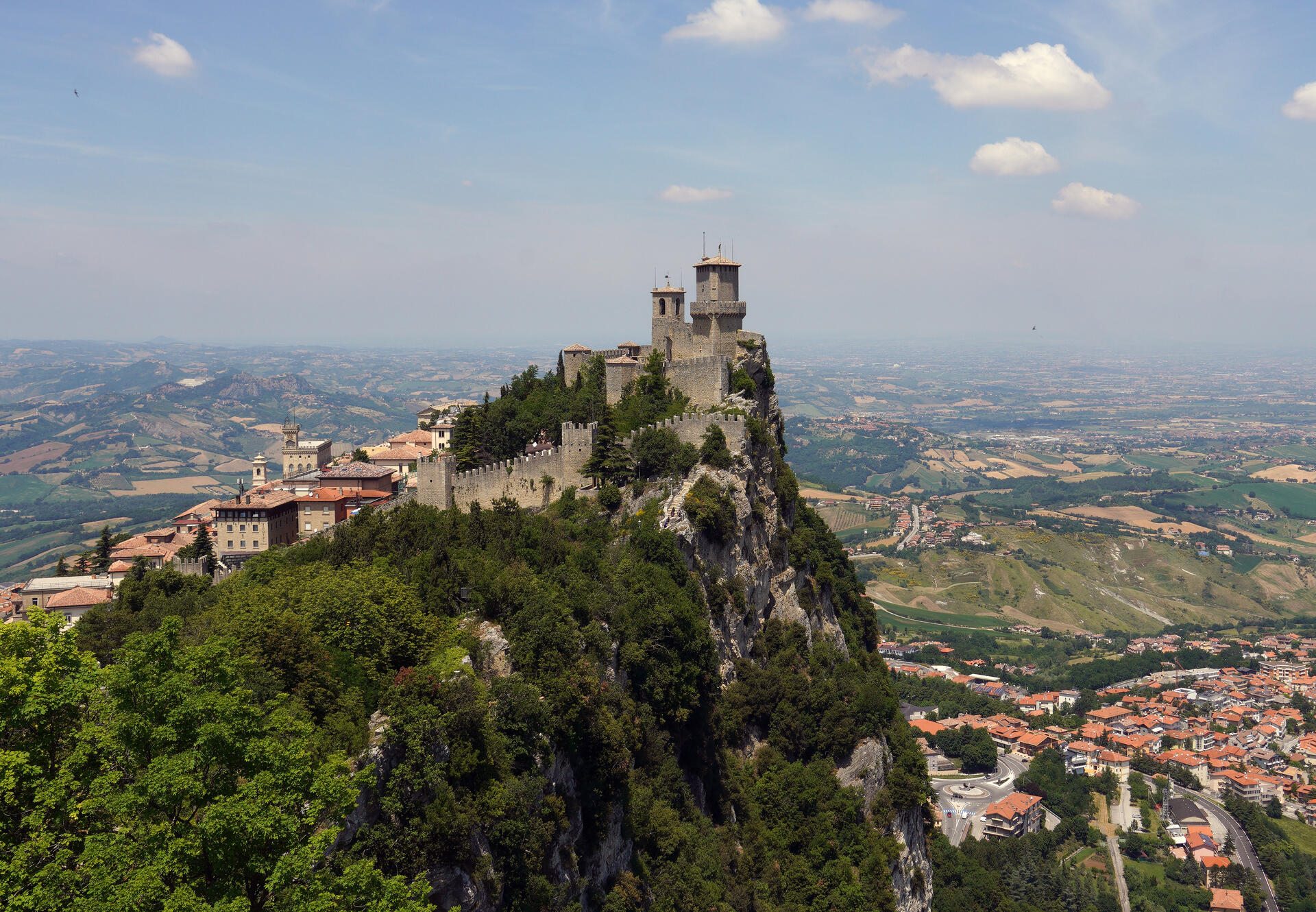
© Commonists, CC BY-SA 4.0 Resized from original. (This derivative is under the same CC BY-SA license.)
World Heritage Research
Discover scientific research and academic studies that deepen our understanding of San Marino Historic Centre and Mount Titano from its history and significance to its conservation, management, and contemporary challenges.
-
Cultureaction! An Interaction and Experience Design Project to Explore San Marino’s Historic Center as a Living Archive.
Design-driven approaches can transform cultural heritage sites into dynamic, engaging archives that bridge tangible and intangible heritage. The 'Cultureaction!' project in San Marino's historic center demonstrates this by using interactive installations, including a device called Iride, to reveal hidden historical layers through multisensory experiences. These installations enhance visitors' cognitive and emotional connections with local stories, offering a model for small historic towns to replicate. By integrating digital technology with community memory, the project reimagines archives as evolving cultural engagement sites, highlighting design's potential in preserving heritage dynamically rather than statically.
Gasparotto, S. (2026). Cultureaction! An Interaction and Experience Design Project to Explore San Marino’s Historic Center as a Living Archive. DRS 2026: Edinburgh. https://doi.org/10.21606/drs.2026.575
View Publication Record | Read Publication -
Towards the application of EU Habitats Directive to a non-EU country: the case of San Marino
A study confirms the presence of nine habitat types within San Marino, covering just 4.4% of its territory but including rare species found in surrounding Italian regions. This research tests the application of the EU Habitats Directive (HD) to a non-EU microstate, offering a blueprint for area-based conservation strategies. By surveying vegetation plots between 2019 and 2022 and using non-metric multidimensional scaling, the study identified potential habitats within a 10 km radius of San Marino's borders. While the confirmed habitat types are limited in coverage, their rarity underscores the importance of local conservation efforts and policy alignment with Italy. The findings suggest that adopting the HD could serve as an effective framework for non-EU states to develop coherent biodiversity protection measures.
Santi, F., Buldrini, F., Di Nuzzo, L., Santolini, R., & Chiarucci, A. (2025). Towards the application of EU Habitats Directive to a non-EU country: the case of San Marino. Journal for Nature Conservation, 88, 127060. https://doi.org/10.1016/j.jnc.2025.127060
View Publication Record | Read Publication -
Nation Scale NeRF Reconstruction
A breakthrough in large-scale 3D reconstruction of cultural heritage sites, Neural Radiance Field (NeRF) rendering techniques have been successfully extended to handle multiscalar datasets, addressing previous limitations in scalability. This advancement, demonstrated through a case study involving seismic vulnerability surveys in San Marino's Historic Centre and Mount Titanoenables more accurate representation of built heritage features compared to traditional structure-from-motion methods. The proposed system links geographic coordinates with large datasets, paving the way for unprecedented precision in digital preservation and analysis of complex architectural landscapes.
Mai, A., McAvoy, S., Klingspon, J., Forcellini, D., & Kuester, F. (2025). Nation Scale NeRF Reconstruction. The International Archives of the Photogrammetry, Remote Sensing and Spatial Information Sciences, XLVIII-M-9-2025, 941–948. https://doi.org/10.5194/isprs-archives-xlviii-m-9-2025-941-2025
View Publication Record | Read Publication -
SRB (Seismic Resilience-Based) methodology for historical centers: San Marino case study
A novel methodology for assessing seismic resilience (SR) at the scale of urban blocks, rather than individual buildings, has been successfully applied to San Marino's historic center—a UNESCO World Heritage Site. This approach combines 3D surveys and visual inspections to derive empirical fragility curves, enabling more accurate quantification of structural vulnerabilities in historical city centers. Unlike previous studies focused on singular structures, this method provides a comprehensive framework for evaluating recovery investments, addressing the complex interplay of adjacent buildings with shared typologies. The findings highlight its potential for preserving cultural heritage while enhancing seismic resilience in vulnerable urban regions.
Forcellini, D., McAvoy, S., & Kuester, F. (2025). SRB (Seismic Resilience-Based) methodology for historical centers: San Marino case study. Resilient Cities and Structures, 4(4), 132–142. https://doi.org/10.1016/j.rcns.2025.12.001
View Publication Record | Read Publication -
Seismic Resilience of Palazzo Pubblico (UNESCO) with 3D Numerical Simulations
A 3D numerical model of Palazzo Pubblico, a UNESCO-listed historic building in San Marino, reveals critical insights into its seismic resilience. This model, developed using single-station asynchronous ambient vibration measurements and a comprehensive 3D laser scanner survey (3D-LSS), assesses the fundamental resonance frequencies to evaluate its dynamic response under seismic conditions. The study highlights the importance of retrofitting measures for this strategic building, which serves as the seat of Parliament and a focal point during natural disasters. This model provides a foundation for future research on retrofit options and resilience-based evaluations, ensuring the preservation of San Marino's cultural heritage in seismically active regions.
Forcellini, D., Sathurshan, M., & Thamboo, J. (2025). SEISMIC RESILIENCE OF PALAZZO PUBBLICO (UNESCO) WITH 3D NUMERICAL SIMULATIONS. International Association for Earthquake Engineering. https://doi.org/10.71846/18-WCEE-2535
View Publication Record | Read Publication -
Il turismo a San Marino. Un bilancio storiografico
San Marino's tourism potential, driven by its unique status as a small independent city-state with a distinguished historic center, has been the focus of extensive scholarly research. This study synthesizes key findings from various books, highlighting how San Marino's tourism industry has evolved over time. The research adopts a historiographic approach, reviewing and analyzing existing literature to provide a comprehensive overview of the historical development and impact of tourism in this UNESCO World Heritage Site. The findings underscore the significance of San Marino's historic center and its role in shaping the country's tourism narrative.
Troilo, M. (2024). Il turismo a San Marino. Un bilancio storiografico. Clionet, 8. https://doi.org/10.30682/clionet2408ag
View Publication Record | Read Publication -
Liberty Dreamt in Stone: The (Neo)Medieval City of San Marino
San Marino's historic center, inscribed on UNESCO's World Heritage List in 2008, embodies a unique neomedieval identity that transcends its medieval origins. This study reveals how the microstate transformed into a symbol of liberty and tradition through architectural revivalism, particularly between 1884 and 1943—a period marked by the construction of landmarks like the new town hall and the rise of Fascist influence. The research employs comparative historical analysis to explore this phenomenon, highlighting San Marino's dual heritage: one rooted in medieval history and another shaped by modern reinterpretation. This neomedieval identity, characterized by its enduring symbolic power, sets San Marino apart as a distinctive cultural landscape.
Di Carpegna Falconieri, T. (2021). Liberty Dreamt in Stone: The (Neo)Medieval City of San Marino. Práticas Da História. Journal on Theory, Historiography and Uses of the Past, No. 9 (2019). https://doi.org/10.48487/PDH.2019.N9.22370
View Publication Record | Read Publication