World Heritage Identification Number: 990
World Heritage since: 2000
Category: Cultural Heritage
WHE Type: Religious Sites & Sacred Architecture
Transboundary Heritage: No
Endangered Heritage: No
Country: 🇮🇹 Italy
Continent: Europe
UNESCO World Region: Europe and North America
Map
Assisi, the Basilica of San Francesco, and Other Franciscan Sites: A Cultural and Spiritual Journey through Umbria
Assisi, a picturesque hilltop town nestled in the heart of Umbria, is a UNESCO World Heritage Site that offers visitors a unique blend of cultural, historical, and spiritual experiences. The town's designation as a World Heritage Site is primarily due to its close association with Saint Francis, the founder of the Franciscan Order, and the numerous architectural and artistic treasures that bear witness to his legacy.
The most prominent among these treasures is the Basilica of San Francesco (Basilica di San Francesco d'Assisi), located on the western edge of Assisi on the so-called "Hill of Paradise." This monumental basilica, composed of two superimposed churches—the Upper Basilica and the Lower Basilica—was constructed beginning in 1228 and largely completed by the mid-13th century. It is a testament to the fusion of Gothic and Romanesque architectural styles and houses some of the most significant works of Italian art, including frescoes attributed to Cimabue, Pietro Lorenzetti, Simone Martini, and Giotto, depicting the life and teachings of Saint Francis.
Another important Franciscan site associated with Assisi is the Porziuncola, a small church that predates Saint Francis and was restored by him. Located in the plain below Assisi and now enclosed within the Basilica of Santa Maria degli Angeli, it retains its original simplicity and spiritual significance. It was here that the Franciscan Order was founded. Saint Francis spent his final years in Assisi and died in 1226, and he received the stigmata at Mount La Verna in Tuscany, an event of profound significance in Christian history.
Beyond the Basilica of San Francesco, other significant sites in Assisi include the Church of Santa Chiara and the Church of San Damiano, as well as the Temple of Minerva, later converted into the Church of Santa Maria sopra Minerva. Each of these sites holds an important place in the religious and historical development of Assisi, particularly in connection with Saint Francis and his followers during the early days of the Franciscan Order. For example, the Church of San Damiano is where Saint Francis is believed to have first heard the voice of Christ, instructing him to “repair my house.”
In addition to its religious significance, Assisi is also renowned for its rich history and stunning landscapes. The town's medieval streets, lined with charming shops, restaurants, and historic buildings, offer visitors a glimpse into the past. The panoramic views from the slopes of Monte Subasio provide a breathtaking natural backdrop to the town below.
Altogether, Assisi, the Basilica of San Francesco, and Other Franciscan Sites represent a remarkable cultural and spiritual journey through Umbria. The town's World Heritage status is well-deserved, recognizing not only its artistic and architectural achievements but also its enduring influence on the development of Christianity and Western civilization. Whether visitors are drawn by the life of Saint Francis, the beauty of the art and architecture, or the allure of exploring a medieval Italian town, Assisi offers an unforgettable experience.
UNESCO Description of the World Heritage Site
Assisi, a medieval city built on a hill, is the birthplace of Saint Francis, closely associated with the work of the Franciscan Order. Its medieval art masterpieces, such as the Basilica of San Francesco and paintings by Cimabue, Pietro Lorenzetti, Simone Martini and Giotto, have made Assisi a fundamental reference point for the development of Italian and European art and architecture.
UNESCO Justification of the World Heritage Site
Criterion (i): Assisi represents an ensemble of masterpieces of human creative genius, such as the Basilica of San Francesco, which have made it a fundamental reference for art history in Europe and in the world.
Criterion (ii): The interchange of artistic and spiritual message of the Franciscan Order has significantly contributed to developments in art and architecture in the world.
Criterion (iii): Assisi represents a unique example of continuity of a city-sanctuary within its environmental setting from its Umbrian-Roman and medieval origins to the present, represented in the cultural landscape, the religious ensembles, systems of communication, and traditional land-use.
Criterion (iv): The Basilica of San Francesco is an outstanding example of a type of architectural ensemble that has significantly influenced the development of art and architecture.
Criterion (vi): Being the birthplace of the Franciscan Order, Assisi has from the Middle Ages been closely associated with the cult and diffusion of the Franciscan movement in the world, focusing on the universal message of peace and tolerance even to other religions or beliefs.
Encyclopedia Record: Assisi
Assisi is a town and comune of Italy in the Province of Perugia in the Umbria region, on the western flank of Monte Subasio.Additional Site Details
Area: 14,563.25 hectares
Number of Components: 2
(ii) — Significant interchange of human values
(iii) — Unique or exceptional testimony to a cultural tradition
(iv) — Outstanding example of a type of building or landscape
(vi) — Directly associated with events or living traditions
Coordinates: 43.06616667 , 12.62244444
Image
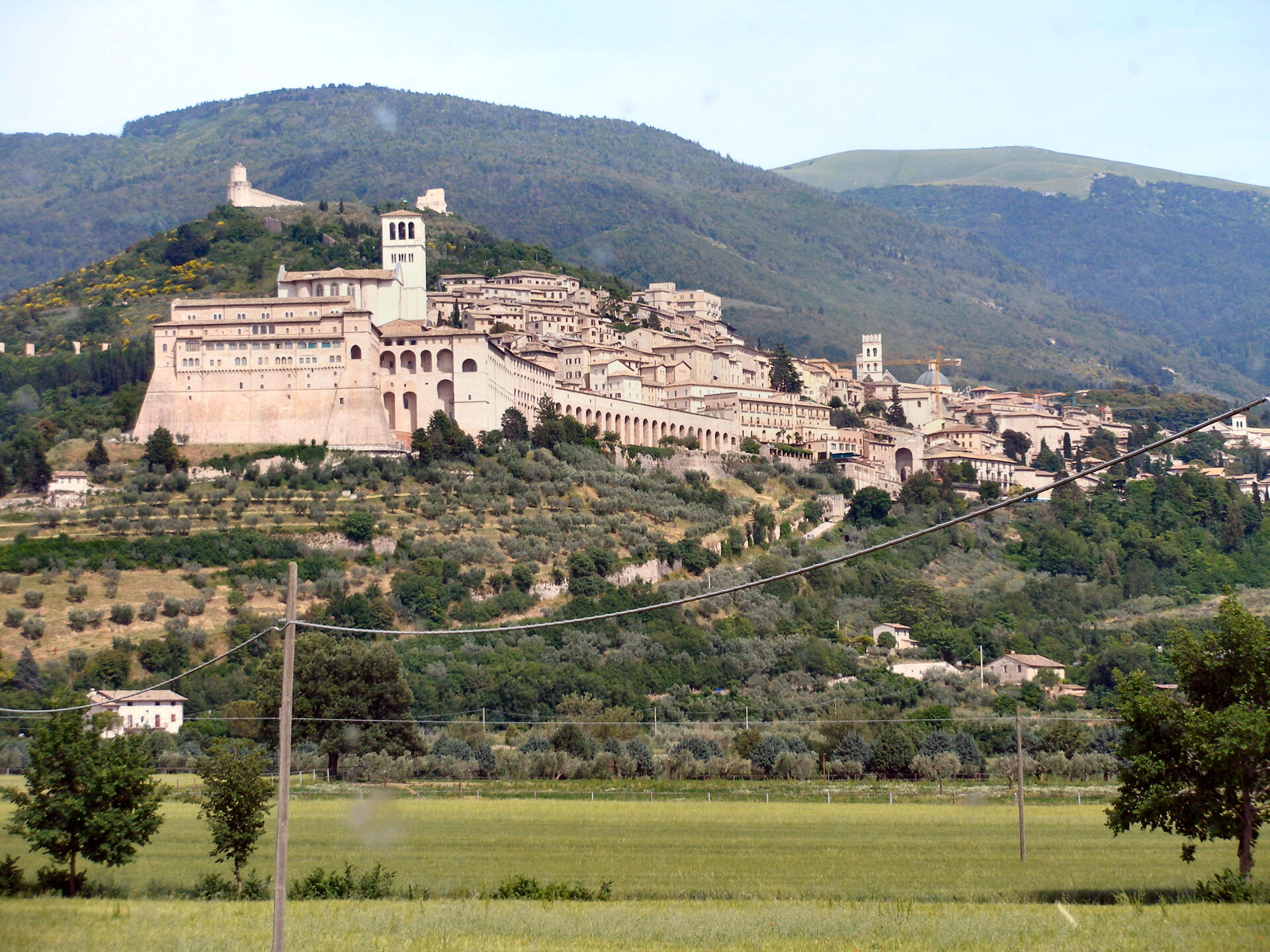
Gunnar Bach Pedersen, Public domain