World Heritage Identification Number: 550
World Heritage since: 1990
Category: Cultural Heritage
WHE Type: Historic Cities & Urban Areas
Transboundary Heritage: No
Endangered Heritage: No
Country: 🇮🇹 Italy
Continent: Europe
UNESCO World Region: Europe and North America
Map
A Journey Through Time: Exploring the Historic Centre of San Gimignano
The Historic Centre of San Gimignano, nestled in the heart of Tuscany, offers a captivating glimpse into the rich history and architectural splendor of medieval Italy. Inscribed as a UNESCO World Heritage Site in 1990, this enchanting hilltown boasts a unique blend of Romanesque and Gothic structures that have miraculously withstood the test of time.
More to come…UNESCO Description of the World Heritage Site
'San Gimignano delle belle Torri' is in Tuscany, 56 km south of Florence. It served as an important relay point for pilgrims travelling to or from Rome on the Via Francigena. The patrician families who controlled the town built around 72 tower-houses (some as high as 50 m) as symbols of their wealth and power. Although only 14 have survived, San Gimignano has retained its feudal atmosphere and appearance. The town also has several masterpieces of 14th- and 15th-century Italian art.
UNESCO Justification of the World Heritage Site
Criterion (i): The Historic Centre of San Gimignano contains a series of masterpieces of 14th and 15th century Italian art in their original architectural settings, including: in the Cathedral, the fresco of The Last Judgment, Heaven and Hell by Taddeo di Bartolo (1393), The Martyrdom of St. Sebastian by Benozzo Gozzoli (1465) and above all the magnificent frescoes by Domenico Ghirlandaio such as the cycle of Santa Fina (1475) and the Annunciation in the Baptistery (1482). Other works of the same outstanding beauty include the huge frescoes by Benozzo Gozzoli depicting St. Sebastian (1464) and St. Augustine (1465).
Criterion (iii): San Gimignano bears exceptional testimony to medieval civilization since it groups together within a small area all the structures typical of urban life: squares and streets, houses and palaces, as well as wells and fountains. The frescoes by Memmo di Filippuccio commissioned by the township in 1303 to decorate the chambers of the Podestà in the Palazzo del Popolo are among the most frequently reproduced documents used to illustrate daily life of the early 14th century, down to its most domestic details.
Criterion (iv): The urban landscape of Florence, dominated by the towers of its public palazzos (Palazzo del Podestà and Palazzo della Signoria), shows that its public institutions prevailed over personal power. After 1250, the height of family tower houses was periodically reduced in the city. Whereas in San Gimignano, whose incastellamento goes back to 998, the 14 towers proudly rising above its palaces, preserve the look of a feudal Tuscan town controlled by rival factions ever ready for conflict. It illustrates a significant moment in history which cannot be found to the same extent in Florence, Sienna or Bologna despite the quality of their monuments.
Encyclopedia Record: San Gimignano
San Gimignano is a small walled medieval hill town in the province of Siena, Tuscany, north-central Italy. Known as the Town of Five Towers, San Gimignano is famous for its medieval architecture, unique in the preservation of about a dozen of its tower houses, which, with its hilltop setting and encircling walls, form "an unforgettable skyline". Within the walls, the well-preserved buildings include notable examples of both Romanesque and Gothic architecture, with outstanding examples of secular buildings as well as churches. The Palazzo Comunale, the Collegiata and Church of Sant' Agostino contain frescos, including cycles dating from the 14th and 15th centuries. The "Historic Centre of San Gimignano" is a UNESCO World Heritage Site. The town also is known for saffron, the dry aged and saffron infused Golden Ham, pecorino cheese and its white wine, Vernaccia di San Gimignano, produced from the ancient variety of Vernaccia grape grown on the sandstone hillsides of the area.Additional Site Details
Area: 13.88 hectares
Number of Components: 1
(iii) — Unique or exceptional testimony to a cultural tradition
(iv) — Outstanding example of a type of building or landscape
Coordinates: 43.46806 , 11.04167
Image
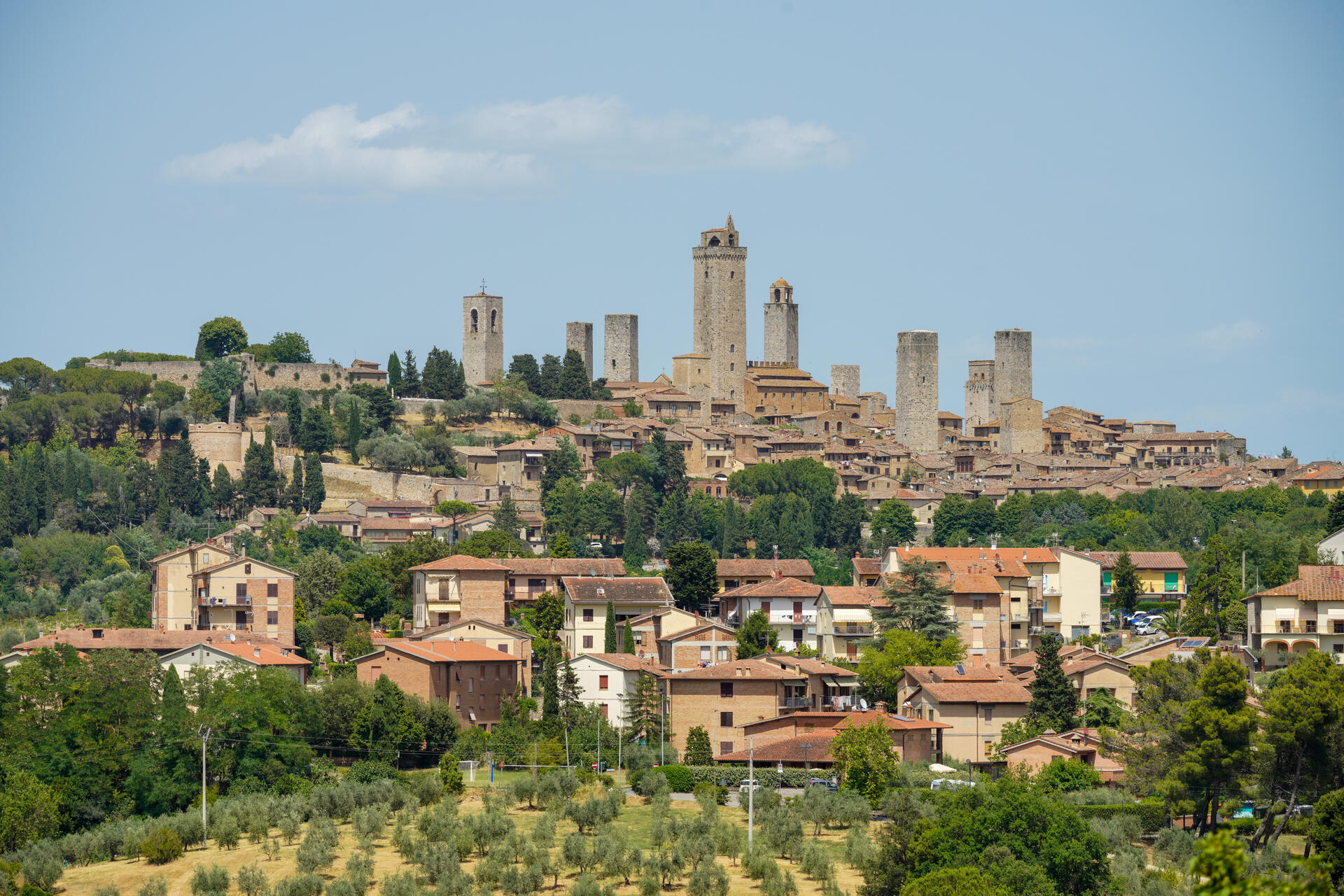
© WikiRomaWiki, CC BY-SA 4.0 Resized from original. (This derivative is under the same CC BY-SA license.)