World Heritage Identification Number: 831
World Heritage since: 1997
Category: Cultural Heritage
WHE Type: Archaeological Sites
Transboundary Heritage: No
Endangered Heritage: No
Country: 🇮🇹 Italy
Continent: Europe
UNESCO World Region: Europe and North America
Map
The Archaeological Area of Agrigento: A Testament to Ancient Greek Civilization
The Archaeological Area of Agrigento, inscribed as a UNESCO World Heritage Site in 1997, stands as one of the most remarkable testimonies to the achievements of ancient Greek civilization in Sicily. Located on the southern coast of the island of Sicily, Italy, this extensive archaeological landscape preserves the remains of Akragas, one of the leading Greek cities of ancient Sicily and the western Mediterranean.
Founded around 580 BC by Greek settlers from Gela, Akragas quickly developed into a wealthy and powerful city. Its prosperity reached its height during the 5th century BC, particularly after the Greek victory over Carthage at the Battle of Himera in 480 BC, which brought wealth and political influence to the city. This prosperity enabled the construction of magnificent Doric temples along the ridge overlooking the surrounding countryside, with distant views towards the Mediterranean. Together with the remains of the ancient urban area, these monuments provide exceptional evidence of Greek architectural skill, religious practices, and city planning.
Among the most notable structures within the Archaeological Area of Agrigento is the Temple of Concordia, one of the best-preserved Doric temples in the ancient world. Dating from the 5th century BC, it has survived remarkably intact, preserving its elegant proportions and nearly complete colonnade. Another significant monument is the Temple of Herakles, one of the oldest temples in the area, whose surviving columns provide valuable insights into the development of early Greek monumental architecture.
Perhaps the most ambitious monument of ancient Akragas was the Temple of Olympian Zeus, begun after the Greek victory over Carthage at the Battle of Himera in 480 BC, probably to commemorate that victory and proclaim the city's power. Although now largely ruined, its enormous scale demonstrates the extraordinary ambitions of its builders and includes the remains of colossal stone figures known as telamons.
Beyond the impressive temples, the archaeological area preserves extensive traces of the ancient city, including defensive walls, sanctuaries, residential districts, burial areas, and hydraulic systems, including reservoirs, aqueducts, and underground waterworks, that reveal the complexity of urban life in Greek Sicily.
Despite its popular name, the "Valley of the Temples" (Valle dei Templi) is not actually situated in a valley but on a ridge south of modern Agrigento. This elevated position creates a dramatic setting in which the ancient temples appear against the Sicilian landscape, contributing to the site's exceptional visual and cultural significance.
The exceptional value of Agrigento lies not only in its individual monuments but also in the relationship between architecture, urban development, and the surrounding landscape. The temples were carefully positioned along the ridge to create a powerful visual connection between sacred spaces and the natural environment. Together, the monuments and archaeological remains provide one of the finest surviving archaeological landscapes of an ancient Greek city outside Greece and illustrate the enduring influence of Greek culture throughout the Mediterranean world.
The Archaeological Area of Agrigento represents an outstanding example of ancient Greek architecture and urban development, preserving one of the largest and most impressive collections of Doric temples outside Greece. Through the conservation of its monuments and archaeological remains, the site continues to offer invaluable insights into the beliefs, achievements, and daily life of the people who shaped this extraordinary center of the ancient Mediterranean world.
UNESCO Description of the World Heritage Site
Founded as a Greek colony in the 6th century B.C., Agrigento became one of the leading cities in the Mediterranean world. Its supremacy and pride are demonstrated by the remains of the magnificent Doric temples that dominate the ancient town, much of which still lies intact under today's fields and orchards. Selected excavated areas throw light on the later Hellenistic and Roman town and the burial practices of its early Christian inhabitants.
UNESCO Justification of the World Heritage Site
Criterion (i): The great row of Doric temples is one of the most outstanding monuments of Greek art and culture.
Criterion (ii): The archaeological area of Agrigento exhibits an important interchange of human values, being undoubtedly one of the leading cities in the Mediterranean region with its outstanding evidence of Greek influence.
Criterion (iii): As one of the greatest cities of the ancient Mediterranean region, Agrigento is an extraordinary testament of Greek civilization in its exceptionally preserved condition.
Criterion (iv): The temples in the area exemplify Greek architecture and are considered to be among the most extraordinary representations of Doric architecture in the world.
Encyclopedia Record: Valle dei Templi
The Valle dei Templi, or Valley of the Temples, is an archaeological site in Agrigento, Sicily. It is one of the most outstanding examples of ancient Greek art and architecture of Magna Graecia, and is one of the main attractions of Sicily. The term "valley" is a misnomer, the site being located on a ridge outside the town of Agrigento.Additional Site Details
Area: 934 hectares
Number of Components: 1
(ii) — Significant interchange of human values
(iii) — Unique or exceptional testimony to a cultural tradition
(iv) — Outstanding example of a type of building or landscape
Coordinates: 37.28972222 , 13.59333333
Image
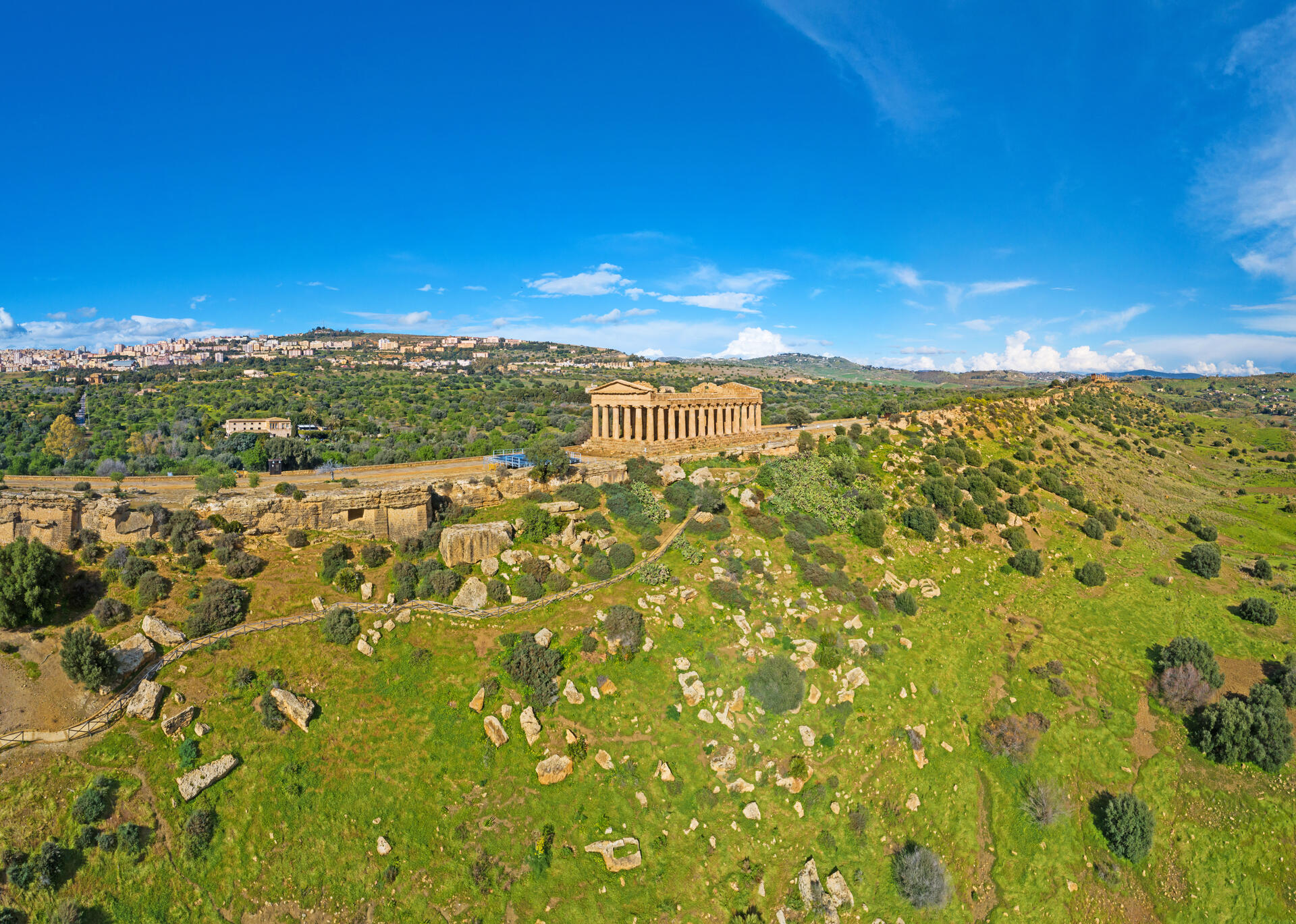
© Ludvig14, CC BY-SA 4.0 Resized from original. (This derivative is under the same CC BY-SA license.)