World Heritage Identification Number: 514
World Heritage since: 1999
Category: Cultural Heritage
WHE Type: Archaeological Sites
Transboundary Heritage: No
Endangered Heritage: No
Country: 🇬🇧 United Kingdom of Great Britain and Northern Ireland
Continent: Europe
UNESCO World Region: Europe and North America
Map
Exploring the Heart of Neolithic Orkney: A Journey Through Prehistory
The Heart of Neolithic Orkney, inscribed as a UNESCO World Heritage Site in 1999, offers a remarkable glimpse into the lives, beliefs, and achievements of Neolithic communities that inhabited the Orkney Islands approximately 5000 years ago. This exceptional group of monuments, located mainly on the Mainland of Orkney in the far north of Scotland, forms a unique prehistoric landscape that provides valuable insights into the social, ceremonial, and architectural traditions of ancient communities.
The significance of the Heart of Neolithic Orkney lies not only in its individual monuments but also in the way they form a connected prehistoric landscape. The chambered tomb of Maeshowe, the stone circles of Stenness and Brodgar, and nearby settlements such as Barnhouse reveal a society that organized its activities around both domestic life and communal ceremonies. The careful placement of these monuments within the Orkney landscape suggests that the natural environment, seasonal cycles, and shared traditions played an important role in the beliefs and identity of Neolithic communities.
Maeshowe, one of the most significant monuments within the Heart of Neolithic Orkney, is a large chambered tomb constructed around 2800 BC. Its sophisticated design, including a corbelled stone roof and a carefully aligned entrance passage, demonstrates the remarkable architectural abilities of Neolithic builders. The passage is aligned so that the low rays of the setting sun around the winter solstice illuminate the inner chamber, suggesting a connection between the monument and seasonal astronomical phenomena. The tomb also contains Viking runic inscriptions carved during the 12th century, providing evidence of its later historical significance.
Another notable monument within the Heart of Neolithic Orkney is the Stones of Stenness, a ceremonial stone circle dating to approximately 3100 BC and among the earliest known stone circles in Britain. Nearby lies the Ring of Brodgar, a much larger stone circle probably constructed between approximately 2500 and 2000 BC. Together, these monuments demonstrate the importance of communal gatherings, ritual practices, and shared beliefs in Neolithic Orkney society. Their location within the same landscape highlights the interconnected nature of prehistoric ceremonial activity.
Skara Brae, often described as the "Scottish Pompeii" because of its exceptional preservation, is one of the best-preserved Neolithic villages in Europe. Dating from approximately 3200 to 2200 BC, the settlement consists of eight interconnected stone-built houses, many of which still contain original features such as stone beds, dressers, storage compartments, and hearths. The carefully planned layout of the settlement provides valuable evidence of domestic life, social organization, and the daily activities of its Neolithic inhabitants.
Beyond their monumental achievements, the people of Neolithic Orkney developed a successful way of life based on farming, animal husbandry, fishing, and craft production. They cultivated crops such as barley, raised cattle and sheep, exploited marine resources, and produced tools, pottery, and other objects from locally available materials. The remains discovered at settlements such as Skara Brae and Barnhouse provide valuable evidence of household organization, food preparation, and the daily activities that supported these communities for many generations.
Recent archaeological discoveries at the Ness of Brodgar have transformed understanding of Neolithic Orkney by revealing a large ceremonial complex with monumental stone buildings, decorated objects, and evidence of large-scale communal activity. These discoveries demonstrate that Neolithic society in Orkney was capable of remarkable architectural planning and social cooperation. Within the wider prehistoric landscape of Orkney, the Ness of Brodgar highlights the complexity of prehistoric communities and their ability to create enduring cultural landscapes.
Visitors to the Heart of Neolithic Orkney can explore a landscape shaped by some of Europe's earliest farming communities and gain insight into their beliefs, technologies, and ways of life. The preservation of these extraordinary monuments allows modern audiences to appreciate the creativity, cooperation, and cultural achievements of Neolithic societies. As a UNESCO World Heritage Site, the Heart of Neolithic Orkney remains one of the world's most important sources of knowledge about prehistoric communities and their enduring relationship with the landscape.
UNESCO Description of the World Heritage Site
The group of Neolithic monuments on Orkney consists of a large chambered tomb (Maes Howe), two ceremonial stone circles (the Stones of Stenness and the Ring of Brodgar) and a settlement (Skara Brae), together with a number of unexcavated burial, ceremonial and settlement sites. The group constitutes a major prehistoric cultural landscape which gives a graphic depiction of life in this remote archipelago in the far north of Scotland some 5,000 years ago.
UNESCO Justification of the World Heritage Site
Criterion (i): The major monuments of the Stones of Stenness, the Ring of Brodgar, the chambered tomb of Maeshowe, and the settlement of Skara Brae display the highest sophistication in architectural accomplishment; they are technologically ingenious and monumental masterpieces.
Criterion (ii): The Heart of Neolithic Orkney exhibits an important interchange of human values during the development of the architecture of major ceremonial complexes in the British Isles, Ireland and northwest Europe.
Criterion (iii): Through the combination of ceremonial, funerary and domestic sites, the Heart of Neolithic Orkney bears a unique testimony to a cultural tradition that flourished between about 3000 BC and 2000 BC. The state of preservation of Skara Brae is unparalleled amongst Neolithic settlement sites in northern Europe.
Criterion (iv): The Heart of Neolithic Orkney is an outstanding example of an architectural ensemble and archaeological landscape that illustrate a significant stage of human history when the first large ceremonial monuments were built.
Encyclopedia Record: Heart of Neolithic Orkney
Heart of Neolithic Orkney is a group of Neolithic monuments on the Mainland of the Orkney Islands, Scotland. The name was adopted by UNESCO when it proclaimed these sites as a World Heritage Site in December 1999.Additional Site Details
Area: 15 hectares
Number of Components: 4
(ii) — Significant interchange of human values
(iii) — Unique or exceptional testimony to a cultural tradition
(iv) — Outstanding example of a type of building or landscape
Coordinates: 58.99605556 , -3.188666667
Image
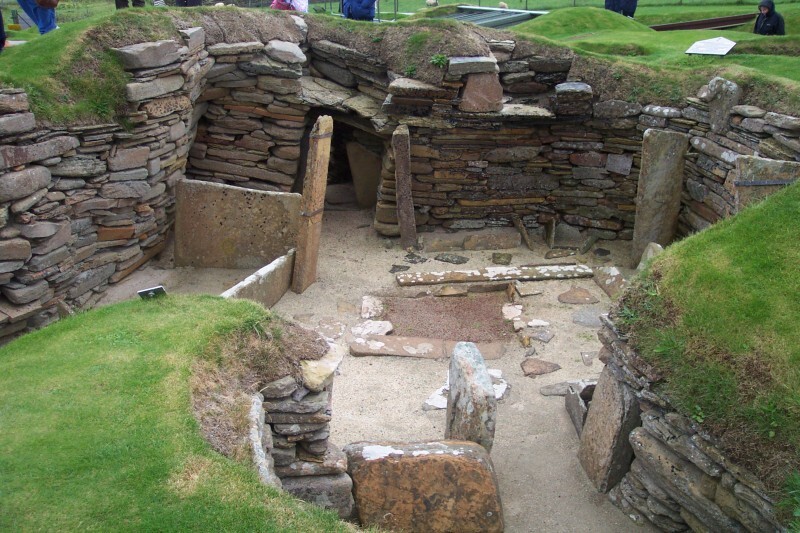
© Dr. John F. Burka, CC BY-SA 3.0 Resized from original. (This derivative is under the same CC BY-SA license.)