World Heritage Identification Number: 258
World Heritage since: 1983
Category: Natural Heritage
WHE Type: Protected Areas & National Parks
Transboundary Heritage: No
Endangered Heritage: No
Country: 🇫🇷 France
Continent: Europe
UNESCO World Region: Europe and North America
Map
The Gulf of Porto: A Stunning UNESCO World Heritage Site in Corsica
The Gulf of Porto, located on the western coast of the Mediterranean island of Corsica, is a breathtaking natural wonder that has been recognized by UNESCO as a World Heritage Site since 1983. This designation encompasses three distinct areas: the Calanques de Piana, the Gulf of Girolata, and the Scandola Nature Reserve.
More to come…UNESCO Description of the World Heritage Site
The nature reserve, which is part of the Regional Natural Park of Corsica, occupies the Scandola peninsula, an impressive, porphyritic rock mass. The vegetation is an outstanding example of scrubland. Seagulls, cormorants and sea eagles can be found there. The clear waters, with their islets and inaccessible caves, host a rich marine life.
Encyclopedia Record: Gulf of Porto
The Gulf of Porto is a gulf of the Mediterranean Sea located on the western façade of the island of Corsica, France, well known for its dramatic coloration and rugged cliffs. The gulf is located within the department of Corse-du-Sud. The gulf and surrounding coast is part of the Regional Natural Park of Corsica. In 1983 the gulf was designated as a UNESCO World Heritage Site, encompassing the Calanques de Piana, Gulf of Girolata, and Scandola Nature Reserve, due to its outstanding scenery, rich avian and marine life, and maquis shrubland.Additional Site Details
Area: 11,800 hectares
Number of Components: 1
(viii) — Outstanding example representing major earth stages
(x) — Contains most important habitats for biodiversity
Coordinates: 42.32519444 , 8.628833333
IUCN World Heritage Outlook
The 2025 Conservation Outlook on Gulf of Porto: Calanche of Piana, Gulf of Girolata, Scandola Reserve reports the following assessment:
Source: International Union for Conservation of Nature (IUCN) · View assessment
Image
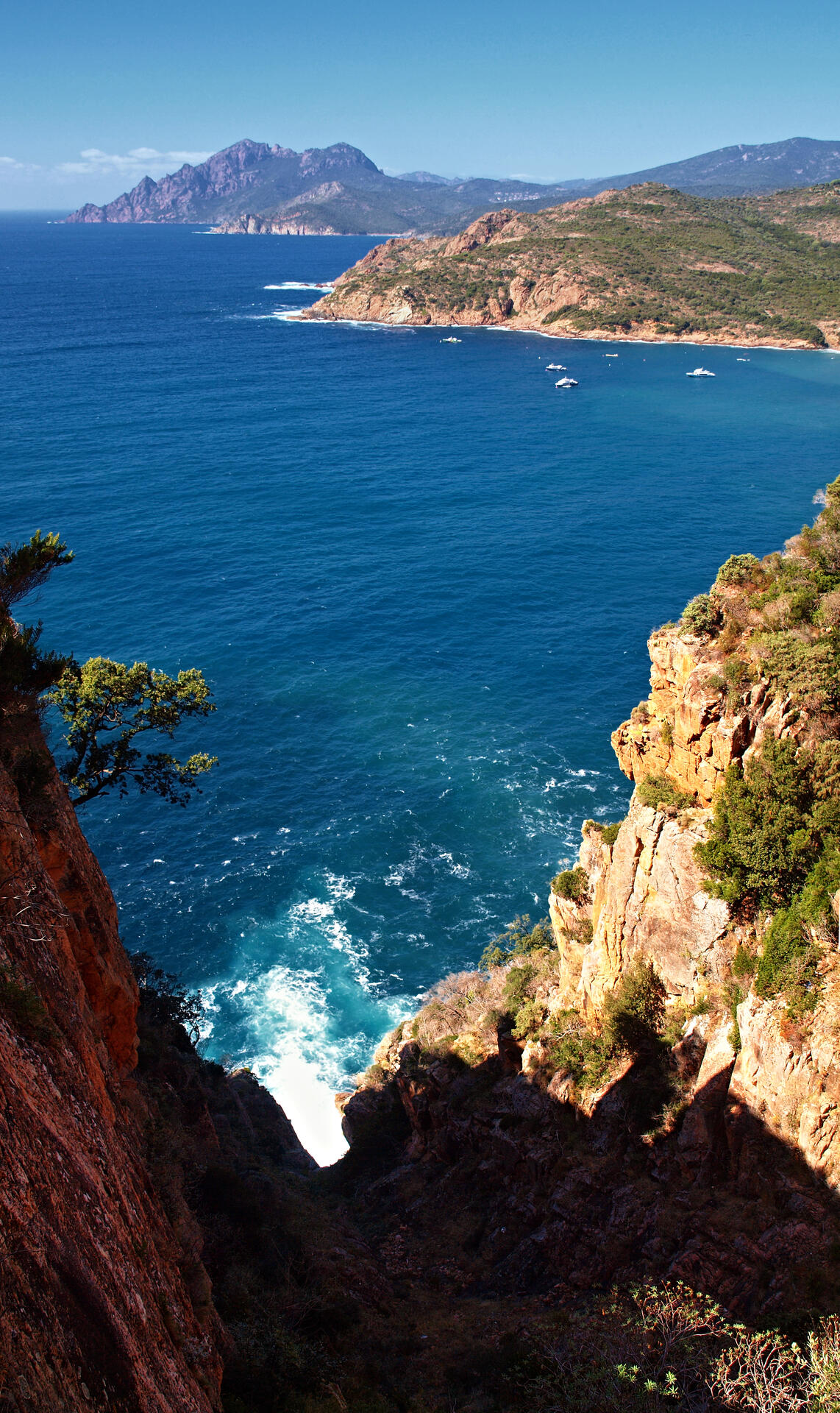
© Pierre Bona, CC BY-SA 3.0 Resized from original. (This derivative is under the same CC BY-SA license.)
World Heritage Research
Discover scientific research and academic studies that deepen our understanding of Gulf of Porto: Calanche of Piana, Gulf of Girolata, Scandola Reserve from its history and significance to its conservation, management, and contemporary challenges.
-
Mid- to Late-Holocene coastal morphological evolution, vegetation history and land-use changes of the Porto Gulf UNESCO World Heritage site and its surroundings (NW Corsica Island, Western Mediterranean)
A significant decline in regional forest cover, the most intense event recorded in the Late-Holocene, occurred from the 11th to the 16th centuries CE in the Porto Gulf UNESCO World Heritage site (NW Corsica), coinciding with Pisan and Genoese dominations. This study reconstructs mid- to late-Holocene landscape evolution, shoreline migration, vegetation history, and land-use changes using boreholes, mollusc identification, pollen/NPP analysis, and sedimentological studies, supported by 18 radiocarbon datings. It reveals that anthropogenic activities began significantly impacting local vegetation around 2500 years BP at Girolata and 2000 years BP at Fangu, with Roman times marked by cereal, grapevine cultivation during the Republic (500 BCE–0) and exclusive olive cultivation during the Empire (0–500 CE). The research provides a comprehensive regional evolution of human-environment interactions over six millennia.
Ghilardi, M., Revelles, J., Mary, J.-B., Rita, F. D., Delhon, C., Delanghe¹, D., & Robresco, S. (2023). Mid- to Late-Holocene coastal morphological evolution, vegetation history and land-use changes of the Porto Gulf UNESCO World Heritage site and its surroundings (NW Corsica Island, Western Mediterranean). The Holocene, 33(9), 1023–1044. https://doi.org/10.1177/09596836231176492
View Publication Record | Read Publication -
Clunio boudouresquei sp. n. and Thalassosmittia ballestai sp. n., two Tyrrhenian marine species occurring in Scandola Nature Reserve, West Corsica (Diptera: Chironomidae)
Two new marine species, Clunio boudouresquei and Thalassosmittia ballestai, have been identified within the Scandola Nature Reserve in West Corsica, part of the Tyrrhenian sub-region. These species exhibit unique biological cycles tied to lunar spring tides, transitioning between marine and terrestrial environments. Their presence is closely linked to specific coastal habitats, particularly those dominated by the red calcified alga Lithophyllum byssoides, which are increasingly threatened by anthropogenic activities such as pollution and sea mussel proliferation. Both species serve as critical indicators of marine ecological health and climate change, including rising sea levels, in the Tyrrhenian Region. The study describes these species based on adult and pupal stages, providing insights into their taxonomy, ecology, and biogeographical significance.
Moubayed-Breil, J., & Dominici, J.-M. (2019). Clunio boudouresquei sp. n. and Thalassosmittia ballestai sp. n., two Tyrrhenian marine species occurring in Scandola Nature Reserve, West Corsica (Diptera: Chironomidae). CHIRONOMUS Journal of Chironomidae Research, (32), 4–24. https://doi.org/10.5324/cjcr.v0i32.3078
View Publication Record | Read Publication -
Flore et végétation vasculaires des petites îles et îlots du littoral de Galeria à Porto (Réserve naturelle de Scandula et environs, Corse occidentale)
A remarkable biodiversity, including several rare or endemic species, thrives on the small islands and islets of the Scandola Reserve along Corsica's western coast. This unique micro-insular ecosystem, preserved within the Natural Reserve, showcases outstanding plant diversity. The study provides a comprehensive inventory of vascular flora in this region, with a detailed synthesis on Gargalu island (22 ha), exploring its environmental and human histories. Proposals for enhanced knowledge and conservation are also outlined to safeguard this original biodiversity.
Médail, F., Petit, Y., Paradis, G., & Hugot, L. (2019). Flore et végétation vasculaires des petites îles et îlots du littoral de Galeria à Porto (Réserve naturelle de Scandula et environs, Corse occidentale). Le Journal de Botanique, 88(1), 13–118. https://doi.org/10.3406/jobot.2019.1937
View Publication Record | Read Publication -
Satellite factors influencing the impact of recreational activities on wildlife
A significant shift in human attitudes toward wildlife, particularly predators, has led to a focus on minimizing human disturbance. Research indicates that recreational activities, such as boat passages near osprey nests in the Scandola Marine Protected Area (Corsica), can reduce breeding performance without severely impacting overall population stability due to the species' long lifespan and resilience. The study suggests that historical persecution of predators may have favored shy individuals, but contemporary peace with wildlife could promote bolder behavior, potentially benefiting species like ospreys. Additionally, alternative habitats provide buffer zones against disturbance, while interactions with opportunistic predators, often subsidized by human activities, can exacerbate negative impacts on nesting birds. This research underscores the need for nuanced conservation strategies that balance ethical considerations with biological realities in a context of peaceful coexistence.
Martínez‐Abraín, A. (2018). Satellite factors influencing the impact of recreational activities on wildlife. Animal Conservation, 21(6), 461–462. Portico. https://doi.org/10.1111/acv.12465
View Publication Record | Read Publication -
Effects of reserve protection level on the vulnerable fish species Sciaena umbra and implications for fishing management and policy
Increased protection levels in marine reserves significantly boost the abundance, size, and biomass of the vulnerable brown meagre (Sciaena umbra), a key demersal fish species in Mediterranean coastal habitats. A study conducted in Scandola Reserve, Corsica, found that strict no-take zones (integral reserves) led to marked improvements in population metrics compared to partially protected buffer zones and unprotected areas where fishing was unrestricted. Visual surveys revealed that larger size classes of S. umbra were notably absent in unprotected zones, suggesting heavy fishing pressure, particularly from spearfishing, as a primary driver of its decline. Comparisons with data from 1983 further highlighted the positive impact of integral reserves on species recovery, while unprotected areas showed no change over time. These findings underscore the critical role of strong protective measures in conserving vulnerable fish populations and have already influenced French fishing policies, including bans on spearfishing and recreational hook-and-line fishing since 2014.
Harmelin-Vivien, M., Cottalorda, J.-M., Dominici, J.-M., Harmelin, J.-G., Le Diréach, L., & Ruitton, S. (2015). Effects of reserve protection level on the vulnerable fish species Sciaena umbra and implications for fishing management and policy. Global Ecology and Conservation, 3, 279–287. https://doi.org/10.1016/j.gecco.2014.12.005
View Publication Record | Read Publication -
A long-term survey of Posidonia oceanica fish assemblages in a Mediterranean Marine Protected Area: emphasis on stability and no-take area effectiveness
A complete fishing ban within the Scandola Marine Reserve (Corsica, Northwestern Mediterranean) effectively restores target fish stocks and enhances the stability of fish assemblages in Posidonia oceanica seagrass beds. Unlike partial restrictions, this approach positively impacts species richness and density while maintaining higher temporal stability, contrasting with findings from rocky reefs where wandering predators may disrupt seagrass fish communities. The study employed annual underwater visual censuses over a long-term series to assess these effects, revealing that no-take zones are crucial for both biodiversity conservation and ecological stability in Mediterranean marine protected areas.
Seytre, C., & Francour, P. (2013). A long-term survey of Posidonia oceanica fish assemblages in a Mediterranean Marine Protected Area: emphasis on stability and no-take area effectiveness. Marine and Freshwater Research, 65(3), 244–254. https://doi.org/10.1071/mf13080
View Publication Record | Read Publication -
Assessing the Effectiveness of Marine Reserves on Unsustainably Harvested Long‐Lived Sessile Invertebrates
A first quantitative assessment of poaching within a marine reserve revealed significant negative impacts on long-lived sessile invertebrates, particularly Mediterranean red coral (Corallium rubrum). The study found that colonies in the Medes Islands Marine Reserve, where recreational diving is permitted and poaching occurred post-establishment, were significantly smaller than predicted growth models and those in strictly protected areas without fishing or diving. Poaching was linked to a 60% loss of coral biomass, while abrasion from divers correlated with reduced colony size, suggesting increased mortality rates for larger colonies. The research highlights the effectiveness of enforced prohibitions on fishing and diving in preserving unsustainably harvested species.
LINARES, C., GARRABOU, J., HEREU, B., DIAZ, D., MARSCHAL, C., SALA, E., & ZABALA, M. (2011). Assessing the Effectiveness of Marine Reserves on Unsustainably Harvested Long‐Lived Sessile Invertebrates. Conservation Biology, 26(1), 88–96. Portico. https://doi.org/10.1111/j.1523-1739.2011.01795.x
View Publication Record | Read Publication