World Heritage Identification Number: 963
World Heritage since: 2000
Category: Cultural Heritage
WHE Type: Religious Sites & Sacred Architecture
Transboundary Heritage: No
Endangered Heritage: No
Country: 🇭🇷 Croatia
Continent: Europe
UNESCO World Region: Europe and North America
Map
The Cathedral of St James in Šibenik: A Testament to Architectural Mastery and Artistic Fusion
The Cathedral of St James in Šibenik, located on the Dalmatian coast of Croatia, stands as a testament to the intricate exchanges in the realm of monumental arts that occurred between Northern Italy, Dalmatia, and Tuscany during the 15th and 16th centuries. This architectural marvel, inscribed as a UNESCO World Heritage Site in 2000, showcases a harmonious blend of Gothic and Renaissance artistry, while also demonstrating innovative construction techniques that have left an indelible mark on the annals of history.
More to come…UNESCO Description of the World Heritage Site
The Cathedral of St James in Šibenik (1431-1535), on the Dalmatian coast, bears witness to the considerable exchanges in the field of monumental arts between Northern Italy, Dalmatia and Tuscany in the 15th and 16th centuries. The three architects who succeeded one another in the construction of the Cathedral - Francesco di Giacomo, Georgius Mathei Dalmaticus and Niccolò di Giovanni Fiorentino - developed a structure built entirely from stone and using unique construction techniques for the vaulting and the dome of the Cathedral. The form and the decorative elements of the Cathedral, such as a remarkable frieze decorated with 71 sculptured faces of men, women, and children, also illustrate the successful fusion of Gothic and Renaissance art.
UNESCO Justification of the World Heritage Site
Criterion (i): The structural characteristics of the Cathedral of St James in Šibenik make it a unique and outstanding building in which Gothic and Renaissance forms have been successfully blended.
Criterion (ii): The Cathedral of St James is the fruitful outcome of considerable interchanges of influences between the three culturally different regions of Northern Italy, Dalmatia and Tuscany in the 15th and 16th centuries. These interchanges created the conditions for unique and outstanding solutions to the technical and structural problems of constructing the Cathedral’s vaulting and dome.
Criterion (iv): The Cathedral of St James in Šibenik is a unique testimony to the transition from the Gothic to the Renaissance period in church architecture.
Encyclopedia Record: Šibenik Cathedral
The Cathedral of St. James in Šibenik, Croatia, is a triple-nave Catholic basilica with three apses and a dome. It is the episcopal seat of the Šibenik diocese. It is also the most important architectural monument of the Renaissance in the entire country. Since 2000, the cathedral has been on the UNESCO World Heritage List.Additional Site Details
Area: 0.1 hectares
Number of Components: 1
(ii) — Significant interchange of human values
(iv) — Outstanding example of a type of building or landscape
Coordinates: 43.73629 , 15.89038
Image
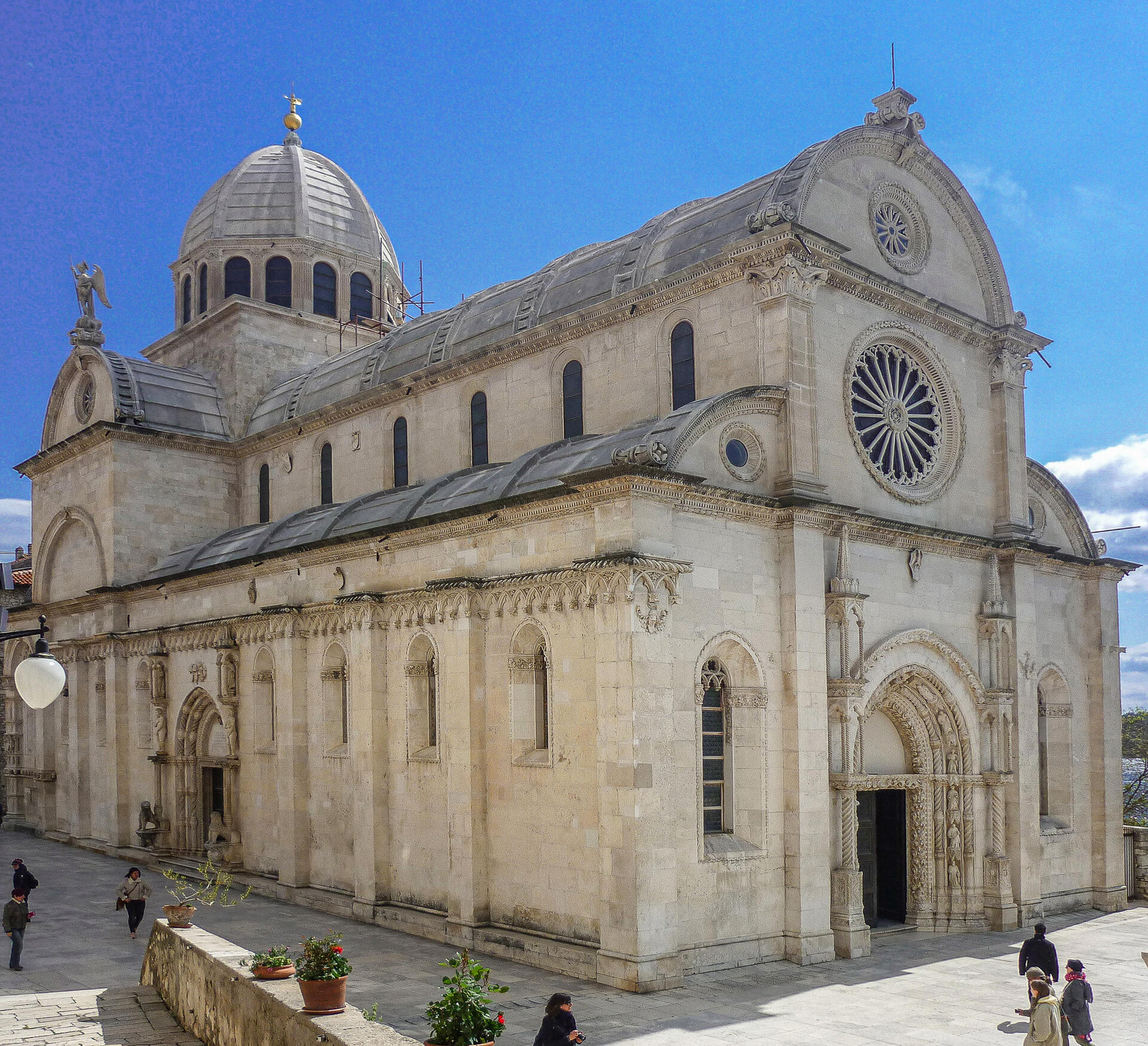
© SchiDD, CC BY-SA 4.0 Resized from original. (This derivative is under the same CC BY-SA license.)
World Heritage Research
Discover scientific research and academic studies that deepen our understanding of The Cathedral of St James in Šibenik from its history and significance to its conservation, management, and contemporary challenges.
-
Vanished Glories: Nin, Biograd, Šibenik
Historical and cultural insights reveal the lost glories of Nin, Biograd, and Šibenik, particularly focusing on the UNESCO-listed Cathedral of St James. The study highlights the region's rich heritage, from its Croat origins and vanished capitals to its maritime significance as a 'Bride of the Sea' and Templar stronghold. It explores the diverse cultural layers—Muslim paradises, seafaring traditions of Zlarin, and architectural marvels like Šibenik Cathedral—while also touching on natural wonders such as the Krka Falls and Skradin's monastic heritage. The research approach combines historical narrative with geographical exploration, offering a multifaceted perspective on the area's past.
Edwards, L. F. (2024). Vanished Glories: Nin, Biograd, Šibenik. Introducing Yugoslavia, 59–75. https://doi.org/10.4324/9781003595748-5
View Publication Record | Read Publication -
Sacred Spaces
A comprehensive exploration of sacred spaces reveals the intricate interplay between architecture, music, and symbolism across diverse cultural and historical contexts. The study examines 12 iconic sites, including the Cathedral of St James in Šibenik, through interdisciplinary analyses that blend art history, musicology, and architectural studies. Key findings highlight how these spaces were designed to evoke spiritual experiences, often integrating musical elements such as organs or choral works (e.g., the Chapel of King Sigismund in Krakow). The research employs close textual analysis, iconographic study, and historical documentation to uncover the layered meanings embedded in these structures. Notably, the Cathedral of St James in Šibenik is analyzed for its Renaissance architecture and religious significance, showcasing how such sites served as both spiritual centers and cultural landmarks.
(Ed.). (2023). Sacred Spaces. The Museum of Renaissance Music, 251–301. https://doi.org/10.1484/m.em-eb.5.134838
View Publication Record | Read Publication -
Bishop Vincenzo Arrigoni (1599-1626) and Some New Insights Concerning the Altarpiece by Filippo Zaniberti (1585-1636) in the Šibenik Cathedral of Saint James
New archival evidence challenges the long-held belief that Bishop Vincenzo Arrigoni commissioned Filippo Zaniberti’s altarpiece for Šibenik Cathedral. Analysis of Lucija Ivetić’s 1626 will and 1635 acquisition records from Venice reveals the altarpiece was likely commissioned by a different patron, despite shared origins with Arrigoni and Zaniberti in Brescia. This discovery reshapes understanding of post-Tridentine artistic patronage in Šibenik, highlighting the need for rigorous archival scrutiny to avoid attributional assumptions based on regional connections.
Šitina, A. (2021). Bishop Vincenzo Arrigoni (1599-1626) and Some New Insights Concerning the Altarpiece by Filippo Zaniberti (1585-1636) in the Šibenik Cathedral of Saint James. Ars Adriatica, 11. https://doi.org/10.15291/aa.3577
View Publication Record | Read Publication -
The Influence of Building Materials on Architectural Design: Dalmatian Stone at the Cathedrals in Korčula and Šibenik
Dalmatian stone played a pivotal role in shaping the architectural forms, structural systems, and technical solutions of 15th- and 16th-century cathedrals in Korčula and Šibenik, marking significant contributions to European art. The study highlights the intricate vaulting system of Šibenik Cathedral, which surpasses the simplicity of Split's Temple of Jupiter, and the similar dome structures of the Korcula campanile and Šibenik Cathedral, both employing a combination of stone ribs and thin slabs. George of Sibenik's wealth, derived partly from trading Dalmatian stone, underscored its importance in his architectural endeavors. The research approach involves analyzing material usage and its impact on design, providing insights into the technical innovations of the period.
Nikšić, G. (2014). The Influence of Building Materials on Architectural Design: Dalmatian Stone at the Cathedrals in Korčula and Šibenik. Dalmatia and the Mediterranean, 382–401. https://doi.org/10.1163/9789004263918_013
View Publication Record | Read Publication