World Heritage Identification Number: 604
World Heritage since: 1992
Category: Cultural Heritage
WHE Type: Historic Cities & Urban Areas
Transboundary Heritage: No
Endangered Heritage: No
Country: 🇷🇺 Russian Federation
Continent: Europe
UNESCO World Region: Europe and North America
Map
Historic Monuments of Novgorod and Surroundings: A Journey Through Medieval Russia
The Historic Monuments of Novgorod and Surroundings, inscribed as a UNESCO World Heritage Site in 1992, offers a captivating glimpse into the rich history and architectural prowess of medieval Russia. Located in the northwestern region of the country, this composite site encompasses a variety of structures that bear testament to the city's significance as a center of political power, religious influence, and artistic creativity during the Middle Ages.
More to come…UNESCO Description of the World Heritage Site
Situated on the ancient trade route between Central Asia and northern Europe, Novgorod was Russia's first capital in the 9th century. Surrounded by churches and monasteries, it was a centre for Orthodox spirituality as well as Russian architecture. Its medieval monuments and the 14th-century frescoes of Theophanes the Greek (Andrei Rublev's teacher) illustrate the development of its remarkable architecture and cultural creativity.
UNESCO Justification of the World Heritage Site
Criterion (ii): An outstanding cultural centre, the birthplace of the national style of stone architecture, and one of the oldest national schools of painting, the town of Novgorod influenced the development of Russian art throughout the Middle Ages.
Criterion (iv): With the broad range of monuments conserved in Novgorod, the town is a veritable conservatory of Russian architecture of the Middle Ages and later periods (11th-19th centuries). These monuments alone suffice to illustrate the development of Russian architecture.
Criterion (vi): Novgorod was one of the major centres of Russian culture and spirituality; its monuments and the treasures they house bear living witness to this.
Encyclopedia Record: Historic Monuments of Novgorod and Surroundings
The Historic Monuments of Novgorod and Surroundings is a composite World Heritage Site which includes a number of medieval monuments in and around Veliky Novgorod, Russia. The site was inscribed in 1992.Additional Site Details
Area: Not available
Number of Components: 11
(iv) — Outstanding example of a type of building or landscape
(vi) — Directly associated with events or living traditions
Coordinates: 58.53333 , 31.28333
Image
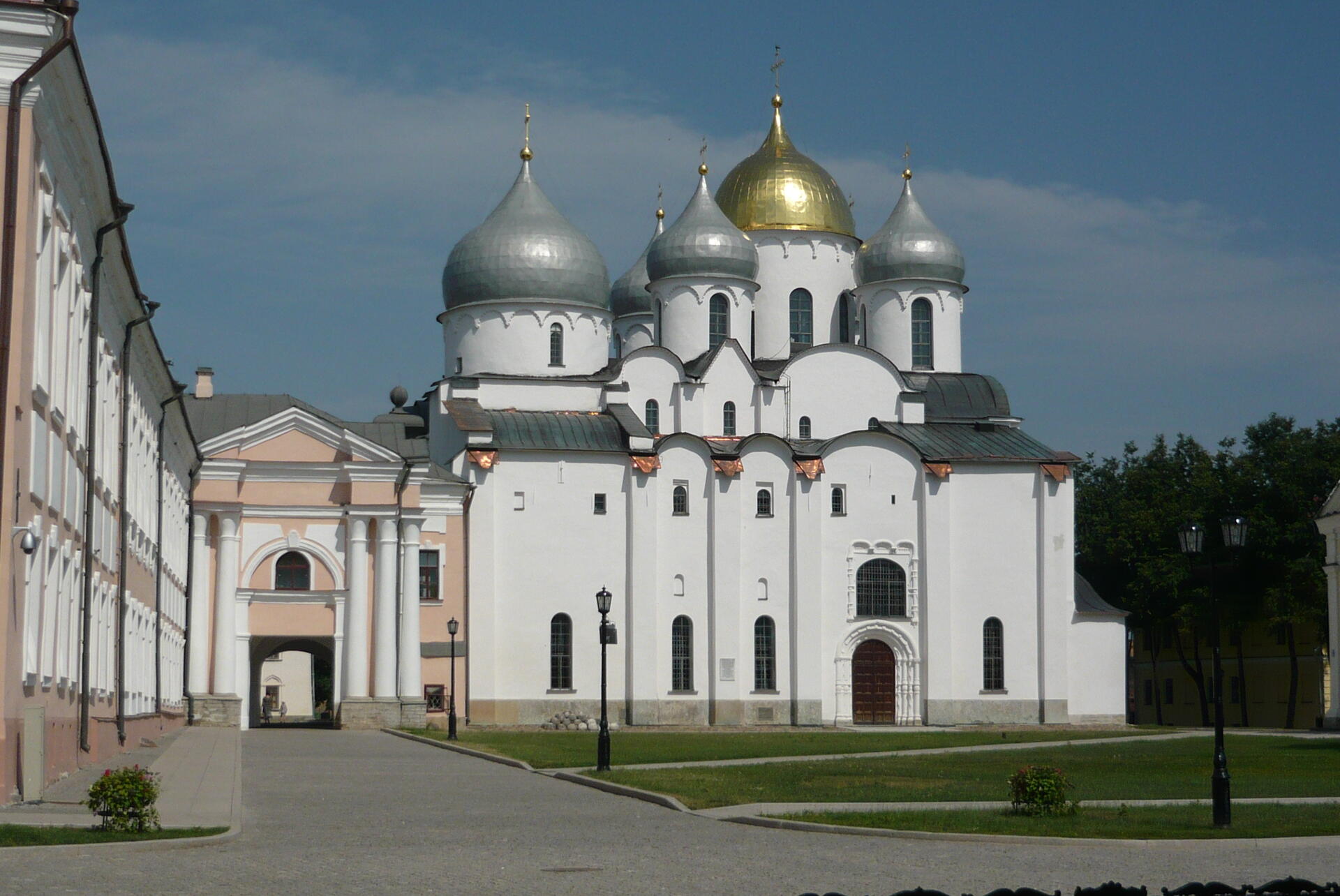
© AleAlexander, CC BY-SA 3.0 Resized from original. (This derivative is under the same CC BY-SA license.)
World Heritage Research
Discover scientific research and academic studies that deepen our understanding of Historic Monuments of Novgorod and Surroundings from its history and significance to its conservation, management, and contemporary challenges.
-
Analyses of Mortars from St. George’s Cathedral, Great Novgorod
A comparative analysis of mortars from St. George’s Cathedral, part of the UNESCO-listed Yuriev Monastery in Veliky Novgorod, reveals distinct differences between pre-Mongolian and later construction periods, as well as variations among structural elements like walls, foundations, floors, and plaster. The study identified crushed bricks (tsemyanka) as a key component in medieval mortars, even in post-Mongolian layers, while also distinguishing two types of sand used historically. Microscopy techniques uncovered these differences, providing insights into construction practices over centuries. Additionally, an unknown structure within the monastery was preliminarily dated to the late 12th or 14th century based on mortar composition.
Ianovskaia, E. G., Vozniak, A. A., Nosova, A. A., Sazonova, L. V., Lebedeva, N. M., & Erofeeva, K. G. (2025). Analyses of Mortars from St. George’s Cathedral, Great Novgorod. Archeometriai Műhely, 22(1), 39–54. https://doi.org/10.55023/issn.1786-271x.2025-004
View Publication Record | Read Publication -
Climate Change Impact on the Cultural Heritage Sites in the European Part of Russia over the Past 60 Years
Climate change is significantly increasing frost damage and salt weathering at UNESCO World Heritage Sites in the European part of Russia, threatening their structural integrity. Over the past 60 years (1960–2020), rising air temperatures and atmospheric moisture levels have exacerbated these destructive processes, particularly in northern regions. The study, using ERA5 re-analysis data to calculate two frost damage indices and two salt weathering indices, highlights that current trends will likely worsen without mitigation. Given Russia's diverse climatic conditions—ranging from north to south—adaptation strategies must be tailored locally, considering the material composition of each site to effectively protect these cultural treasures.
Vyshkvarkova, E., & Sukhonos, O. (2023). Climate Change Impact on the Cultural Heritage Sites in the European Part of Russia over the Past 60 Years. Climate, 11(3), 50. https://doi.org/10.3390/cli11030050
View Publication Record | Read Publication -
Reconstruction of the Urban Historical Centre: Contemporary Problems, Difficulties, and Perspectives
Modern architectural integration with historical city centers, such as Novgorod's urban core, is feasible through strategic policies and innovative methods. The study highlights that unique contemporary buildings can coexist harmoniously with historical structures by adhering to principles of size, spatial composition, and architectural coherence. Experts propose the use of modern techniques, operational modes, and public programs to preserve cultural heritage while advancing sustainable development. This approach ensures the retention of irreplaceable spiritual, cultural, economic, and social values for future generations.
Goussous, J., & Hmood, K. F. (2023). Rekonstrukcja Miejskiego Centrum Historycznego: współczesne problemy, trudności i perspektywy. Problemy Ekorozwoju, 18(2), 263–267. https://doi.org/10.35784/preko.4040
View Publication Record | Read Publication