World Heritage Identification Number: 633
World Heritage since: 1992
Category: Cultural Heritage
WHE Type: Buildings & Architectural Ensembles
Transboundary Heritage: No
Endangered Heritage: No
Country: 🇷🇺 Russian Federation
Continent: Europe
UNESCO World Region: Europe and North America
Map
The White Monuments of Vladimir and Suzdal: A Glimpse into Medieval Russia's Architectural Legacy
The White Monuments of Vladimir and Suzdal, located in the Vladimir Oblast of Central Russia, stand as a testament to the rich architectural history of the region. Inscribed as a UNESCO World Heritage Site in 1992, this collection of eight medieval limestone structures spans the late 12th and early 13th centuries. This serial property includes Russian Orthodox churches, a monastery, a castle, and a gate, each a masterpiece of its time.
More to come…UNESCO Description of the World Heritage Site
These two artistic centres in central Russia hold an important place in the country's architectural history. There are a number of magnificent 12th- and 13th-century public and religious buildings, above all the masterpieces of the Collegiate Church of St Demetrios and the Cathedral of the Assumption of the Virgin.
UNESCO Justification of the World Heritage Site
Criterion (i): The White Monuments of Vladimir and Suzdal are outstanding examples of ancient Russian architecture. These white-stone structures are a unique phenomenon, incorporating the best work of creative master-minds and presenting an amazing synthesis of architecture and monumental art.
Criterion (ii): The white-stone architecture of Vladimir and Suzdal is an outstanding example of the development and perfection of architectural shapes and white-stone building techniques which formed a unique school of architecture. This influential style began and achieved its greatest expression here and illustrates a most important stage of human history and culture in the North-East Rus. Widely used as an example for subsequent construction throughout Russian history, they set a standard as a benchmark of architectural beauty and expressiveness of Russian ecclesiastical architecture.
Criterion (iv): The white-stone monuments and ensembles of the Vladimir and Suzdal school of architecture are outstanding examples of architectural art and perfect models of technical and construction skill, fully harmonized with the surrounding landscape. They exemplify the beginnings and the peak of the white-stone building style of the 12th-13th centuries, and are remarkable for a prominent harmony and perfection of architectural shapes.
Encyclopedia Record: White Monuments of Vladimir and Suzdal
The White Monuments of Vladimir and Suzdal in Vladimir Oblast, Russia, have been designated as a UNESCO World Heritage Site. The patrimony embraces eight medieval limestone monuments of Zalesye from the late 12th and early 13th centuries. They include Russian Orthodox churches and a monastery, as well as a castle and gate. It is a serial property, which means it is made up of multiple monuments.Additional Site Details
Area: Not available
Number of Components: 8
(ii) — Significant interchange of human values
(iv) — Outstanding example of a type of building or landscape
Coordinates: 56.15 , 40.41666667
Image
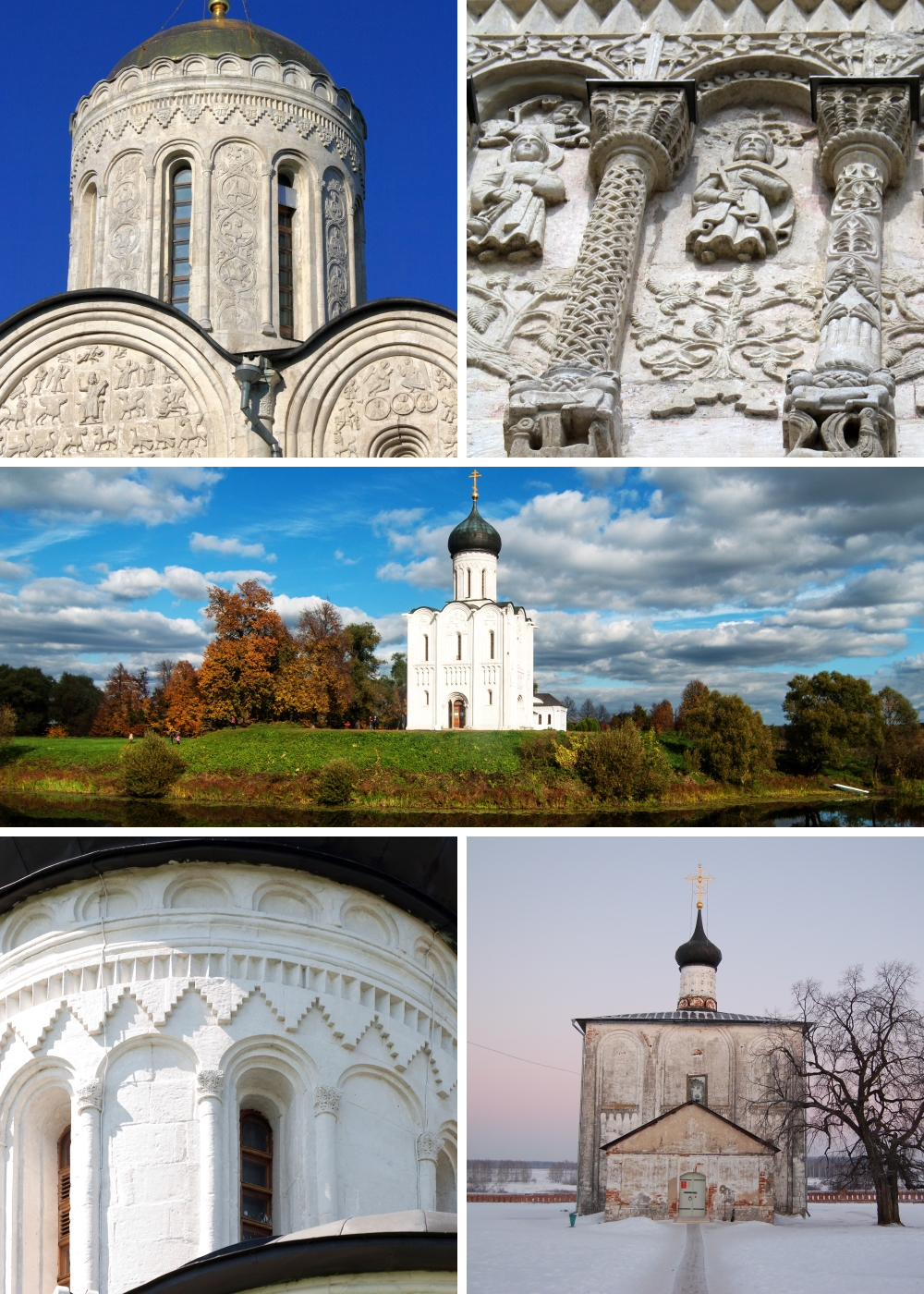
© Trasprd, CC BY-SA 4.0 Resized from original. (This derivative is under the same CC BY-SA license.)
World Heritage Research
Discover scientific research and academic studies that deepen our understanding of White Monuments of Vladimir and Suzdal from its history and significance to its conservation, management, and contemporary challenges.
-
Monument of Russian History and Culture of the XII Century – Transfiguration Cathedral in Pereslavl-Zalesky. Study and Restoration. II Part
A groundbreaking study on the Transfiguration Cathedral in Pereslavl-Zalessky, a 12th-century monument of Russian history and religious architecture, reveals critical insights into its structural integrity and restoration challenges. The cathedral, founded by Grand Duke Yuri Dolgoruky in 1152 and completed by Holy Prince Andrei Bogolyubsky in 1157, stands as a foundational element of Vladimir-Suzdal architecture from the 12th–13th centuries. This research utilizes advanced restoration techniques to address long-standing questions about the cathedral's preservation and historical significance. The findings not only contribute to the understanding of medieval Russian architectural evolution but also provide practical solutions for the conservation of similar heritage sites.
Vorobyеv, S. I. (2025). MONUMENT OF RUSSIAN HISTORY AND CULTURE OF THE XII CENTURY – TRANSFIGURATION CATHEDRAL IN PERESLAVL-ZALESSKY. STUDY AND RESTORATION. II part. Bulletin of Russian Academy of Natural Sciences, 25(1), 165–173. https://doi.org/10.52531/1682-1696-2025-25-1-165-173
View Publication Record | Read Publication -
Pre-Slavic and Slavic Interaction at Eastern Periphery of Slavic Expansion in Northeastern Europe (Y-Gene Pools of Volga-Oka Region)
About half of the R1a haplogroup carriers among modern Ryazan Russians and Finnic populations in the Volga-Oka region descend from a pre-Slavic population, indicating that Slavs did not fully replace but culturally assimilated autochthonous tribes like the Meshchyora. This finding stems from analyzing Y-STR clusters within R1a haplogroups using ancient DNA samples from the Ryazan-Oka culture (6–7th centuries), Suzdal (12–13th centuries), and Vladimir (13th century). The study employed two independent methods of phylogeny analysis to identify 10 informative Y-STR clusters, some linked to ancient Baltic populations, suggesting deep historical connections across northeastern Europe. These clusters, shared between modern and ancient samples, imply that pre-Slavic tribes significantly influenced the genetic makeup of the urban population in Vladimir and Suzdal during the Rus period.
Adamov, D., Shlykov, A., Potanina, A., Voronina, M., Gorin, I., Ponomarev, G., Kabaev, D., Chernyaeva, L., Gavrilov, A., Rusakov, D., Pocheshkhova, E., Zhur, K., Prokhortchouk, E., Goncharova, N., & Balanovska, E. (2025). Pre-Slavic and Slavic Interaction at Eastern Periphery of Slavic Expansion in Northeastern Europe (Y-Gene Pools of Volga-Oka Region). Genes, 16(10), 1149. https://doi.org/10.3390/genes16101149
View Publication Record | Read Publication -
Rusya Federasyonu Unesco Dünya Miras Kentlerini Tehdit Eden Faktörler Üzerine Bir Araştırma
A comprehensive analysis identifies 29 factors threatening UNESCO World Heritage Sites in Russia, with 13 significantly impacting urban heritage areas. Climate-related threats emerge as the most widespread, alongside notable environmental risks from human activities. The study, based on 2024 periodic reporting data, highlights the need for context-specific conservation strategies and positions periodic reporting as both a monitoring and proactive planning tool. This research underscores the critical requirement for tailored political mechanisms to safeguard Russia's rich cultural heritage, including the White Monuments of Vladimir and Suzdal.
Özbey, V. (2025). RUSYA FEDERASYONU UNESCO DÜNYA MİRAS KENTLERİNİ TEHDİT EDEN FAKTÖRLER ÜZERİNE BİR ARAŞTIRMA. Rusya Araştırmaları Dergisi, (14), 329–347. https://doi.org/10.48068/rusad.1535091
View Publication Record | Read Publication -
The city of Vladimir as the center of the origin of Russian monarchism (from Monomakh to the Batu invasion – 1158–1238)
The city of Vladimir emerges as the cradle of Russian monarchism, where the seeds of late medieval political structures were sown between 1158 and 1238. This study reveals that Suzdal princes of this era drew on biblical narratives—particularly the sole rule of King David and the 'Christianized' legacy of Alexander the Great—to justify their imperial ambitions. By imbuing Vladimir with symbolic parallels to Jerusalem, these rulers solidified their authority, a framework later adopted by Moscow's descendants to shape Russia's kingdom and empire. The research transcends traditional chronicle reliance, integrating archaeological, linguistic, and anthropological data to reconstruct pre-Mongolian Vladimir, offering a nuanced understanding of early Russian statehood.
Lyapanov, A. V., & Ragimkhanov, A. V. (2024). The city of Vladimir as the center of the origin of Russian monarchism (from Monomakh to the Batu invasion – 1158–1238). Вестник Гуманитарного Образования, (4(36)), 28–40. https://doi.org/10.25730/vsu.2070.24.055
View Publication Record | Read Publication -
Cementless Compositions for the Restoration of White Stone Based on Lime Binder and Silicon Dioxide
Researchers have developed cement-free compositions for restoring white stone, combining lime and silicon dioxide with chemical additives to enhance adhesive and strength properties. The addition of white soot (silicon dioxide) increases adhesive strength by 1.5 times and compressive strength from 10.6 to 15.6 MPa, surpassing the strength of composites without white soot. These compositions exhibit homogeneous structures compatible with white stone and high adhesion levels, making them promising for the restoration of architectural monuments like those in the White Monuments of Vladimir and Suzdal. The study used modern equipment at the BM Department of VlSU to test these compositions, confirming their phase composition similarity to white stone through XRD, optical microscopy, and SEM analysis.
Repina, E., Zakrevskaya, L., & Panov, Y. (2023). Cementless Compositions for the Restoration of White Stone Based on Lime Binder and Silicon Dioxide. Materials, 17(1), 105. https://doi.org/10.3390/ma17010105
View Publication Record | Read Publication -
The “Seven Sleepers”: Materials From North-East Rus’
A compelling connection emerges between medieval art and religious narratives in North-Eastern Rus', specifically through the motif of the 'Seven Sleepers'. This study reveals that artifacts like the Suzdal hystera-amulet, reliefs from Saint George Cathedral in Yuriev-Polski, and a stone carved icon from Vladimir all feature this biblical tale. These works, dating back to the 12th–14th centuries, share common iconographic compositions despite their unknown authorship. The artifacts, brought ready-made or crafted by local artisans, represent a shared material and visual culture of the region during the Middle Ages, offering insights into the intellectual and artistic heritage of North-Eastern Rus'.
Lapshin, A. (2021). The “Seven Sleepers”: Materials From North-East Rus’. EURAS Journal of Social Sciences, 3(2), 145–161. https://doi.org/10.17932/ejoss.2021.023/ejoss_v03i2002
View Publication Record | Read Publication -
Domestic schools of architectural restoration in the XX century
Russian architectural restoration in the 20th century saw the emergence of distinct regional schools, each shaped by local typological and artistic contexts. This study reveals how Moscow, Novgorod, Vladimir-Suzdal, Leningrad, and Pskov restoration schools developed unique methodological approaches and techniques—ranging from integral to synthetic restoration—while adapting to varying degrees of architectural preservation. By analyzing bibliographic material, the research identifies key features of these schools, highlighting their role in advancing both theory and practice. The findings underscore how regional contexts influenced restoration strategies, offering insights into the evolution of Russian heritage conservation.
Shumilkin, A. (2020). Domestic schools of architectural restoration in the XX century. E3S Web of Conferences, 164, 5019. https://doi.org/10.1051/e3sconf/202016405019
View Publication Record | Read Publication