World Heritage Identification Number: 433
World Heritage since: 1987
Category: Cultural Heritage
WHE Type: Buildings & Architectural Ensembles
Transboundary Heritage: No
Endangered Heritage: No
Country: 🇴🇲 Oman
Continent: Asia
UNESCO World Region: Arab States
Map
Bahla Fort: A Remarkable Example of Ancient Omani Fortification
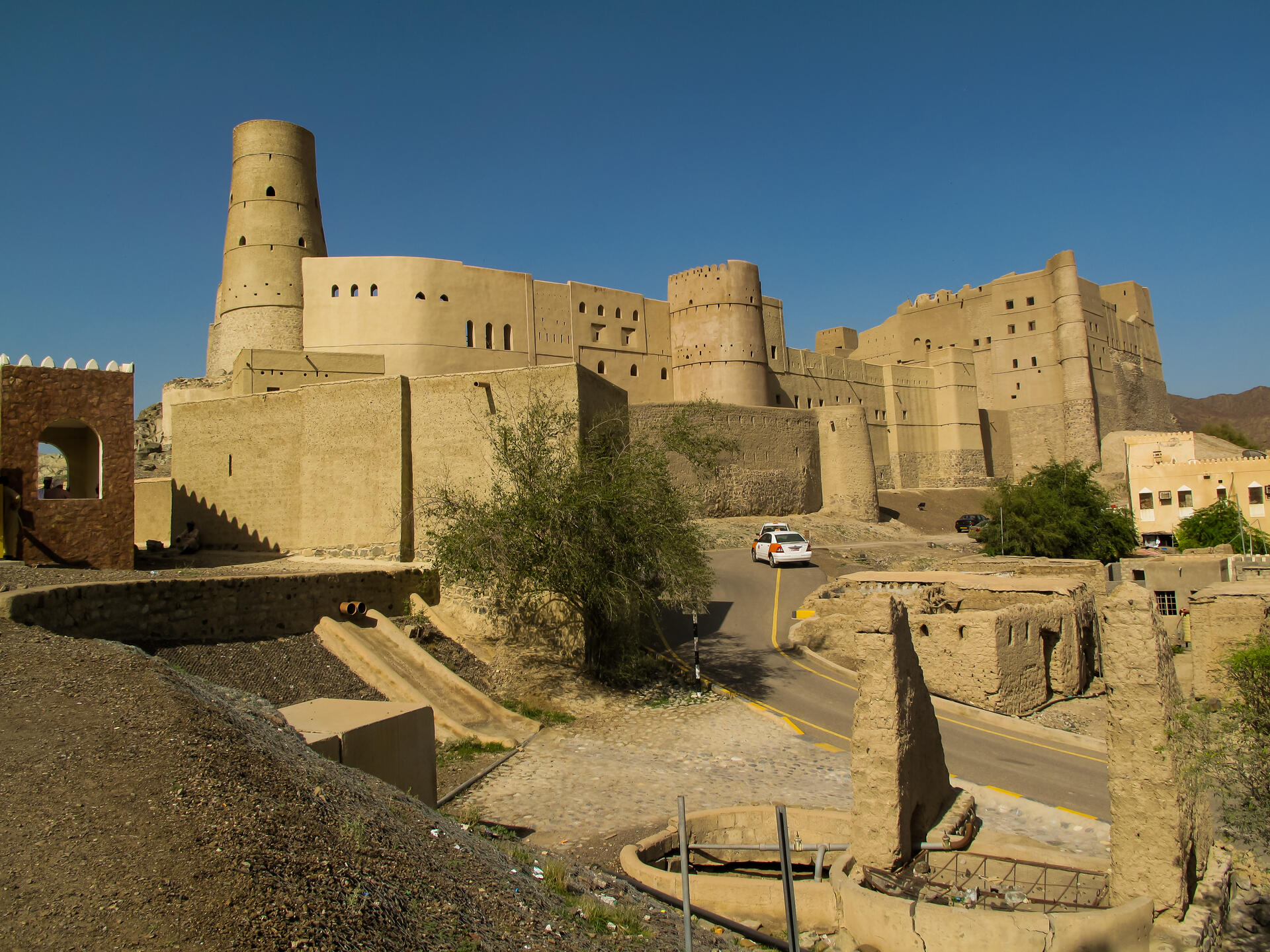
The Bahla Fort, located in the heart of Oman, stands as a testament to the rich history and architectural prowess of the ancient civilizations that once thrived in the region. Inscribed as a UNESCO World Heritage Site in 1987, the fort is one of four historic fortresses nestled at the base of the Jebel Akhdar highlands.
More to come…UNESCO Description of the World Heritage Site
The oasis of Bahla owes its prosperity to the Banu Nebhan, the dominant tribe in the area from the 12th to the end of the 15th century. The ruins of the immense fort, with its walls and towers of unbaked brick and its stone foundations, is a remarkable example of this type of fortification and attests to the power of the Banu Nebhan.
UNESCO Justification of the World Heritage Site
Criterion (iv): The Bahla Fort and oasis settlement with its perimeter fortification are an outstanding example of a type of defensive architectural ensemble that enabled dominant tribes to achieve prosperity in Oman and the Arabian Peninsula during the late medieval period.
Encyclopedia Record: Bahla Fort
Bahla Fort is one of four historic fortresses situated at the foot of the Jebel Akhdar highlands in Oman and was the country's first UNESCO-listed fort added in 1987.Additional Site Details
Area: Not available
Number of Components: 1
Coordinates: 22.96417 , 57.30111
World Heritage Research
Discover scientific research and academic studies that deepen our understanding of Bahla Fort from its history and significance to its conservation, management, and contemporary challenges.
-
Pedo-Archeo Heritage Sites in Northern Oman: from Traditional Soil-Sediment Materials in Building Engineering to Booming Tourism
Omani soils, often overlooked in geoheritage studies, hold significant cultural and historical value, yet they remain underrepresented in conservation efforts. This study highlights the unique pedodiversity across Oman's regions and their traditional use in building engineering, such as mortar, plaster, and water management systems like falaj liners. Through satellite imaging and physicochemical analysis of geomaterials from five northern Omani sites—including Bahla Fort—researchers identified distinct material properties linked to local topography, geomorphology, and hydrology. These findings underscore the potential for rediscovering ancestral building techniques that offer sustainable solutions for thermal insulation, erosion resistance, and water management in arid environments. The study also explores the growing tourism interest in these ancient monuments, integrating Omani landscapes with educational dimensions that extend beyond agronomic value.
Al-Ismaily, S., Al-Mayhai, A., Kacimov, A., Al-Rawahy, Y., Al-Shibli, A., Al-Mukhaini, N., Al-Sabahi, A., Al-Wahaibi, M., Al-Naabi, I., Al-Thuhli, A.-H., & Al-Balushi, S. (2026). Pedo-Archeo Heritage Sites in Northern Oman: from Traditional Soil-Sediment Materials in Building Engineering to Booming Tourism. Geoheritage, 18(1). https://doi.org/10.1007/s12371-026-01288-5
View Publication Record | Read Publication -
The Art of Preservation: Bridging Historical Narratives and Modern Visual Expression in Omani Heritage Sites
Modern visual technologies, including virtual reality (VR) and augmented reality (AR), offer a transformative approach to preserving and presenting Oman's rich historical heritage, such as Bahla Fort. By minimizing direct interaction with fragile sites, these tools create immersive, educational experiences that engage both local and global audiences while fostering eco-friendly tourism. The integration of digital reconstructions—ranging from ancient cities to traditional handicrafts—enhances narrative accessibility and generates new economic opportunities in innovation and preservation. This method not only attracts more visitors but also encourages intergenerational knowledge transfer, making heritage more appealing to younger generations. The study positions Oman as a potential leader in Gulf region cultural tourism by blending artistic, technological, and historical narratives.
Soliman, A. E., Jerzy Wierzbicki, Ossama Hegazy, Hanna Al-Lawati, Sarra Mrabti, & Muznah Almiqbali. (2026). The Art of Preservation: Bridging Historical Narratives and Modern Visual Expression in Omani Heritage Sites. International Conference on Tourism Research, 9(1), 442–450. https://doi.org/10.34190/ictr.9.1.4393
View Publication Record | Read Publication -
Natural Language Processing in the Tourism Industry of Oman: A Study on Bahla Fort
A sentiment analysis of Bahla Fort, a UNESCO World Heritage site in Oman, reveals predominantly positive visitor perceptions, with terms like 'nice,' 'well,' and 'heritage' frequently highlighted. While the fort is recognized for its cultural significance, the study identifies subtle negative sentiments and areas for improvement that could enhance its appeal as a tourist destination. Using Natural Language Processing (NLP), researchers analyzed visitor feedback to provide actionable insights for strategic improvements, aiming to align Bahla Fort's offerings more closely with visitor preferences and address concerns effectively.
Maghfiroh, M. F. N., & Azzam, A. (2025). Natural Language Processing in the Tourism Industry of Oman: A Study on Bahla Fort. 2025 International Conference for Artificial Intelligence, Applications, Innovation and Ethics (AI2E), 1–4. https://doi.org/10.1109/ai2e64943.2025.10983012
View Publication Record | Read Publication -
A Journey into Cultural Marvels: Tourist Perception and Satisfaction with Cultural Heritage Sites in Muscat, Oman
Tourists visiting cultural heritage sites in Muscat, Oman, particularly value the aesthetic and traditional aspects of these locations. The study found that Mutrah Souq was the most frequently visited site, with tourists expressing high satisfaction for its culturally rich environment. Safety and security emerged as a key expectation, indicating a need for improved accessibility and amenities to enhance visitor experience. While research on UNESCO World Heritage Sites in Oman exists, this study uniquely focuses on Muscat, providing valuable insights for stakeholders aiming to boost cultural heritage tourism through strategic planning and targeted initiatives.
Al Saqri, M. S., Tumati, R.,. (2023). A Journey into Cultural Marvels: Tourist Perception and Satisfaction with Cultural Heritage Sites in Muscat, Oman. International Journal of Research in Entrepreneurship & Business Studies, 4(4), 1–14. https://doi.org/10.47259/ijrebs.441
View Publication Record | Read Publication -
Re(dis)covering the recent: Surveying settlements and society in central Oman from the 17th to the 20th centuries
A refined ceramic chronology for the Late Islamic period (17th to 20th centuries) in central Oman, including Bahla Fort, has been established through a comprehensive analysis of mudbrick settlements. This study synthesizes previous ceramic research and provides a baseline for interpreting material culture from this understudied region. By systematically reviewing past surveys and refining chronological frameworks, the research offers new insights into settlement patterns and societal changes during this period. The findings aim to serve as a reference for future archaeological studies in Oman, enabling the re(dis)covery of subrecent history through material culture analysis.
Biezeveld, I. (2022). Re(dis)covering the recent: Surveying settlements and society in central Oman from the 17th to the 20th centuries. Arabian Archaeology and Epigraphy, 34(S1). Portico. https://doi.org/10.1111/aae.12225
View Publication Record | Read Publication -
The development of legal framework for the management of World Heritage Sites in Oman: a case study on Bahla Oasis
Oman's recent heritage legislation, specifically the Omani Cultural Heritage Law 35/2019 and Special Management Regulations 81/2019, significantly enhances the management of World Heritage Sites by aligning with UNESCO's World Heritage Convention (WHC) and Operational Guidelines. This study highlights how these laws facilitate tailored solutions for local challenges, exemplified by Bahla Fort and Oasis—the first Omani World Heritage Site—demonstrating the effectiveness of customized heritage legislation in implementing national plans. The research analyzes the evolution of Omani heritage protection laws since 1970, comparing them against UNESCO standards to assess their impact on site management.
Khalil, M. A. M., & Nasr, E. H. M. (2021). The development of legal framework for the management of World Heritage Sites in Oman: a case study on Bahla Oasis. Journal of Cultural Heritage Management and Sustainable Development, 13(1), 146–166. https://doi.org/10.1108/jchmsd-07-2020-0106
View Publication Record | Read Publication -
Community-led initiatives for the rehabilitation and management of vernacular settlements in Oman: a phenomenon in the making
Community-led initiatives are emerging as a transformative force in the rehabilitation and adaptive reuse of vernacular settlements in Oman, particularly at Bahla Fort. This research reveals that such bottom-up efforts, driven by local communities, are fostering heritage tourism while facing significant challenges due to centralized policies and insufficient regulations regarding land use, restoration, and adaptive reuse. Through three case studies, the study employed a mixed-methods approach—including data analysis, onsite observations, interviews with stakeholders, and quantitative data extraction from hotel booking platforms—to uncover unexpected interrelations among these initiatives and their operational dynamics. The findings highlight the potential of horizontal cooperation between community-led projects but also underscore the need for policy reforms to support sustainable heritage management.
Naima, B. (2021). Community-led initiatives for the rehabilitation and management of vernacular settlements in Oman: a phenomenon in the making. Built Heritage, 5(1). https://doi.org/10.1186/s43238-021-00039-5
View Publication Record | Read Publication