World Heritage Identification Number: 1619
World Heritage since: 2021
Category: Cultural Heritage
WHE Type: Archaeological Sites
Transboundary Heritage: No
Endangered Heritage: No
Country: 🇸🇦 Saudi Arabia
Continent: Asia
UNESCO World Region: Arab States
Map
Ḥimā Cultural Area: A Timeless Testimony of Ancient Civilizations
The Ḥimā Cultural Area, inscribed as a UNESCO World Heritage Site in 2021, offers a captivating glimpse into the rich cultural history of southwest Saudi Arabia. Situated within an arid, mountainous region, this site serves as a significant stopover along one of the ancient caravan routes that crisscrossed the Arabian Peninsula.
More to come…UNESCO Description of the World Heritage Site
Located in an arid, mountainous area of southwest Saudi Arabia, on one of the Arabian Peninsula’s ancient caravan routes, Ḥimā Cultural Area contains a substantial collection of rock art images depicting hunting, fauna, flora and lifestyles in a cultural continuity of 7,000 years. Travellers and armies camping on the site left a wealth of rock inscriptions and petroglyphs through the ages and until the late 20th century, most of which are preserved in pristine condition. Inscriptions are in different scripts, including Musnad, South-Arabian, Thamudic, Greek and Arabic. The property and its buffer zone are also rich in unexcavated archaeological resources in the form of cairns, stone structures, interments, stone tool scatters and ancient wells. This location is at the oldest known toll station on an important ancient desert caravan route, where the wells of Bi’r Ḥimā date back at least 3,000 years and still produce fresh water.
UNESCO Justification of the World Heritage Site
Criterion (iii): The Ḥimā Cultural Area bears an exceptional testimony to a number of ancient traditions over the span of many millennia, chronicling the history of the Arab people more effectively than any other place and thus representing an immense outdoor library of that history. The property bears an exceptional testimony to a long series of cultural traditions, arguably from the Paleolithic and at the very least to the Neolithic and stretching from then until the present day. Over this long period, the people passing through the region left a pristine record of their presence and passage in the form of rock inscriptions and rock art, the former in some cases describing their lived context and environment, the themes in the rock art reflecting the changing character of the environment and how they adapted to it.
Encyclopedia Record: Bir Hima Rock Petroglyphs and Inscriptions
Bir Hima is a rock art site in Najran province, in southwest Saudi Arabia, about 120 kilometres (75 mi) north of the city of Najran. An ancient site of Prehistoric Arabia, it was settled during the Paleolithic and Neolithic periods, with the Bir Hima Complex covering the time period of 7000–1000 BC. Bir Hima contains numerous troughs whose type is similar from North Arabia to Yemen.Additional Site Details
Area: 242.17 hectares
Number of Components: 6
Coordinates: 18.3167111111 , 44.5453361111
Image
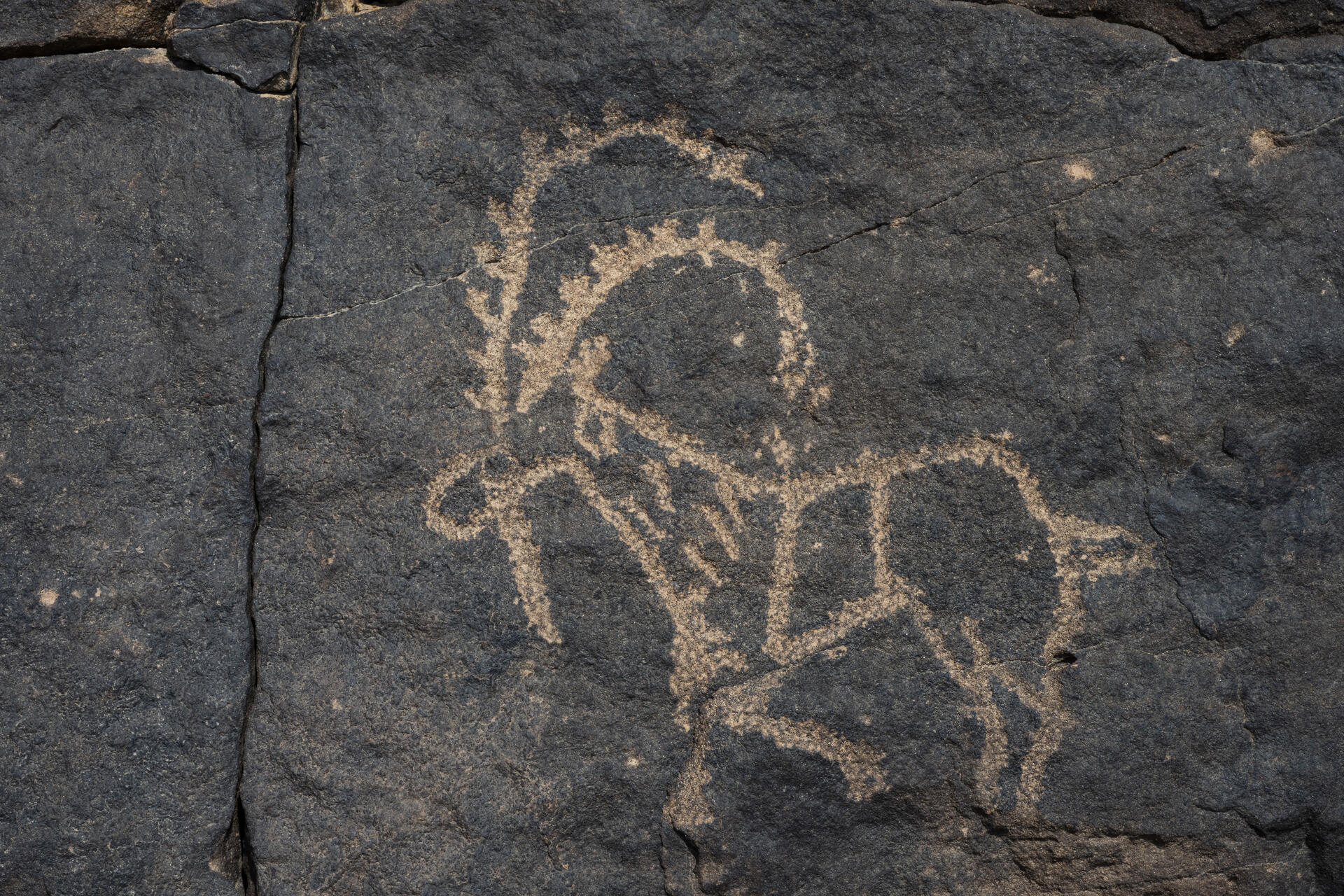
© Heritage Commission , CC BY-SA 4.0 Resized from original. (This derivative is under the same CC BY-SA license.)
World Heritage Research
Discover scientific research and academic studies that deepen our understanding of Ḥimā Cultural Area from its history and significance to its conservation, management, and contemporary challenges.
-
Bovines in Rock Art in Ḥimā Sites, near Najrān
Rock art in southern Saudi Arabia, particularly the bovine motif found in the Ḥimā Cultural Area near Najrān, challenges traditional timelines of rock art in northern Arabia. While bovine depictions faded in the north by the end of the Holocene humid period due to desertification, hundreds of later representations persist in the south, extending into the Iron Age and Late Antiquity. This suggests a divergent timeline between northern and southern Arabia. The study, conducted by the French-Saudi Archaeological and Epigraphic Mission in Najrān (MAFSN), systematically documented over 300 bovine figures across eight sites, integrating rock art, epigraphic, archaeozoological, and ethological data to analyze morphology, stylistic evolution, and societal development. Some depictions are linked to Ancient South Arabian and Thamudic scripts, providing a rare chronological marker for this region's cultural heritage.
Vartin, R., Prioletta, A., & Al-Qahtani, S. (2026). Bovines in Rock Art in Ḥimā Sites, near Najrān. Athīrat: Journal of Ancient Arabia, 2(1-2), 202–238. https://doi.org/10.1163/30504880-12340030
View Publication Record | Read Publication -
Two Anthropomorphic Stelae Connected With a Platform‐Like Structure in the Area of Ḥimā (Saudi Arabia): New Data From Southwestern Arabia
Archaeological excavations in the Ḥimā Cultural Area, Saudi Arabia, have uncovered two anthropomorphic stelae associated with a platform-like structure, providing new insights into Bronze Age occupation in southwestern Arabia. The discovery, made by the Saudi-French Archaeological and Epigraphic Mission to Najrān (MAFSN) in November 2021, challenges previous assumptions about the region's historical significance as a transit hub along caravan routes. The stelae, documented on the eastern side of Jabal al-Kawkab, contribute to a re-evaluation of the area's Bronze Age landscape, which has been characterized by continuous human activity from the Palaeolithic to modern times. This finding underscores the importance of Ḥimā as a key site for understanding regional history and cultural evolution.
Lischi, S., Haquet, J.-F., Schiettecatte, J., & Prioletta, A. (2024). Two Anthropomorphic Stelae Connected With a Platform‐Like Structure in the Area of Ḥimā (Saudi Arabia): New Data From Southwestern Arabia. Arabian Archaeology and Epigraphy, 36(1), 39–51. Portico. https://doi.org/10.1111/aae.12260
View Publication Record | Read Publication -
Minaeans at Ḥimā: The Epigraphic Corpus and Its Historical, Linguistic and Cultural Implications
Over 150 Minaean inscriptions and graffiti from Ḥimā, a critical trans-Arabian caravan route stopover, reveal insights into the social hierarchy and linguistic practices of ancient traders. The study highlights that these inscriptions reflect a close mirroring of spoken language, distinct from formal urban scripts, suggesting varying literacy levels and roles within trading caravans. Notable individuals with higher ranks or specific functions are identified, emphasizing the integration of Minaean families across regions and underscoring trade's pivotal role in their social organization.
Prioletta, A., & Arbach, M. (2024). Minaeans at Ḥimā: The Epigraphic Corpus and Its Historical, Linguistic and Cultural Implications. Arabian Archaeology and Epigraphy, 36(1), 253–276. Portico. https://doi.org/10.1111/aae.12261
View Publication Record | Read Publication -
Biocultural conservation systems in the Mediterranean region: the role of values, rules, and knowledge
Biocultural conservation systems in the Mediterranean region, such as agdal (Morocco), communal forests (Spain), sacred natural sites (Greece), and hima (Lebanon), play a crucial role in preserving biodiversity by integrating values, rules, and local knowledge. These systems are shaped by instrumental, intrinsic, and relational values, often adapting to Mediterranean climatic uncertainty while ensuring equitable resource use through informal rules, including taboos. Local knowledge drives these systems, which support linkages between nature and human well-being. The study highlights the need for fostering biocultural conservation by navigating interlinkages between values, rules, and knowledge in decision-making processes.
Plieninger, T., Abunnasr, Y., D’Ambrosio, U., Guo, T., Kizos, T., Kmoch, L., Topp, E., & Varela, E. (2022). Biocultural conservation systems in the Mediterranean region: the role of values, rules, and knowledge. Sustainability Science, 18(2), 823–838. https://doi.org/10.1007/s11625-022-01155-6
View Publication Record | Read Publication