World Heritage Identification Number: 1396
World Heritage since: 2012
Category: Cultural Heritage
WHE Type: Archaeological Sites
Transboundary Heritage: No
Endangered Heritage: No
Country: 🇲🇾 Malaysia
Continent: Asia
UNESCO World Region: Asia and the Pacific
Map
Archaeological Heritage of the Lenggong Valley: A Window into Early Human History
The Archaeological Heritage of the Lenggong Valley, inscribed as a UNESCO World Heritage Site in 2012, offers a unique glimpse into the rich and diverse history of human civilization. Located in the picturesque Lenggong Valley, this site spans nearly 2 million years, making it one of the longest records of early human existence in a single location, and the oldest outside Africa.
More to come…UNESCO Description of the World Heritage Site
Situated in the lush Lenggong Valley, the property includes four archaeological sites in two clusters which span close to 2 million years, one of the longest records of early man in a single locality, and the oldest outside the African continent. It features open-air and cave sites with Palaeolithic tool workshops, evidence of early technology. The number of sites found in the relatively contained area suggests the presence of a fairly large, semi-sedentary population with cultural remains from the Palaeolithic, Neolithic and Metal ages.
UNESCO Justification of the World Heritage Site
Criterion (iii) : The series of cave and open air sites along the Perak River in the Lenggong Valley is an exceptional testimony to occupation of the area particularly during the Palaeolithic era, but also during the Neolithic and Bronze Age periods from 1.83 million years ago to 1,700 years ago.
Criterion (iv) : The undisturbed in situ Palaeolithic stone tool workshops located on the shores of a paleolake and ancient river gravel beds and dated in a long chronological sequence are an outstanding ensemble of lithic technology.
Encyclopedia Record: Lenggong
Lenggong or Lenggong Valley is a geographical area defined by the mountain ranges of Bintang in the west and Titiwangsa to its east. It is a rural area, with small kampongs surrounded by green vegetation and limestone hills with numerous caves.Additional Site Details
Area: 398.64 hectares
Number of Components: 4
(iv) — Outstanding example of a type of building or landscape
Coordinates: 5.0679083333 , 100.9723277778
Image
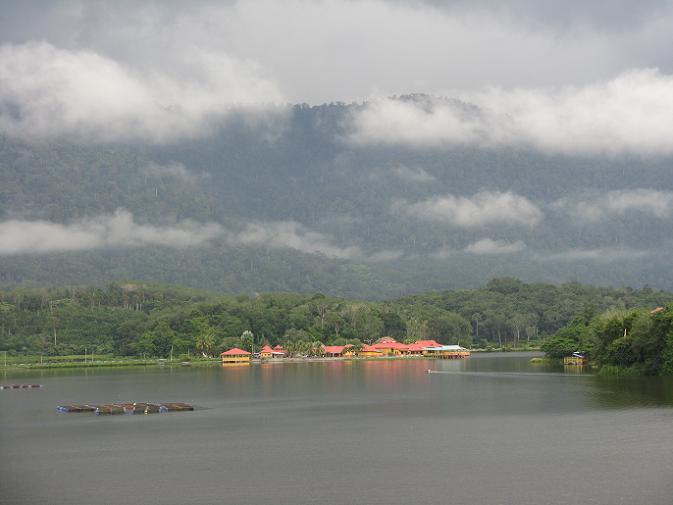
© Tony Ng, CC BY-SA 3.0 Resized from original. (This derivative is under the same CC BY-SA license.)
World Heritage Research
Discover scientific research and academic studies that deepen our understanding of Archaeological Heritage of the Lenggong Valley from its history and significance to its conservation, management, and contemporary challenges.
-
Land Use Change Detection and Prediction Around Lenggong UNESCO World Heritage Site Using ANN–CA Modelling
A significant increase in built-up areas, from 3.6% to 10.5%, has been detected within the 1 km heritage buffer of the Lenggong Valley UNESCO World Heritage Site between 2000 and 2020, with projections suggesting this trend will continue, reaching 13.2% by 2040. This study utilized an Artificial Neural Network (ANN) combined with Cellular Automata (CA) modeling to analyze historical land use changes and predict future patterns in the Lenggong catchment. The model demonstrated high accuracy, achieving an overall Kappa value of 0.71 and validation accuracy of 83.1%. While forest and agriculture remained dominant land uses, the study highlighted a concerning decrease in forest cover (from 58.9% to 54.4%) and an increase in built-up areas, posing potential threats to the heritage landscape's authenticity and environmental quality. These findings underscore the need for proactive heritage-sensitive planning and conservation strategies to mitigate development pressures.
Ramli, M. W. A., Wan Ibrahim, W. M. M., Ramanthan, A., Ahmad, A., Abdul Wahab, Y. F., & Mahamud, M. A. (2026). Land Use Change Detection and Prediction Around Lenggong UNESCO World Heritage Site Using ANN–CA Modelling. Earth, 7(5), 144. https://doi.org/10.3390/earth7050144
View Publication Record | Read Publication -
Geoheritage Tourism in Lenggong Valley, Perak, Malaysia: Local Community Involvement
A study on the Archaeological Heritage of the Lenggong Valley demonstrates that local communities have successfully integrated into geotourism activities, significantly empowering heritage tourism while aligning with Sustainable Development Goals (SDGs). The research highlights how stakeholders and locals have collaboratively developed tourism initiatives, including certified geoguides, traditional food services, and homestays. By employing survey and participation-based methods, the study systematically documented the involvement of communities in organized tourism programs, mapping site conditions and facilities while training locals to lead heritage tours. This approach not only safeguards Lenggong Valley’s geoarchaeological sites but also showcases a model for inclusive, community-driven geotourism that leaves no one behind.
ABD HALIM, M. H., TALIB, N. K., MASNAN, S. S. K., RASHIDI, N. A., SAIDIN, M.,. (2025). GEOHERITAGE TOURISM IN LENGGONG VALLEY, PERAK, MALAYSIA: LOCAL COMMUNITY INVOLVEMENT. Geojournal of Tourism and Geosites, 59(2), 844–855. https://doi.org/10.30892/gtg.59229-1461
View Publication Record | Read Publication -
Design and Evaluation of a 2D Educational Game on Malaysian Cultural Heritage: Travel Game – Heritage Quest Journey to the Past
A 2D educational game, 'Travel Game: Heritage Quest – Journey to the Past,' effectively enhances awareness and understanding of Malaysia's tangible cultural heritage, particularly the Lenggong Valley and Perak Man. The game, developed using the Godot Engine (v4.0) under Agile methodology, combines interactive storytelling, puzzles, and NPC dialogues to promote heritage learning through exploration and problem-solving. Usability testing with 21 participants revealed high engagement scores (mean ≥ 4.6/5), with qualitative feedback highlighting appreciation for its visual design, narrative structure, and cultural content. Participants demonstrated improved knowledge of Malaysian prehistoric heritage post-gameplay, suggesting that serious games can transform passive learning into interactive, meaningful experiences. This study offers a localized model for integrating educational games in both academic and tourism settings.
Ibrahim, M. A. I., & Abd Ghani, N. F. (2025). DESIGN AND EVALUATION OF A 2D EDUCATIONAL GAME ON MALAYSIAN CULTURAL HERITAGE: TRAVEL GAME – HERITAGE QUEST JOURNEY TO THE PAST. Journal of Creative Industry and Sustainable Culture, 4, 250–269. https://doi.org/10.32890/jcisc2025.4.16
View Publication Record | Read Publication -
Tabulation and Landscape Characters of Lenggong Valley’s Malay Traditional Houses
Lenggong Valley's Malay traditional houses, particularly the Rumah Limas Bumbung Perak (RLBP) and Rumah Kutai (RK), are concentrated near caves and the Perak River, reflecting historical human settlement patterns from Paleolithic to Malay sultanate eras. A study of 108 houses using Kernel Density Analysis revealed that most retain vernacular or semi-vernacular architecture, underscoring their cultural significance. The landscape distribution supports Lenggong's potential as a Global Geopark by highlighting its unique heritage attributes. These findings provide critical data for conservation efforts and encourage further assessment of house conditions to strengthen preservation strategies.
Che Zahari, M. R., & Wan Ibrahim, W. Y. (2024). Tabulation and Landscape Characters of Lenggong Valley’s Malay Traditional Houses. Built Environment Journal, 21(1). https://doi.org/10.24191/bej.v21i1.227
View Publication Record | Read Publication -
Financial Management Policy and Governance for the Preservation of the UNESCO World Heritage Site in Malaysia as a Tourism Attraction
A comprehensive policy and governance framework is essential for balancing economic development with sustainable tourism, particularly in preserving UNESCO World Heritage Sites. This study highlights the need for Malaysia to revise its current policies to ensure effective management of heritage assets, such as the Archaeological Heritage of the Lenggong Valley, through sustainable tourism practices. To achieve this, the research proposes a benchmarking approach comparing Malaysia's documentation with that of Indonesia, aiming to assess the adequacy of existing policies and governance structures. The study emphasizes the importance of integrating financial management strategies to safeguard these sites while promoting their development as tourism attractions.
Che Soh, M., Abdul Rahim, M., Zainuddin, A., & Soegiono, A. N. (2024). Financial Management Policy and Governance for the Preservation of the UNESCO World Heritage Site in Malaysia as a Tourism Attraction. Environment-Behaviour Proceedings Journal, 9(SI20), 533–538. https://doi.org/10.21834/e-bpj.v9isi20.5899
View Publication Record | Read Publication -
Anthropology and History in Local Wisdom
Anthropology and History in Local Wisdom highlights the profound contributions of indigenous knowledge systems to regional development, demonstrating how local wisdom has persisted across diverse fields. The book explores 15 interconnected themes, including nomadic traditions, socioeconomic changes, language dynamics, maritime technology, and cultural assimilation, all rooted in anthropological and historical research. A key insight is the resilience and adaptability of Malay and Orang Asli communities, showcasing their cognitive and psychological influences on cultural stability. Methodologically, the work synthesizes academic research across disciplines to reconstruct the epistemological foundations of Islamic Malay worldviews and other traditional practices. This synthesis underscores the enduring value of local knowledge in shaping societal structures, economic systems, and cultural identities in Southeast Asia.
Iqbal, U. (2024). Anthropology and History in Local Wisdom. Anthropology and Ethnology Open Access Journal, 7(2). https://doi.org/10.23880/aeoaj-16000239
View Publication Record | Read Publication -
Willingness to Pay for Conservation and Sustainability of Lenggong Valley as World Heritage Site (WHS)
Research reveals significant local willingness to support the conservation and sustainability of Lenggong Valley, a UNESCO World Heritage Site (WHS) in Malaysia. Despite its designation in 2012, the site faces threats due to inadequate maintenance, risking its WHS status. The study, involving 400 respondents—including 300 local residents—found that economic valuation of visits and community engagement are critical for future preservation efforts. Demographic factors also influence willingness to pay, highlighting the need for targeted conservation strategies. Funded by Malaysia's Ministry of Higher Education (MOHE), this research underscores the importance of local awareness and participation in safeguarding Lenggong Valley's prehistoric significance.
Fazlin, S. N., Affizzah, A. M. D., & Abu Bakar, N. A. (2024). Willingness to Pay for Conservation and Sustainability of Lenggong Valley as World Heritage Site (WHS). International Journal of Academic Research in Economics and Management Sciences, 13(4). https://doi.org/10.6007/ijarems/v13-i4/23048
View Publication Record | Read Publication