World Heritage Identification Number: 1612
World Heritage since: 2021
Category: Cultural Heritage
WHE Type: Religious Sites & Sacred Architecture
Transboundary Heritage: No
Endangered Heritage: No
Country: 🇺🇾 Uruguay
Continent: Americas
UNESCO World Region: Latin America and the Caribbean
Map
A Modernist Masterpiece: The Church of Atlántida by Engineer Eladio Dieste
The Church of Atlántida, located in Estación Atlántida approximately 45 kilometers from Montevideo, Uruguay, stands as a testament to the innovative spirit and architectural prowess of engineer Eladio Dieste. Inscribed as a UNESCO World Heritage Site in 2021, this modernist church complex showcases Dieste's unique application of exposed and reinforced brick, drawing inspiration from Italian paleo-Christian and medieval religious architecture.
More to come…UNESCO Description of the World Heritage Site
The Church of Atlántida with its belfry and underground baptistery is located in Estación Atlántida, 45 km away from Montevideo. Inspired by Italian paleo-Christian and medieval religious architecture, the modernistic Church complex, inaugurated in 1960, represents a novel utilization of exposed and reinforced brick. Built on rectangular plan of one single hall, the church features distinctive undulating walls supporting a similarly undulating roof, composed of a sequence of reinforced brick Gaussian vaults developed by Eladio Dieste (1917-2000). The cylindrical bell-tower, built in openwork exposed brick masonry, rises from the ground to the right of the main church facade, while the underground baptistery is located on the left side of the parvis, accessible from a triangular prismatic entrance and illuminated via a central oculus. The Church provides an eminent example of the remarkable formal and spatial achievements of modern architecture in Latin America during the second part of the 20th century, embodying the search for social equality with a spare use of resources, meeting structural imperatives to great aesthetic effect.
UNESCO Justification of the World Heritage Site
Criterion (iv): The Church of Atlántida of engineer Eladio Dieste represents the highest spatial and aesthetic expression of a construction and technological innovation – the reinforced brickwork coupled with the mobile formwork – that draws from tradition, whilst reinterpreting and innovating it, and opens up structural and formal opportunities in architecture impossible to conceive and achieve up to that date with traditional masonry. The property embodies the post-war search for a renewed architectural language, expressing a modernity rooted in tradition and in the vernacular in Latin America and worldwide. It also reflects the locale and its people who built it. The church illustrates the confluence of geometry, of the static conception of the building, of the form expressed by the chosen building material.
Encyclopedia Record: Iglesia de Cristo Obrero y Nuestra Señora de Lourdes
The Church of Christ the Worker and Our Lady of Lourdes, also known simply as Iglesia de Estación Atlántida, is a Roman Catholic parish church and a World Heritage Site in Estación Atlántida, Uruguay.Additional Site Details
Area: 0.56 hectares
Number of Components: 1
Coordinates: -34.7439194444 , -55.7664083333
Image
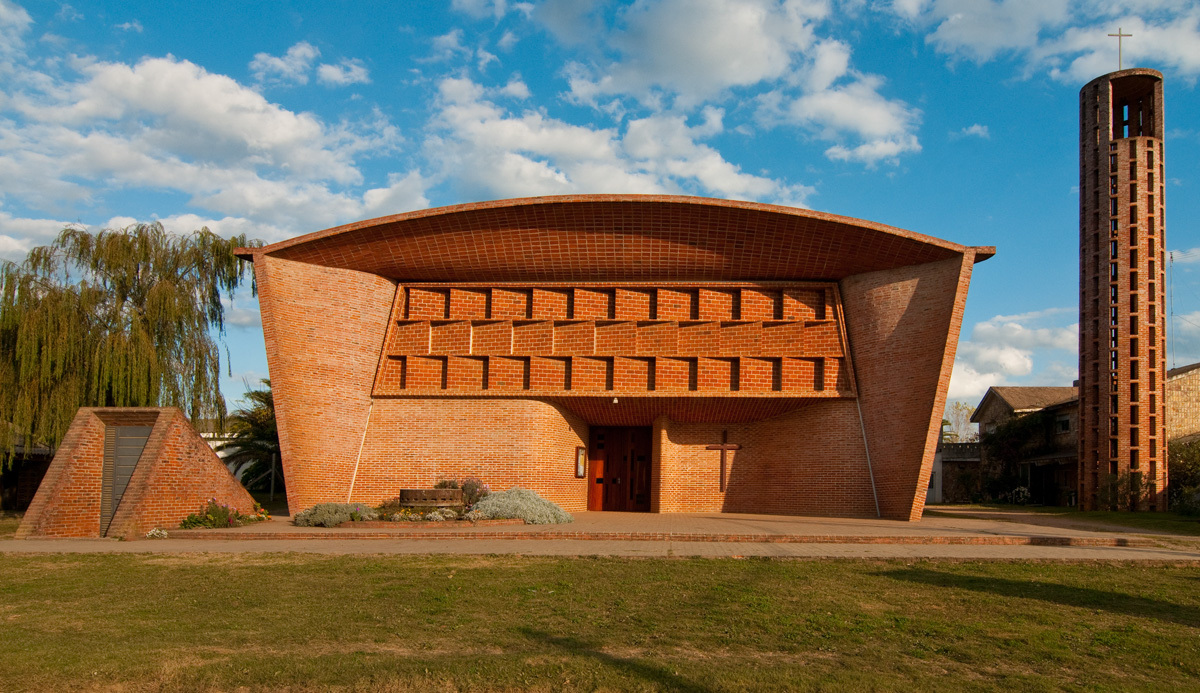
© Nicolas Barriola, CC BY-SA 3.0 Resized from original. (This derivative is under the same CC BY-SA license.)
World Heritage Research
Discover scientific research and academic studies that deepen our understanding of The work of engineer Eladio Dieste: Church of Atlántida from its history and significance to its conservation, management, and contemporary challenges.
-
Evaluating Digital Tool’s Integration for the Preservation of XX century Architectures
A robust, multi-tool digital documentation approach enhances the preservation of twentieth-century architectural landmarks, as demonstrated by a case study on Eladio Dieste's UNESCO-listed Church of Atlántida. The research reveals that while SLAM-based methods show greater deviation, they remain valuable for initial surveys or confined spaces, whereas photogrammetry excels in capturing unreachable features, complementing laser scanning's precision. By integrating these tools and aligning their data sets with scalar fields to trace reliability, the study proposes a replicable workflow that improves data quality and supports sustainable conservation practices.
Rossato, L., Zaffagnini, T., Giau, G., & Planu, F. (2025). Evaluating Digital Tool’s Integration for the Preservation of XX century Architectures. The International Archives of the Photogrammetry, Remote Sensing and Spatial Information Sciences, XLVIII-M-9-2025, 1309–1315. https://doi.org/10.5194/isprs-archives-xlviii-m-9-2025-1309-2025
View Publication Record | Read Publication -
Revisiting Eladio Dieste’s Walls Through Digital Design and Simulation Technologies: A Case on Atlántida Church
A groundbreaking study leverages digital design and simulation technologies to redefine the potential of brick, one of humanity's oldest materials, in modern architecture. Focusing on Eladio Dieste’s innovative structure at Atlántida Churchthe research demonstrates how computational methods can unlock new understandings of masonry, particularly in complex surface formation. By integrating digital tools with traditional brickwork, the study reveals novel tectonic possibilities that challenge conventional architectural paradigms. This approach not only preserves Dieste’s legacy but also offers a scalable model for future designs, bridging historical techniques with cutting-edge technology.
Kara, C. E., Selçuk, S. A., Akan, A. E., & Unay, A. I. (2024). Revisiting Eladio Dieste’s Walls Through Digital Design and Simulation Technologies: A Case on Atlántida Church. Civil Engineering and Architecture, 12(5), 3414–3425. https://doi.org/10.13189/cea.2024.120521
View Publication Record | Read Publication -
The Architectural Geometry of the Church of Cristo Obrero y Nuestra Señora de Lourdes
The Church of Cristo Obrero y Nuestra Señora de Lourdes, designed by Uruguayan engineer Eladio Dieste between 1956 and 1960, showcases groundbreaking architectural geometry through its continuous Gaussian vaults and ruled surfaces. This study verifies the intricate geometrical relationships within these structural elements, contributing significantly to the understanding of Dieste's innovative approach to reinforced brickwork. The research employed in situ analysis, consultation of original construction drawings, and parametric modeling techniques to dissect the church's design. Recognized as a UNESCO World Heritage Site in 2021, this study also aims to promote Latin-American modern architectural heritage within European academic circles and foster digital design technologies in regional research centers.
Melachos, F. C., Florio, W., Rossato, L., & Maietti, F. (2023). THE ARCHITECTURAL GEOMETRY OF THE CHURCH OF CRISTO OBRERO Y NUESTRA SEÑORA DE LOURDES. The International Archives of the Photogrammetry, Remote Sensing and Spatial Information Sciences, XLVIII-M-2-2023, 1059–1066. https://doi.org/10.5194/isprs-archives-xlviii-m-2-2023-1059-2023
View Publication Record | Read Publication -
Dieste y Montañez e o desenvolvimentismo no Brasil
The Dieste y Montañez (DyM) office's innovative use of reinforced ceramics significantly impacted Brazil's architectural landscape during the 1960s to 1980s, coinciding with its economic boom. This system, recognized as part of UNESCO World Heritage Site with the Church of Atlántida, spread widely due to its cost efficiency and structural advantages. The study reveals that DyM's projects, including religious works, warehouses, and grain silos, often relied on state patronage, highlighting a unique intersection between architecture and state policy during Brazil's developmental surge. The research approach combines historical analysis with architectural assessment, emphasizing the system's dissemination and its broader socio-political context.
Suzuki, J. H., & Segawa, H. (2023). Dieste y Montañez e o desenvolvimentismo no Brasil (I. R. Giroto, Ed.). IAU e FAU — Universidade de São Paulo. https://doi.org/10.5281/ZENODO.19069567
View Publication Record | Read Publication -
Non-destructive evaluation of a dieste’s historical reinforced brick masonry church
A non-destructive evaluation of Eladio Dieste's Church of Christ the Worker in Atlántida, Uruguay, reveals the church's impressive state of preservation despite showing early signs of aging. The study, conducted under UNESCO's Keeping It Modern program, applied techniques such as infrared thermography, ground-penetrating radar, penetration resistance, and ultrasonic testing to assess the structure's conservation. Findings indicate common deterioration mechanisms like moisture presence, steel bar corrosion, and mortar degradation, yet the church remains well-preserved, highlighting Dieste's innovative reinforced brick masonry (RBM) design and construction.
Domenech, L. D., Spalvier, A., Moltini, G., Aulet, A. B., & Cetrangolo, G. P. (2017). Non-destructive evaluation of a dieste’s historical reinforced brick masonry church. International Journal of Heritage Architecture: Studies, Repairs and Maintence, 2(1), 115–127. https://doi.org/10.2495/ha-v2-n1-115-127
View Publication Record | Read Publication -
Os casos das igrejas de Eladio Dieste em Atlântida e Durazno
Uruguayan engineer Eladio Dieste's innovative use of reinforced brick in architectural design, particularly in his two emblematic churches—Cristo Obrero in Atlántida (1958–60) and San Pedro in Durazno (1969–71)—challenges conventional engineering norms while achieving structural efficiency and aesthetic sophistication. Dieste's approach, rooted in the physical properties of brick and steel, subverted traditional construction standards by prioritizing fundamental principles over pragmatic solutions. His method, combining an innovative calculation technique with industrialized construction processes, allowed for the creation of complex, durable structures that transcend typical engineering constraints. The churches exemplify his mastery of light manipulation, proportional design, and symbolic material use, where brick serves as both a structural and aesthetic element, embodying a locally adapted modernity.
Fitz, L. (2013). Os casos das igrejas de Eladio Dieste em Atlântida e Durazno (C. E. Comas, C. C. Cabral, & A. Cattani, Eds.). Núcleo Docomomo RS / PROPAR-UFRGS. https://doi.org/10.5281/ZENODO.19291964
View Publication Record | Read Publication