World Heritage Identification Number: 648
World Heritage since: 1993
Category: Cultural Heritage
WHE Type: Buildings & Architectural Ensembles
Transboundary Heritage: No
Endangered Heritage: No
Country: 🇵🇾 Paraguay
Continent: Americas
UNESCO World Region: Latin America and the Caribbean
Map
Jesuit Missions of La Santísima Trinidad de Paraná and Jesús de Tavarangue: A Testament to Colonial Christianity in South America
The Jesuit Missions of La Santísima Trinidad de Paraná and Jesús de Tavarangue, situated in the Itapúa Department of Paraguay, stand as a testament to the profound impact of colonial Christianity in South America. Inscribed as a UNESCO World Heritage Site in 1993, these religious complexes offer a unique glimpse into the Jesuit missionaries' endeavors during the 17th and 18th centuries.
La Santísima Trinidad de Paraná, founded in 1706 and moved to its current location in 1712, was one of the most significant Jesuit missions in the Río de la Plata basin. Its name reflects the centrality of the Holy Trinity in the mission's teachings. The mission was designed as a self-contained community, with a church, residences, workshops, and communal areas. Notably, the mission's layout followed a formal grid plan reflecting European urban ideals and facilitating social organization and communal life.
Jesús de Tavarangue, established in 1685 and relocated several times, shares many architectural and organizational features with La Santísima Trinidad. Like its counterpart, Jesús de Tavarangue was also planned meticulously, featuring a church, residences, and workshops. However, unlike its larger counterpart, Jesús de Tavarangue was never fully completed. Its monumental church remains unfinished, yet it stands as an impressive example of Jesuit-Guaraní Baroque architecture.
Both missions were built primarily by the Guaraní people, who were attracted to the Jesuit missionaries due to their promise of protection, education, and spiritual guidance. The Guaraní were encouraged to adopt European agricultural techniques, such as the cultivation of wheat, corn, and livestock farming. This shift towards European agriculture allowed the missions to become relatively self-sufficient, reducing their reliance on external trade and resources.
Education played a central role in mission life. The Jesuits promoted literacy and vocational training, establishing schools where instruction was primarily conducted in the Guaraní language, alongside religious education, music, craftsmanship, and basic sciences. While Latin was used mainly for ecclesiastical purposes, the Jesuits’ use of Guaraní helped preserve the language and facilitated cultural continuity within the indigenous communities.
However, the Jesuit missions faced numerous challenges throughout their history. The missions were were threatened by colonial rivalries eeking to exploit the region's natural resources and by Portuguese slave raiders known as bandeirantes. In 1767, the Jesuit Order was expelled from Spanish territories by royal decree of the Spanish Crown, leading to the rapid decline and eventual abandonment of many missions, including La Santísima Trinidad and Jesús de Tavarangue.
Today, these two missions serve as important historical landmarks, offering insights into the complex interplay between colonialism, Christian missionary activity, and indigenous societies in South America. Their inclusion as a UNESCO World Heritage Site underscores their significance not only as architectural marvels but also as living testimonies to the enduring symbols of the Jesuit-Guaraní experience and its continuing influence on the cultural identity of modern Paraguay.
UNESCO Description of the World Heritage Site
In addition to their artistic interest, these missions are a reminder of the Jesuits' Christianization of the Río de la Plata basin in the 17th and 18th centuries, with the accompanying social and economic initiatives.
UNESCO Justification of the World Heritage Site
Criterion (iv) : La Santísima Trinidad de Paraná and Jesús de Tavarangue are exceptional examples of the Jesuit missions built in the 17th and 18th centuries throughout this region. The archaeological ruins of these urban complexes represent a fusion of cultures in which the process of Christianisation permitted the indigenous population to retain elements of their traditional culture.
Encyclopedia Record: Jesuit Missions of La Santísima Trinidad de Paraná and Jesús de Tavarangue
The Jesuit Missions of La Santísima Trinidad de Paraná and Jesús de Tavarangue are located in the Itapúa Department, Paraguay, and are religious missions that are still preserved and that were founded by the Jesuit missioners during the colonization of South America in the 17th century. These religious missions were created in 1609 and developed for 150 years. Both Jesuit missions were declared World Heritage Site by the UNESCO in 1993.Additional Site Details
Area: 27.88 hectares
Number of Components: 2
Coordinates: -27.131613 , -55.702672
Image
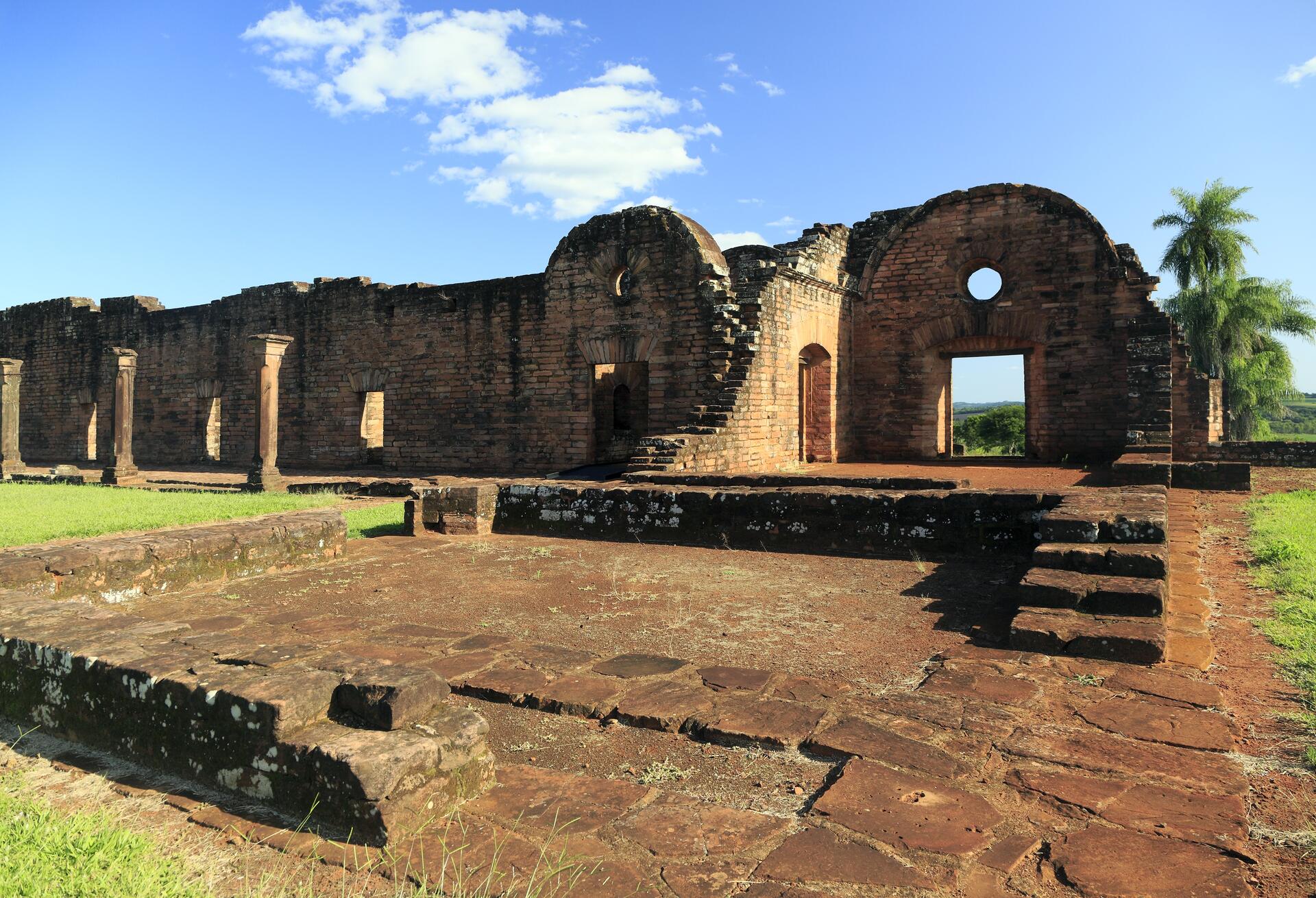
© Falk2, CC BY-SA 4.0 Resized from original. (This derivative is under the same CC BY-SA license.)