
World Heritage Identification Number: 1237
World Heritage since: 2009
Category: Natural Heritage
WHE Type: Natural Landscapes & Geographic Features
Transboundary Heritage: No
Endangered Heritage: No
Country: 🇮🇹 Italy
Continent: Europe
UNESCO World Region: Europe and North America
Map
The Dolomites: A Geological Marvel in the Italian Alps
The Dolomites, officially recognized as a UNESCO World Heritage Site since 2009, stand as a testament to the breathtaking beauty and geological complexity of the Italian Alps. This mountain range, spanning across the regions of Veneto, Trentino-Alto Adige/Südtirol, and Friuli-Venezia Giulia, offers a unique blend of stunning landscapes, rich history, and scientific importance.
Covering an expansive area of approximately 141,903 hectares, the Dolomites encompass eighteen peaks that tower above 3,000 meters. Among them, Marmolada—frequently referred to as the “Queen of the Dolomites”—is the highest peak, reaching 3,343 meters at Punta Penìa. The region's topography is characterized by vertical walls, sheer cliffs, and a high density of narrow, deep, and long valleys, creating a dramatic and awe-inspiring visual spectacle.
One of the key attributes that led to the Dolomites’ designation as a World Heritage Site is their exceptional geomorphology. The area presents a variety of spectacular landscapes, including steeples, pinnacles, and extensive rock walls, all of which are significant on an international scale for their geological value. These landscapes are the result of dynamic natural processes, including erosion, landslides, floods, and avalanches, which continue to shape the Dolomites and contribute to their evolving character.
In addition to their geomorphological features, the Dolomites contain numerous glacial landforms and well-developed karst systems. Glaciers have played a crucial role in shaping the landscape over millennia, carving deep valleys and sculpting many of the landforms visible today. Karst systems, formed by the dissolution of soluble carbonate rocks such as limestone and dolomite, are widespread and include caves, sinkholes, fissures, and underground drainage networks, offering valuable insights into the region’s geological history.
Another significant aspect of the Dolomites is their exceptional preservation of Mesozoic carbonate platform systems, particularly those dating to the Triassic period - roughly 250 to 200 million years ago. These ancient reef structures and associated sedimentary layers contain rich fossil assemblages that document marine life and environmental conditions from over 200 million years ago, making the site essential for paleontological research. The fossil record preserved in the Dolomites has played a key role in advancing scientific understanding of reef evolution, plate tectonics, and mountain-building processes.
Beyond their geological and scientific significance, the Dolomites also hold cultural and historical importance. The region has been inhabited for thousands of years, with evidence of human activity dating back to the Bronze Age. Over time, diverse cultural influences—including Roman, Ladin, Venetian, and Austro-Hungarian—have left their marks on the Dolomites, resulting in a rich tapestry of architecture, art, and land-use practices.
Today, the Dolomites continue to captivate visitors from around the world. Whether hiking through the picturesque valleys, exploring ancient villages, or witnessing the dramatic play of light on the pale rock faces, the mountain range offers an unparalleled experience that transcends mere tourism. As a UNESCO World Heritage Site, the Dolomites stand as a powerful reminder of the Earth’s geological history, natural beauty, and the importance of safeguarding such extraordinary landscapes for future generations.
UNESCO Description of the World Heritage Site
The site of the Dolomites comprises a mountain range in the northern Italian Alps, numbering 18 peaks which rise to above 3,000 metres and cover 141,903 ha. It features some of the most beautiful mountain landscapes anywhere, with vertical walls, sheer cliffs and a high density of narrow, deep and long valleys. A serial property of nine areas that present a diversity of spectacular landscapes of international significance for geomorphology marked by steeples, pinnacles and rock walls, the site also contains glacial landforms and karst systems. It is characterized by dynamic processes with frequent landslides, floods and avalanches. The property also features one of the best examples of the preservation of Mesozoic carbonate platform systems, with fossil records.
UNESCO Justification of the World Heritage Site
Criterion (vii): The Dolomites are widely regarded as being among the most attractive mountain landscapes in the world. Their intrinsic beauty derives from a variety of spectacular vertical forms such as pinnacles, spires and towers, with contrasting horizontal surfaces including ledges, crags and plateaux, all of which rise abruptly above extensive talus deposits and more gentle foothills. A great diversity of colours is provided by the contrasts between the bare pale-coloured rock surfaces and the forests and meadows below. The mountains rise as peaks with intervening ravines, in some places standing isolated but in others forming sweeping panoramas. Some of the rock cliffs here rise more than 1,500 m and are among the highest limestone walls found anywhere in the world. The distinctive scenery of the Dolomites has become the archetype of a “dolomitic landscape”. Geologist pioneers were the first to be captured by the beauty of the mountains, and their writing and subsequent painting and photography further underline the aesthetic appeal of the property.
Criterion (viii): The Dolomites are of international significance for geomorphology, as the classic site for the development of mountains in dolomitic limestone. The area presents a wide range of landforms related to erosion, tectonism and glaciation. The quantity and concentration of extremely varied limestone formations is extraordinary in a global context, including peaks, towers, pinnacles and some of the highest vertical rock walls in the world. The geological values are also of international significance, notably the evidence of Mesozoic carbonate platforms, or “fossilized atolls”, particularly in terms of the evidence they provide of the evolution of the bio-constructors after the Permian/Triassic boundary, and the preservation of the relationships between the reefs they constructed and their surrounding basins. The Dolomites also include several internationally important type sections for the stratigraphy of the Triassic Period. The scientific values of the property are also supported by the evidence of a long history of study and recognition at the international level. Taken together, the combination of geomorphological and geological values creates a property of global significance.
Encyclopedia Record: Dolomites
The Dolomites or Pale Mountains are a mountain range in northeastern Italy. They form part of the Southern Limestone Alps and extend from the river Adige in the west to the Piave Valley in the east. The northern and southern borders are defined by the Puster Valley and the Sugana Valley. The Dolomites are in the regions of Veneto, Trentino-Alto Adige/Südtirol and Friuli-Venezia Giulia, covering an area shared between the provinces of Belluno, Vicenza, Verona, Trentino, South Tyrol, Udine and Pordenone.Additional Site Details
Area: 141,902.8 hectares
Number of Components: 9
(viii) — Outstanding example representing major earth stages
Coordinates: 46.6130555556 , 12.1630555556
IUCN World Heritage Outlook
The 2025 Conservation Outlook on The Dolomites reports the following assessment:
Source: International Union for Conservation of Nature (IUCN) · View assessment
Image
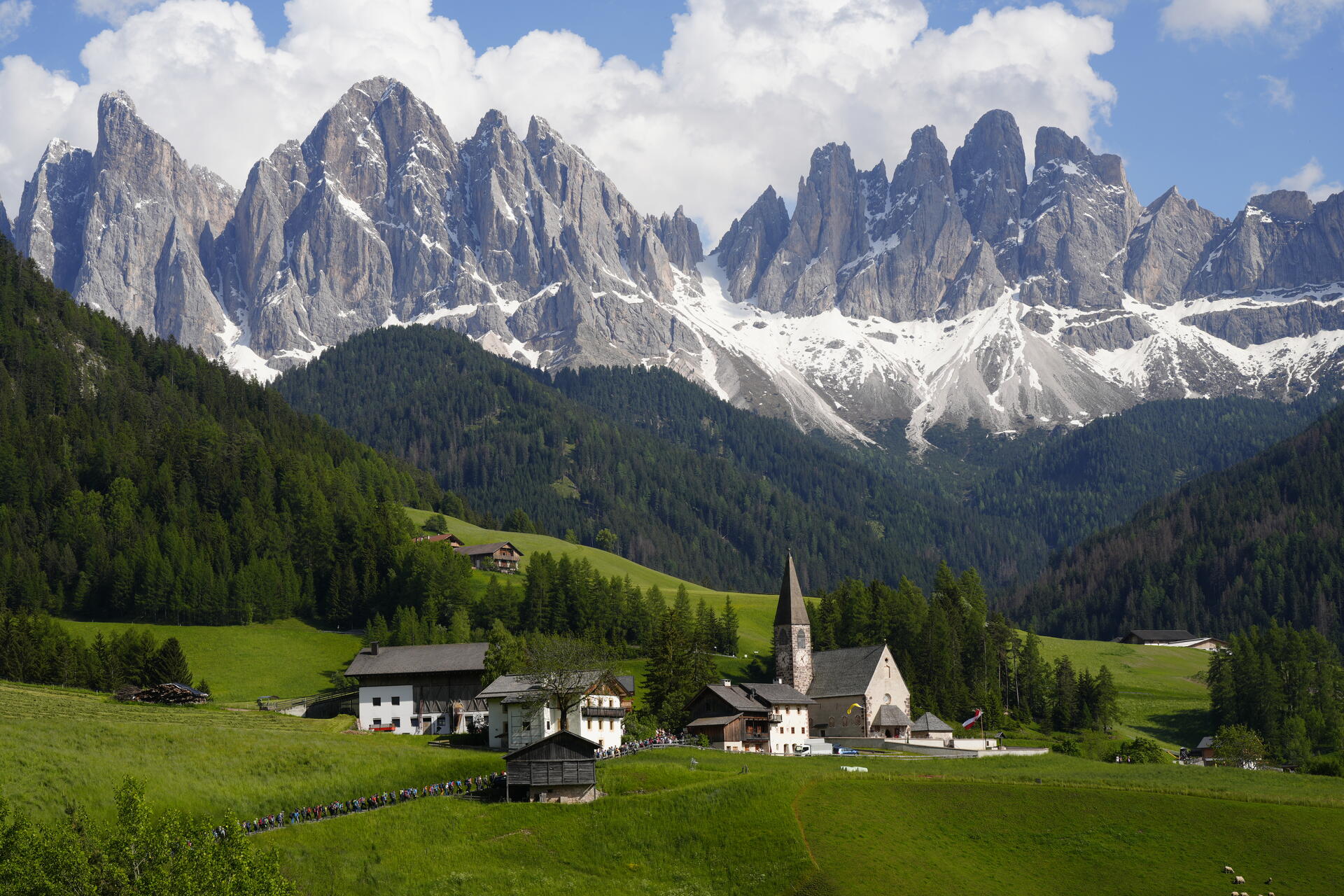
© Chensiyuan, CC BY-SA 4.0 Resized from original. (This derivative is under the same CC BY-SA license.)