World Heritage Identification Number: 712
World Heritage since: 1994
Category: Cultural Heritage
WHE Type: Historic Cities & Urban Areas
Transboundary Heritage: No
Endangered Heritage: No
Country: 🇮🇹 Italy
Continent: Europe
UNESCO World Region: Europe and North America
Map
City of Vicenza and the Palladian Villas of the Veneto: A Legacy of Classical Architecture
The City of Vicenza and the Palladian Villas of the Veneto, inscribed on the World Heritage List in 1994, stands as a testament to the enduring legacy of Andrea Palladio, one of the most influential architects in Western history. This Italian site encompasses not only the urban fabric of Vicenza but also a series of villas scattered across the Veneto region, each embodying Palladio's distinctive blend of classical Roman architecture and innovative design principles.
More to come…UNESCO Description of the World Heritage Site
Founded in the 2nd century B.C. in northern Italy, Vicenza prospered under Venetian rule from the early 15th to the end of the 18th century. The work of Andrea Palladio (1508–80), based on a detailed study of classical Roman architecture, gives the city its unique appearance. Palladio's urban buildings, as well as his villas, scattered throughout the Veneto region, had a decisive influence on the development of architecture. His work inspired a distinct architectural style known as Palladian, which spread to England and other European countries, and also to North America.
UNESCO Justification of the World Heritage Site
Criterion (i): Vicenza represents a unique artistic achievement in the many architectural contributions of Andrea Palladio, integrated within its historic fabric and creating its overall character. Scattered in the Veneto, the Palladian villas are the result of this Renaissance master’s architectural genius. The numerous variations of the villa pattern are evidence of Palladio’s constant typological experimentation, carried out by means of the reworking of classical architecture patterns.
Criterion (ii): Palladio’s works in the city of Vicenza and in the Veneto, inspired by classical architecture and characterized by incomparable formal purity, have exerted exceptional influence on architectural and urban design in most European countries and throughout the world, giving rise to Palladianism, a movement named after the architect and destined to last for three centuries.
Encyclopedia Record: City of Vicenza and the Palladian Villas of the Veneto
City of Vicenza and the Palladian Villas of the Veneto is a World Heritage Site in Italy, which protects buildings by the architect Andrea Palladio. UNESCO inscribed the site on the World Heritage List in 1994. At first the site was called "Vicenza, City of Palladio" and only buildings in the immediate area of Vicenza were included.Additional Site Details
Area: 333.87 hectares
Number of Components: 25
(ii) — Significant interchange of human values
Coordinates: 45.54916667 , 11.54944444
Image
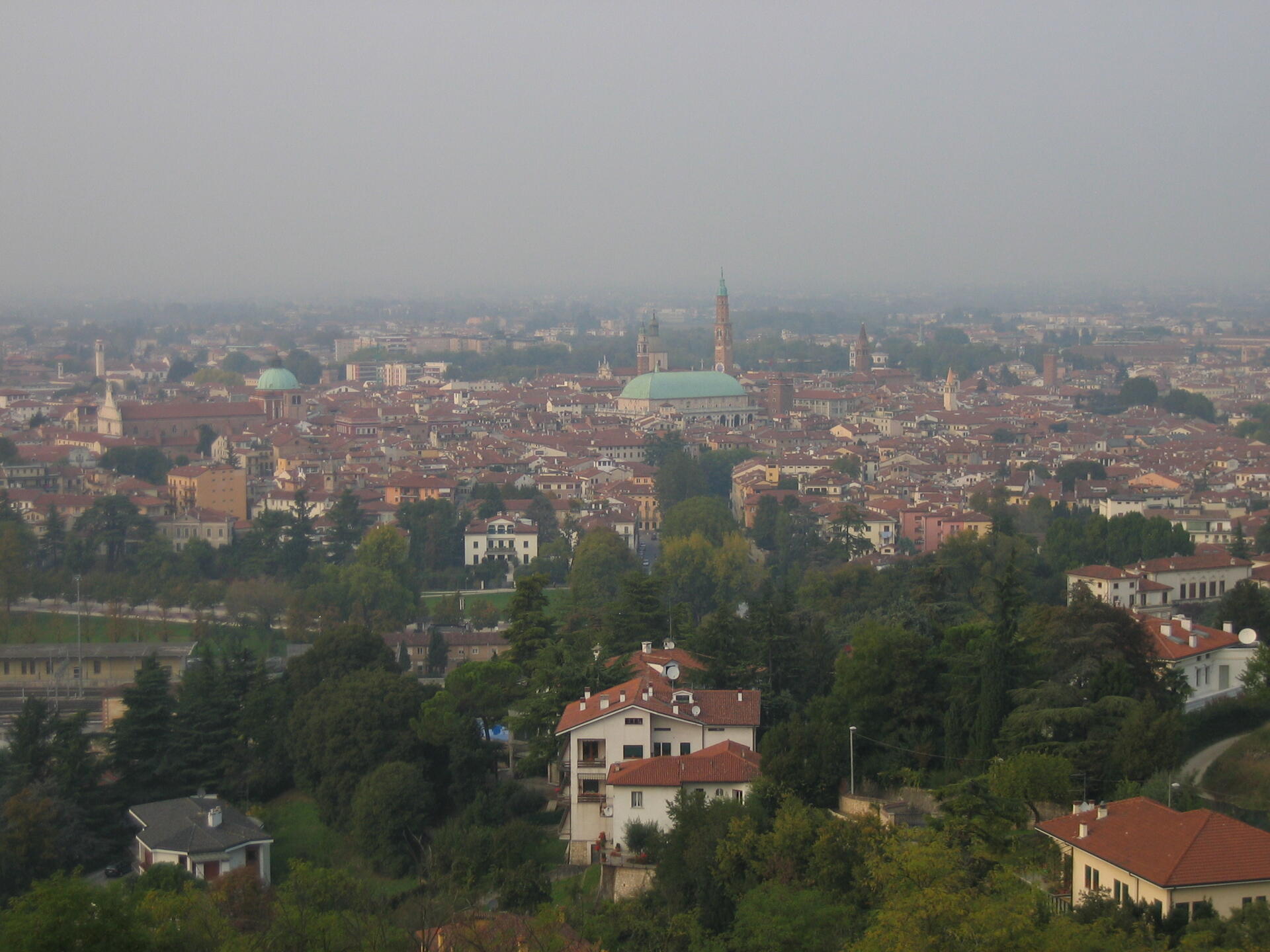
© Original uploader was Mhwater at nl.wikipedia, CC BY-SA 3.0 Resized from original. (This derivative is under the same CC BY-SA license.)
World Heritage Research
Discover scientific research and academic studies that deepen our understanding of City of Vicenza and the Palladian Villas of the Veneto from its history and significance to its conservation, management, and contemporary challenges.
-
Nexus 2025. Relations Between Architecture and Mathematics
Nexus 2025: Relationships Between Architecture and Mathematics, held in Vicenza, Italy (June 3–6, 2025), explored the profound interplay between architectural design and mathematical principles, particularly through the lens of Andrea Palladio’s work. The conference highlighted how mathematical concepts—such as symmetry, proportion, and geometric patterns—underpin the aesthetic and structural integrity of Palladian architecture. By analyzing historical villas in the Veneto region, researchers demonstrated that Palladio’s designs were not merely artistic but rooted in rigorous mathematical reasoning, influencing both form and function. This interdisciplinary approach offers new insights into the fusion of art and science in UNESCO-listed heritage sites.
Zack, M. (2026). Nexus 2025. Relations Between Architecture and Mathematics [JD]. diségno, 17, 353–354. https://doi.org/10.26375/disegno.17.2025.35
View Publication Record | Read Publication -
Grain merchants and famines in late Renaissance
A study of grain trade and victualling systems in late Renaissance Veneto reveals that while cities and merchants relied on established procedures during food shortages, population growth and market closures necessitated adaptations. Using public records like council rolls and municipal accounts, alongside private notarial documents, researchers analyzed the careers of two key merchants—Giovanni Maria Mersi from Padua and Simone Barana—to illustrate how selective application of regulations shaped grain supply strategies. Barana's probate inventory provides rare insight into a merchant's operations during this period. The research challenges a one-dimensional view of grain trade, highlighting its complexity and the dynamic interplay between policy and practice.
Vianello, F. (2025). Grain merchants and famines in late Renaissance. A History of the Global Wheat Trade, 15–30. https://doi.org/10.4324/9781032642369-3
View Publication Record | Read Publication -
The estimi of the Republic of Venice as a resource for studying social mobility in rural areas during the pre-industrial era
Rural communities in the Republic of Venice, particularly those in Vicenza, offer unprecedented insights into social mobility during the pre-industrial era. Tax registers, known as 'estimi,' reveal detailed and precise data on social changes due to their annual revisions. These records, managed with significant local autonomy after Venice's control over the Mainland in the 15th century, provide a unique lens for analyzing social dynamics. The study leverages methodologies developed within the SMITE project to reconstruct mobility patterns, offering valuable evidence for understanding societal evolution in rural areas during this period.
Viale, M. (2025). The estimi of the Republic of Venice as a resource for studying social mobility in rural areas during the pre-industrial era. La Mobilità Sociale Nelle Società Preindustriali: Tendenze, Cause Ed Effetti (Secc. XIII-XVIII) / Social Mobility in Pre-Industrial Societies: Tendencies, Causes and Effects (13th-18th Centuries), 119–131. https://doi.org/10.36253/979-12-215-0667-9.08
View Publication Record | Read Publication -
2010 Stolpersteine: Hamburg and Other European Cities
A notable discovery from the City of Vicenza and the Palladian Villas of the Veneto involves the presence of 'Stolpersteine'—small brass plaques embedded in pavements across Europe, commemorating victims of the Holocaust. These 10 cm × 10 cm stones, initiated by German artist Gunter Demnig, serve as a permanent and individual memorial for those arrested or deported during World War II, often with unknown fates. In Vicenza, these plaques detail the lives, arrests, deportations, and deaths of local individuals, such as Angela Caivano Orvieto and Torquato Fraccon, who were deported to Auschwitz and Mauthausen respectively. The study highlights the Stolpersteine's role in preserving historical memory through an accessible, tactile medium, contrasting with traditional monuments. This approach ensures that the stories of victims are directly linked to their former homes, fostering a profound and personal connection for passersby.
Davis, H. (2025). 2010 Stolpersteine: Hamburg and Other European Cities. Encounters with Architecture, 228–230. https://doi.org/10.4324/9781003594598-81
View Publication Record | Read Publication -
Report on UNESCO's awareness raising and capacity building actions in the SmartCulTour Living Labs
UNESCO's capacity-building initiatives within the SmartCulTour Living Labs, spanning six regions including Vicenza (Italy), demonstrated that participatory and context-specific approaches can effectively integrate culture and tourism into sustainable local development. The report highlights the importance of stakeholder engagement in tailoring training programs to address knowledge gaps and foster dialogue among diverse actors, such as destination management organizations (DMOs) and cultural heritage practitioners. Preliminary findings suggest that while immediate impacts are limited, these initiatives lay a foundation for long-term, scalable improvements in cultural tourism performance. The study underscores the potential of soft capacity-building methods—focusing on networking and exchange—to drive sustainable growth at regional levels.
Fidelbo, C., Rosati, M., Debrine, P., Nikolić Đerić, T., Petrić, L., Mandić, A., Björn, E., Lozano, D., Kerst, I., Neuts, B., Lioce, R., & Bettin, M. (2023). Report on UNESCO's awareness raising and capacity building actions in the SmartCulTour Living Labs. https://doi.org/10.5281/ZENODO.8080105
View Publication Record | Read Publication -
Tra spezie e spie: Filippo Pigafetta nel Mediterraneo del Cinquecento
Filippo Pigafetta, a Vicentine scholar and soldier of the 16th century, played a significant role in trans-Mediterranean networks as an 'explorer, informer, and spy,' contributing to military knowledge during a period marked by conflict with the Ottoman Empire. His career, peaking between 1576 and 1587, involved extensive travel across key Mediterranean cities, including Suez, London, Madrid, Lisbon, Rome, Jerusalem, and Venice, where he engaged with exiled scholars and religious figures like Giovanni Battista Castagna (later Pope Urban VII). Pigafetta's work as a translator and author of military treatises reflected his deep interest in warfare, while his connections to Vicenza's intellectual circles—such as the Accademia Olimpica and Accademia dei Costanti—highlighted his broader engagement with Renaissance scholarly networks. This study sheds light on the informal diplomacy and transnational exchanges that characterized early modern Europe.
Fletcher, C. (2023). : Tra spezie e spie: Filippo Pigafetta nel Mediterraneo del Cinquecento. Renaissance Quarterly, 76(3), 1128–1129. https://doi.org/10.1017/rqx.2023.451
View Publication Record | Read Publication -
An utopia made true
A groundbreaking study challenges the traditional notion of architectural patronage, revealing that the creation of two pioneering parish communities in Vicenza and Arzignano during the 1950s-60s was a collaborative effort involving clergy, architects, and faithful. The research demonstrates that these projects, rooted in biblical and liturgical traditions, transcended conventional church design to redefine communal worship experiences. By analyzing documentary sources, architectural plans, and testimonies, the study highlights the inadequacy of attributing sole authorship to architects, instead advocating for concepts like nascent state and charisma from social sciences and psychology to better understand these innovative ecclesiastical spaces.
Leto, F., & Comiati, G. A. (2023). Una utopía hecha realidad. Actas de Arquitectura Religiosa Contemporánea, 10, 110–123. https://doi.org/10.17979/aarc.2023.10.0.10185
View Publication Record | Read Publication