World Heritage Identification Number: 1298
World Heritage since: 2009
Category: Cultural Heritage
WHE Type: Buildings & Architectural Ensembles
Transboundary Heritage: No
Endangered Heritage: No
Country: 🇧🇪 Belgium
Continent: Europe
UNESCO World Region: Europe and North America
Map
Stoclet House: A Masterpiece of the Vienna Secession
The Stoclet House, located in Woluwe-Saint-Pierre, a municipality of Brussels, Belgium, stands as a testament to the artistic renewal that swept through European architecture at the turn of the 20th century. Commissioned by the Belgian financier Adolphe Stoclet in 1905, the Stoclet House was designed by the Austrian architect Josef Hoffmann, marking a significant milestone in the Vienna Secession movement.
More to come…UNESCO Description of the World Heritage Site
When banker and art collector Adolphe Stoclet commissioned this house from one of the leading architects of the Vienna Secession movement, Josef Hoffmann, in 1905, he imposed neither aesthetic nor financial restrictions on the project. The house and garden were completed in 1911 and their austere geometry marked a turning point in Art Nouveau, foreshadowing Art Deco and the Modern Movement in architecture. Stoclet House is one of the most accomplished and homogenous buildings of the Vienna Secession, and features works by Koloman Moser and Gustav Klimt, embodying the aspiration of creating a ‘total work of art' (Gesamtkunstwerk). Bearing testimony to artistic renewal in European architecture, the house retains a high level of integrity, both externally and internally as it retains most of its original fixtures and furnishings.
UNESCO Justification of the World Heritage Site
Criterion (i): Created under the supervision of the architect and interior designer Josef Hoffmann, the Stoclet House is a masterpiece of the creative genius of the Vienna Secession through its aesthetic and conceptual programme of Gesamtkunstwerk, through its architectural vocabulary, through its originality, and through the exceptional quality of its decoration, of its furniture, of its works of art and of its garden. It is a remarkably well conserved symbol of constructive and aesthetic modernity in the west at the start of the 20th century.
Criterion (ii): Drawing on the values of the Vienna Secession and its many artists, including Koloman Moser and Gustav Klimt, the Stoclet House was recognised from the beginning as one of the most representative and refined works of this school. Created in Brussels, a key location for Art Nouveau, it exercised a considerable influence on modernism in architecture and on the birth of Art Deco.
Encyclopedia Record: Stoclet Palace
The Stoclet Palace, also known as the Stoclet House, is a historic mansion in Woluwe-Saint-Pierre, a municipality of Brussels, Belgium. It was designed by the Austrian architect Josef Hoffmann for the Belgian financier Adolphe Stoclet, and built between 1905 and 1911, in the Vienna Secession style. Considered Hoffman's masterpiece, the residence is one of the 20th century's most refined and luxurious private houses.Additional Site Details
Area: 0.86 hectares
Number of Components: 1
(ii) — Significant interchange of human values
Coordinates: 50.835 , 4.4161111111
Image
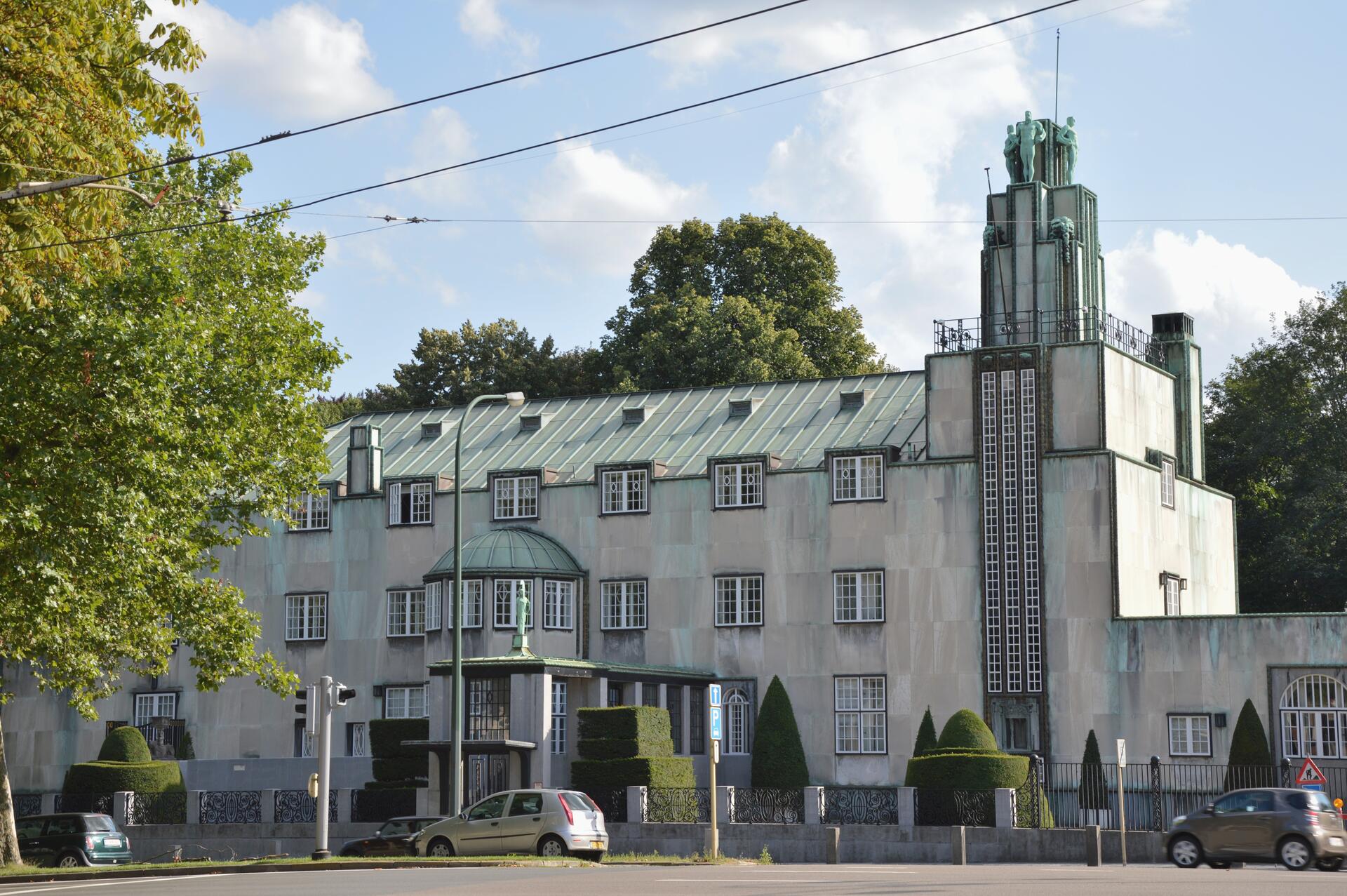
© Busoni, CC BY-SA 3.0 Resized from original. (This derivative is under the same CC BY-SA license.)
World Heritage Research
Discover scientific research and academic studies that deepen our understanding of Stoclet House from its history and significance to its conservation, management, and contemporary challenges.
-
Building a Reflexive Space for Scientific Dialogue through the Digital Reconstruction Case of the Palais Stoclet Dining Room
A novel method for visualizing evidential proximity in digital architectural reconstructions has been developed, enabling the representation of uncertainties and interpretive processes within 3D models. This approach, implemented using Blender's native tools, systematically evaluates historical sources based on their integration modes (transposition, interpretation, extrapolation) and embeds interpretive metadata directly into the model. Applied to the UNESCO-listed Palais Stoclet dining room—unaccessible for direct survey—the method enhances transparency and critical evaluation by framing reconstruction as a reflexive space for scientific dialogue. By mapping the distance between reconstructed geometry and documented sources, it addresses gaps in evidential support while projecting hypotheses across time.
Neaga, F.-T., Derycke, D., & Lo Buglio, D. (2026). Building a Reflexive Space for Scientific Dialogue through the Digital Reconstruction Case of the Palais Stoclet Dining Room. SHS Web of Conferences, 233, 3003. https://doi.org/10.1051/shsconf/202623303003
View Publication Record | Read Publication -
Charles Rennie Mackintosh ve Josef Hoffmann arasındaki tasarım etkileşimleri: Sanatsever Evi ve Stoclet Palas Örneği
Contrary to common belief, Josef Hoffmann's designs for the Stoclet Palace (1905–11) were not primarily influenced by Charles Rennie Mackintosh’s Art Nouveau works. Instead, evidence suggests a bidirectional exchange of design elements between the two architects. While Mackintosh’s earlier Art Nouveau-inspired House for an Art Lover (1901) shares geometric similarities with Stoclet Palace, Hoffmann had already employed comparable motifs in his prior work. The study challenges the notion that Glasgow’s influence preceded Vienna’s, revealing that Viyana Secession’s stylistic impact on Mackintosh was more pronounced and likely occurred earlier than previously assumed.
PFEİFFER-TAŞ, Ş., & KÖSE, M. (2023). Charles Rennie Mackintosh ve Josef Hoffmann arasındaki tasarım etkileşimleri: Sanatsever Evi ve Stoclet Palas Örneği. GRID - Architecture Planning and Design Journal. https://doi.org/10.37246/grid.1209968
View Publication Record | Read Publication -
Kinderkunst between Vienna and Brussels 1900
A study reveals that the Secessionist 'art for the child' movement, which drew inspiration from child art and folk aesthetics, may have paradoxically stifled children's innate creativity by surrounding them with a highly structured aesthetic system. This movement, evident in key commissions like the Palais Stoclet in Brussels, sought to nurture creativity through exposure to beauty but inadvertently created an environment that suppressed the childlike aesthetics modernists associated with vernacular folk art. The research examines this contradiction through an analysis of collecting practices and design spaces in Vienna and Brussels during 1900.
Brandow-Faller, M. (2021). Kinderkunst between Vienna and Brussels 1900. Brussels 1900 Vienna, 287–313. https://doi.org/10.1163/9789004459984_013
View Publication Record | Read Publication -
Viennese Secession and the Beginning of European Art Deco
The Viennese Secession marks a pivotal transition in decorative art, bridging the gap between Art Nouveau and the emergence of Art Deco. This study highlights how the Secession movement, particularly through its Vienna Workshop, synthesized diverse artistic forms into cohesive projects like the Purkersdorf Sanatorium and Palais Stoclet, exemplifying the Gesamtkunstwerk concept. While retaining elements of Art Nouveau's aesthetic, the movement shifted focus toward 'quality of life' and comfort, reflecting a pragmatic approach to decorating elite Viennese homes. The research emphasizes a notable evolution in artistic intent—from earlier modernist manifestos advocating for political engagement ('Art for the time') to a more self-referential stance ('Art never expresses anything but itself'), as articulated by key figures such as Josef Hoffmann, Koloman Moser, and Gustav Klimt.
Dobrydneva, A. S. (2020). VIENNESE SECESSION AND THE BEGINNING OF EUROPEAN ART DECO. Concept: Philosophy, Religion, Culture, (4), 191–199. https://doi.org/10.24833/2541-8831-2019-4-12-191-199
View Publication Record | Read Publication -
“I knew right from the start that the whole thing would be damned expensive” – Gustav Klimt’s Cartoons for the Stoclet Frieze: Their Creation, Execution, and Conservation, Part II
Gustav Klimt's cartoons for the Stoclet Frieze, created between 1910 and 1911, underwent a significant 'de-restoration' process to reverse earlier invasive treatments. These full-scale, 1:1 cartoons on paper, which served as templates for the mosaic frieze in the Stoclet House's dining room, were consolidated and mounted on acid-free honeycomb cardboard panels. This innovative approach allows the cartoons to be displayed side by side without interruption, forming an uninterrupted eleven-meter-long frieze within a climate-stabilized glass display case. Klimt's detailed instructions for material use and color shades, written directly onto the cartoons, played a crucial role in this conservation effort.
Murr, B. (2014). “I knew right from the start that the whole thing would be damned expensive” – Gustav Klimt’s Cartoons for the Stoclet Frieze: Their Creation, Execution, and Conservation, Part II. Restaurator. International Journal for the Preservation of Library and Archival Material, 35(1). https://doi.org/10.1515/res-2014-0003
View Publication Record | Read Publication -
Josef Hoffmann's unknown masterpiece: the garden of Stoclet House in Brussels (1905–1911)
Josef Hoffmann's design for the garden of Stoclet House, Brussels (1905–1911), stands as an underrecognized masterpiece that integrates art and life seamlessly. This study reveals how Hoffmann's garden, often overshadowed by the house itself, exemplifies his innovative approach to spatial harmony, blending modernist principles with natural elements. Through meticulous analysis of archival materials—including original sketches, photographs, and historical documents—the research reconstructs the garden's lost details, offering new insights into its architectural and aesthetic significance. The findings highlight Hoffmann's holistic vision, where the garden functioned as an extension of the house, creating a cohesive artistic experience that challenged conventional boundaries between interior and exterior spaces.
Freytag, A. (2010). Josef Hoffmann’s unknown masterpiece: the garden of Stoclet House in Brussels (1905–1911). Studies in the History of Gardens & Designed Landscapes, 30(4), 337–372. https://doi.org/10.1080/14601176.2010.485733
View Publication Record | Read Publication -
Restoration Program for the Marble Panels of the Stoclet Palace in Brussels / Programm für das Restaurieren der Marmorplatten am Stoclet Palast in Brüssel
A comprehensive restoration program for the marble panels of Stoclet Palace, a UNESCO World Heritage Site designed by architect Adolf Loos and artist Egon Schiele, was successfully implemented. The study identified critical degradation factors, including weathering, pollution, and structural damage, and developed targeted interventions to preserve the artistic integrity and historical value of the panels. Non-invasive diagnostic techniques, such as high-resolution imaging and material analysis, were employed to assess the condition of the marble without causing further harm. The restoration process prioritized minimal intervention while ensuring long-term stability, setting a benchmark for conserving modernist heritage structures.
Clercq, H. D., Jovanovi, M., Pien, A., & Vanhellemont, Y. (2010). Restoration Program for the Marble Panels of the Stoclet Palace in Brussels / Programm für das Restaurieren der Marmorplatten am Stoclet Palast in Brüssel. Restoration of Buildings and Monuments, 16(1), 3–14. https://doi.org/10.1515/rbm-2010-6347
View Publication Record | Read Publication