World Heritage Identification Number: 857
World Heritage since: 1998
Category: Cultural Heritage
WHE Type: Buildings & Architectural Ensembles
Transboundary Heritage: No
Endangered Heritage: No
Country: 🇧🇪 Belgium
Continent: Europe
UNESCO World Region: Europe and North America
Map
A Cultural Gem: La Grand-Place, Brussels - An Architectural Marvel and Historical Landmark
La Grand-Place, also known as the Grote Markt, stands as the central square of Brussels, the capital city of Belgium. This remarkable urban space, inscribed on the UNESCO World Heritage List in 1998, offers a captivating glimpse into the rich history, culture, and architectural prowess of the region during the late 17th century.
More to come…UNESCO Description of the World Heritage Site
La Grand-Place in Brussels is a remarkably homogeneous body of public and private buildings, dating mainly from the late 17th century. The architecture provides a vivid illustration of the level of social and cultural life of the period in this important political and commercial centre.
UNESCO Justification of the World Heritage Site
Criterion (ii): The Grand-Place is an outstanding example of the eclectic and highly successful blending of architectural and artistic styles that characterizes the culture and society of this region.
Criterion (iv): Through the nature and quality of its architecture and of its outstanding quality as a public open space, the Grand-Place illustrates in an exceptional way the evolution and achievements of a highly successful mercantile city of northern Europe at the height of its prosperity.
Encyclopedia Record: Grand-Place
The Grand-Place or Grote Markt is the central square of Brussels, Belgium. It is surrounded by opulent Baroque guildhalls of the former Guilds of Brussels and two larger edifices; the city's Flamboyant Town Hall, and the neo-Gothic King's House or Bread House building, containing the Brussels City Museum. The square measures 68 by 110 metres and is entirely paved.Additional Site Details
Area: 1.48 hectares
Number of Components: 1
(iv) — Outstanding example of a type of building or landscape
Coordinates: 50.84668 , 4.35242
Image
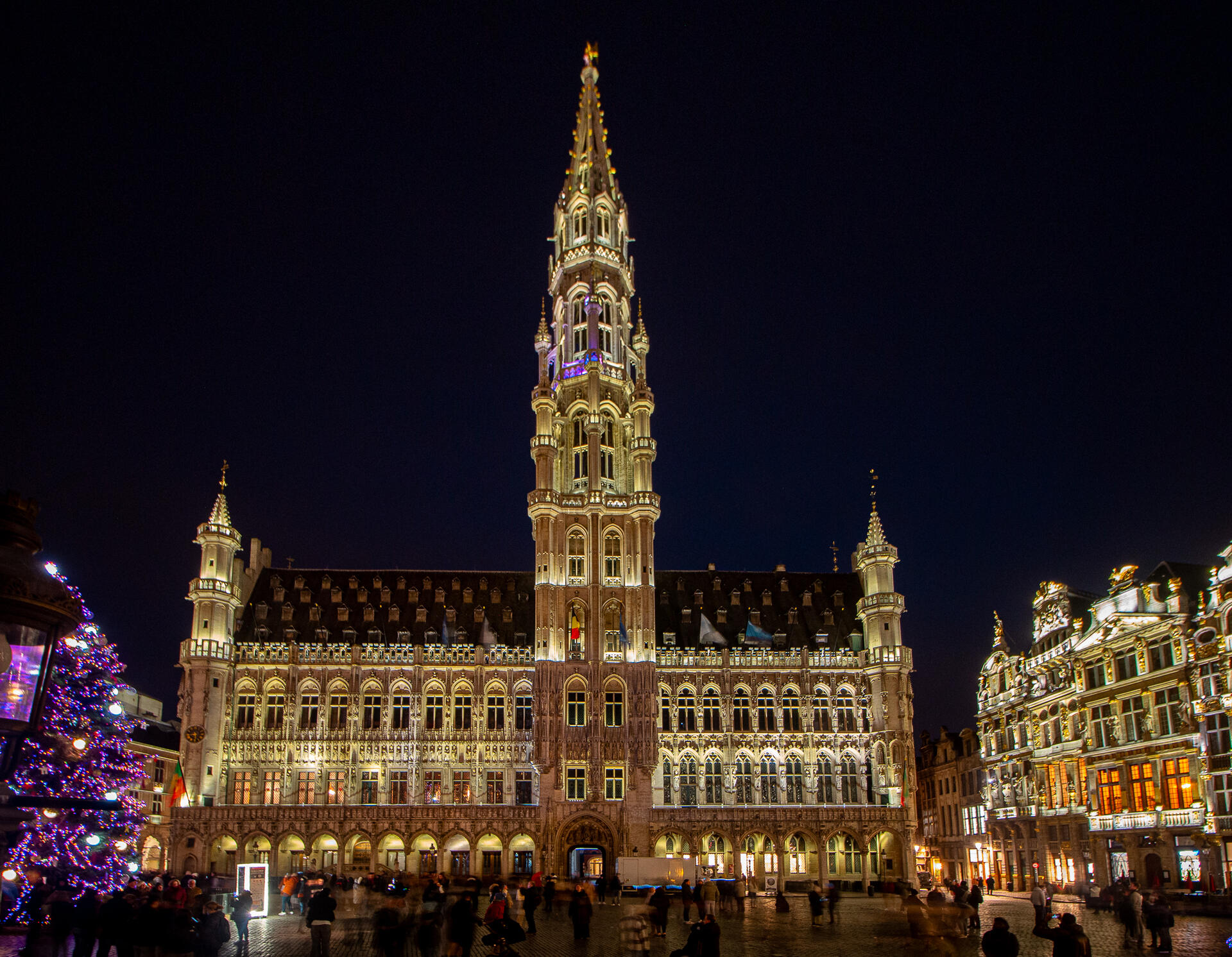
© VitVit, CC BY-SA 4.0 Resized from original. (This derivative is under the same CC BY-SA license.)
World Heritage Research
Discover scientific research and academic studies that deepen our understanding of La Grand-Place, Brussels from its history and significance to its conservation, management, and contemporary challenges.
-
Who built Brussels? The profile of artisans and entrepreneurs in the Brussels construction sector around 1865
Around 1865, Brussels was undergoing rapid transformation, but the roles of artisans and entrepreneurs in shaping the city remained largely unexplored. A study analyzing almanachs, patent registers, voter registries, and cadastral matrices reveals that the construction sector was dominated by a diverse group of small-scale operators, including women and migrants, alongside a few wealthy entrepreneurs leading large firms. This decentralized, labor-intensive model allowed for widespread local engagement in urban development. The findings offer new insights into Brussels' urban fabric formation and highlight the enduring need for locally anchored construction practices.
Degraeve, M. (2024). Who built Brussels? The profile of artisans and entrepreneurs in the Brussels construction sector around 1865 (H. White, Trans.). Brussels Studies. https://doi.org/10.4000/brussels.7350
View Publication Record | Read Publication -
From QR code to toppling. Debating the symbols of a controversial past in the public space of Brussels
A new study identifies six distinct strategies for addressing contested memorial markers in Brussels, ranging from maintaining the status quo to removal. These strategies are categorized based on intervention location and visibility of contestation, offering a framework for managing symbols with colonialist, racist, or sexist connotations. The research analyzes public discourse—including interviews, workshops, and press coverage—to illustrate each strategy with examples and arguments. This approach provides valuable insights for both researchers in memory studies and policymakers navigating the complexities of public symbol management.
Vaesen, J., Jaumain, S., Degryse, I., Jacobs, D., & Wayens, B. (2024). From QR code to toppling. Debating the symbols of a controversial past in the public space of Brussels (J. Corrigan, Trans.). Brussels Studies. https://doi.org/10.4000/12lwu
View Publication Record | Read Publication -
Transactional architecture: the interwar activities of architect-developer Jean-Florian Collin in Brussels
A groundbreaking study challenges the traditional view of architects as detached from commercial interests, instead highlighting the role of architect-developers in shaping urban landscapes. Focusing on Jean-Florian Collin's interwar activities in Brussels, the research demonstrates how transactional spaces—where architectural and development roles intersect—can lead to meaningful contributions to city-building. The study supports the hypothesis that urban societies are influenced by the real estate they produce, adding depth to discussions on housing architecture and planning. By analyzing Collin's trajectory, the authors reveal societal conditions that enable architects to thrive, offering new insights into the dynamics between design and development.
Heindryckx, L., Broes, T., & Dehaene, M. (2024). Transactional architecture: the interwar activities of architect-developer Jean-Florian Collin in Brussels. Architectural Research Quarterly, 28(1), 35–48. https://doi.org/10.1017/s1359135524000137
View Publication Record | Read Publication -
THE POLITICS OF URBAN ECOLOGY : Paul Duvigneaud and the Rise of Ecological Urbanism in Brussels during the 1970s
Urban ecology in Brussels during the 1970s was not merely an ecological endeavor but a politically charged discipline that shaped regional planning and governance. This study reveals how Paul Duvigneaud, a prominent urban ecologist, leveraged ecological knowledge to influence political agendas, overcome opposition, and establish ecological zoning practices within urban planning policies. By analyzing the Brussels school of urban ecology, the research demonstrates the interplay between ecological science and regional politics, arguing that ecological urbanism was instrumental in advancing a specific regionalist agenda. The study employs historical analysis to uncover the agency and political dimensions of ecological science, offering a nuanced perspective on the socioecological approach to urban development.
Danneels, K. (2023).
View Publication Record | Read PublicationTHE POLITICS OF URBAN ECOLOGY : Paul Duvigneaud and the Rise of Ecological Urbanism in Brussels during the 1970s. International Journal of Urban and Regional Research, 47(5), 792–808. Portico. https://doi.org/10.1111/1468-2427.13197 -
Pedestrianisation as a Step in a Societal Transformation? An Analysis of Support and Opposition in Brussels
A significant shift in public opinion towards pedestrianisation has occurred in Brussels, with a majority now supporting the initiative and its expansion. This transformation challenges car dominance, revealing deep societal changes. The study, conducted through pre- and post-implementation surveys involving residents, employees, and passers-by, identified that habitual car use remains a strong predictor of opposition. Support was notably higher among those living near pedestrianised areas, underscoring the spatial dimensions of urban mobility preferences. These findings highlight pedestrianisation as a potential catalyst for broader societal change away from automobility.
te Boveldt, G., De Wilde, L., Keseru, I., & Macharis, C. (2023). Pedestrianisation as a step in a societal transformation? An analysis of support and opposition in Brussels. Cities, 143, 104577. https://doi.org/10.1016/j.cities.2023.104577
View Publication Record | Read Publication -
Landscape: an evolving category of public action in Brussels
Landscape has emerged as a significant and evolving category of public action in Brussels, reflecting broader shifts in sustainability frameworks and urban development. The study analyzes Regional Development Plans from 1995 to 2018, revealing how landscape increasingly associates with nature while also adapting to metropolitan processes. Key findings include the transition from heritage-focused interests to sustainability concerns, as well as persistent themes like slow mobility and consensus-driven perception of landscape. This analysis demonstrates landscape's dual role as both an indicator of urban evolution and a stable element in public discourse.
Hubaut, S. (2021). Landscape: an evolving category of public action in Brussels (J. Corrigan, Trans.). Brussels Studies. https://doi.org/10.4000/brussels.5463
View Publication Record | Read Publication -
Urban Industrial Tourism: Cultural Sustainability as a Tool for Confronting Overtourism—Cases of Madrid, Brussels, and Copenhagen
Industrial heritage can serve as a powerful tool for cultural sustainability, effectively mitigating overtourism by redirecting visitors away from overcrowded historic city centers. A study analyzing Madrid, Brussels, and Copenhagen found that integrating industrial tourism into urban dynamics not only generates new resources but also creates culturally rich spaces. Researchers employed a methodology based on Tripadvisor data, selecting specific indicators and creating maps to assess the impact of industrial heritage on tourism patterns. The results were promising, suggesting that this approach could be scaled with additional case studies to uncover broader trends in urban industrial tourism.
Hidalgo-Giralt, C., Palacios-García, A., Barrado-Timón, D., & Rodríguez-Esteban, J. A. (2021). Urban Industrial Tourism: Cultural Sustainability as a Tool for Confronting Overtourism—Cases of Madrid, Brussels, and Copenhagen. Sustainability, 13(9), 4694. https://doi.org/10.3390/su13094694
View Publication Record | Read Publication