World Heritage Identification Number: 1393
World Heritage since: 2012
Category: Cultural Heritage
WHE Type: Archaeological Sites
Transboundary Heritage: No
Endangered Heritage: No
Country: 🇮🇱 Israel
Continent: Asia
UNESCO World Region: Europe and North America
Map
Unraveling Human History: The Sites of Human Evolution at Mount Carmel: The Nahal Me'arot / Wadi el-Mughara Caves
The Sites of Human Evolution at Mount Carmel, specifically the Nahal Me'arot / Wadi el-Mughara Caves, offer a captivating glimpse into the rich tapestry of human history. Located on the western slopes of Mount Carmel in northern Israel, this UNESCO World Heritage Site is a treasure trove of archaeological findings that span over half a million years.
More to come…UNESCO Description of the World Heritage Site
Situated on the western slopes of the Mount Carmel range, the site includes the caves of Tabun, Jamal, el-Wad and Skhul. Ninety years of archaeological research have revealed a cultural sequence of unparalleled duration, providing an archive of early human life in south-west Asia. This 54 ha property contains cultural deposits representing at least 500,000 years of human evolution demonstrating the unique existence of both Neanderthals andEarly Anatomically Modern Humans within the same Middle Palaeolithic cultural framework, the Mousterian. Evidence from numerous Natufian burials and early stone architecture represents the transition from a hunter-gathering lifestyle to agriculture and animal husbandry. As a result, the caves have become a key site of the chrono-stratigraphic framework for human evolution in general, and the prehistory of the Levant in particular.
UNESCO Justification of the World Heritage Site
Criterion (iii) : The site of the Nahal Me'arot/ Wadi el-Mughara Caves displays one of the longest prehistoric cultural sequences in the world. From the Acheulian complex, at least 500,000 years BP, through the Mousterian culture of 250,000-45,000 years BP, and up to the Natufian culture of 15,000-11,500 years BP and beyond, it testifies to at least half a million years of human evolution. Significantly, the site demonstrates the unique existence of both. Neanderthals and Early Anatomically Modern Humans (EAMH) within the same Middle Palaeolithic cultural framework, the Mousterian. As such, it has become a key site of the chrono-stratigraphic framework for human evolution in general, and the prehistory of the Levant in particular. Research at Nahal Me'arot/ Wadi el-Mughara Caves has been ongoing since 1928, and continues to promote multidisciplinary scientific dialogue. The potential for further excavation and archaeological research at the site is to date far from exhausted.
Criterion (v): The Nahal Me'arot/ Wadi el-Mughara Caves are a central site of the Natufian culture in its Mediterranean core zone. This significant regional culture of the late Epi-Palaeolithic period presents the transition from Palaeolithic to Neolithic ways of life, from nomadic to complex, sedentary communities, bearing testimony to the last hunter-gatherer society and the various adaptations it underwent on the threshold of agriculture.
Encyclopedia Record: Nahal Me'arot Nature Reserve
The Caves of Nahal Me’arot / Wadi el-Mughara, named here by the Hebrew and Arabic name of the valley where they are located, are a UNESCO Site of Human Evolution in the Carmel mountain range near Haifa in northern Israel.Additional Site Details
Area: 54 hectares
Number of Components: 1
(v) — Outstanding example of traditional human settlement
Coordinates: 32.6686111111 , 34.9680555556
Image
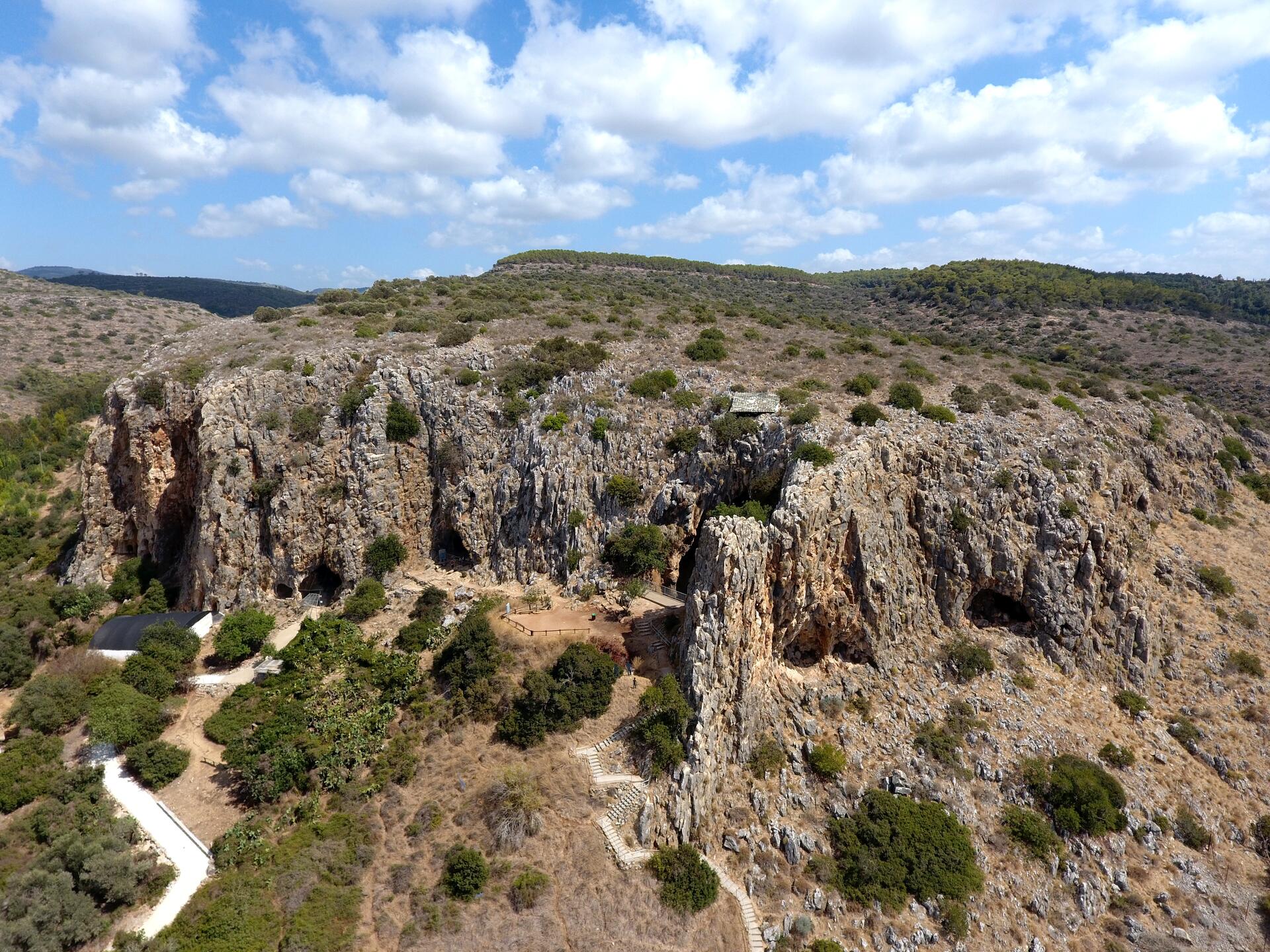
© Yitzhak Marmelstein, CC BY-SA 4.0 Resized from original. (This derivative is under the same CC BY-SA license.)
World Heritage Research
Discover scientific research and academic studies that deepen our understanding of Sites of Human Evolution at Mount Carmel: The Nahal Me’arot / Wadi el-Mughara Caves from its history and significance to its conservation, management, and contemporary challenges.
-
Revisiting taphonomic methodologies in microvertebrate research: A case study from Tabun Cave Layer C (Mount Carmel Israel)
A critical reappraisal of taphonomic methodologies in microvertebrate research, using Tabun Cave Layer C (Mount Carmel, Israel) as a case study, reveals the robustness and importance of comprehensive taphonomic analysis. The study reorganizes and reanalyzes raw data from Fried et al. (2024), applying established frameworks such as those by Andrews (1990). Key findings emphasize the necessity of identifying accumulation agents and assessing post-depositional processes to avoid interpretive errors, thereby providing critical palaeoecological insights into Neanderthal and Homo sapiens fossil remains. This work advocates for the refinement and broader integration of taphonomic methodologies in microvertebrate palaeoecology.
Fernández-Jalvo, Y., García-Morato, S., Denys, C., & Andrews, P. (2026). Revisiting taphonomic methodologies in microvertebrate research: A case study from Tabun Cave Layer C (Mount Carmel Israel). Quaternary Science Advances, 23, 100323. https://doi.org/10.1016/j.qsa.2026.100323
View Publication Record | Read Publication -
Natufian sickle blades (ca. 15,000–11,700 cal. BP) reveal cereal cultivation ca. 4.5 millennia before domestication
A groundbreaking analysis of Natufian sickle blades from Mount Carmel's caves reveals that prehistoric communities employed sophisticated cereal harvesting techniques approximately 4.5 millennia before systematic crop domestication. Microscopic use-wear analysis on flint sickle blades from el-Wad Terrace and Salibiya I sites identified patterns consistent with the harvest of semi-ripe and ripe cereals, utilizing their natural shattering mechanism. Additionally, traces of stripping suggest a threshing operation to extract grains efficiently. The study reconstructs an intensive, well-organized harvest strategy that began in mid-spring and continued until late spring, targeting unshattered plants. This practice demonstrates an advanced understanding of cereal properties and mixed stands, indicating early cultivation aimed at minimizing seed loss and stockpiling for future sowing.
Groman-Yaroslavski, I., Krugman, T., Belfer-Cohen, A., Yeshurun, R., Grosman, L., Kaufman, D., Barshay, K., Piliponsky, M., Vardi, J., Abadi, I., & Weinstein-Evron, M. (2026). Natufian sickle blades (ca. 15,000–11,700 cal. BP) reveal cereal cultivation ca. 4.5 millennia before domestication. Scientific Reports, 16(1). https://doi.org/10.1038/s41598-026-54740-5
View Publication Record | Read Publication -
Data production, analytical noise, and predator attribution in Tabun Cave Layer C: a reply to Fernández-Jalvo et al. (2026)
A robust analysis of microvertebrate remains from Tabun Cave Layer C confirms that molar digestion grading provides a reliable, noise-resistant signal for predator attribution. This study counters criticisms by Fernández-Jalvo et al. (2026), reinforcing the original finding that a low-impact raptor, such as Tyto alba, was likely the primary accumulating agent of the microvertebrate assemblage. The research employs a 'signal-versus-noise' framework to address post-depositional noise and demonstrates that taxonomic restrictions on molar digestion did not alter conclusions. Limited evidence for hydrodynamic sorting further supports this attribution.
Fried, T., Weissbrod, L., Shimelmitz, R., & Weinstein-Evron, M. (2026). Data production, analytical noise, and predator attribution in Tabun Cave Layer C: a reply to Fernández-Jalvo et al. (2026). Quaternary Science Advances, 23, 100338. https://doi.org/10.1016/j.qsa.2026.100338
View Publication Record | Read Publication -
Three millennia of lizard and snake consumption by Natufian foragers
A comprehensive analysis of squamate (lizard and snake) remains from the Nahal Me’arot/Wadi el-Mughara Caves at Mount Carmel reveals that these reptiles formed a substantial and consistent part of Natufian foragers' diet over three millennia. Evidence of butchery on snake vertebrae indicates regular consumption, with shifts in squamate abundance and bone modification patterns correlating to changes in site-use intensity rather than environmental factors. Unlike older Paleolithic sites, Natufian herpetofaunal assemblages show a more abundant, taxonomically stable, and less diverse range of larger-bodied species, suggesting human foraging choices adapted to emerging sedentary lifestyles. The study highlights the resilience of targeted squamate species despite fluctuations in habitation intensity, offering insights into early human impact on local reptile communities.
Lev, M., Weinstein-Evron, M., & Yeshurun, R. (2026). Three millennia of lizard and snake consumption by Natufian foragers. Proceedings of the National Academy of Sciences, 123(35). https://doi.org/10.1073/pnas.2609354123
View Publication Record | Read Publication -
Roman-Period Burial Caves on the Slopes of Mount Carmel: An Anthropological Study
Archaeological excavations at Ḥorbat Mitla, on the western slopes of Mount Carmel, have uncovered a significant concentration of Roman-period burial caves. The study identified at least 65 individuals—ranging from infants to adults of both sexes—in 13 caves, representing a typical 'civilian' cemetery population. Despite the poor preservation of skeletal fragments, on-site anthropological analysis provided insights into this historic burial site. This discovery contributes to our understanding of Roman-period funerary practices and demographic structures in the region.
Nagar, Y. (2025). Roman-Period Burial Caves on the Slopes of Mount Carmel: An Anthropological Study. ’Atiqot, 117(1). https://doi.org/10.70967/2948-040x.2267
View Publication Record | Read Publication -
The human side of biodiversity: coevolution of the human niche, palaeo-synanthropy and ecosystem complexity in the deep human past
A groundbreaking study reveals that human activities, particularly those of hunter-gatherers, have played a pivotal role in shaping biodiversity dynamics and ecosystem complexity since the Late Pleistocene. The research challenges the conventional view that biodiversity loss is solely an anthropogenic issue, instead highlighting the deep-time interplay between humans and ecosystems. By analyzing archaeological evidence from sites like Mount Carmel's Nahal Me'arot caves, the study demonstrates that human-environment feedback systems have significantly influenced biodiversity, with implications for understanding current ecological crises. It argues that fostering cultural diversity could be key to promoting biodiversity conservation, offering a novel perspective on planetary stewardship.
Hussain, S. T., & Baumann, C. (2024). The human side of biodiversity: coevolution of the human niche, palaeo-synanthropy and ecosystem complexity in the deep human past. Philosophical Transactions of the Royal Society B: Biological Sciences, 379(1902). https://doi.org/10.1098/rstb.2023.0021
View Publication Record | Read Publication -
Cultural Dynamics in the Levantine Upper Paleolithic, ca. 40–33 ky BP: Insights Based on Recent Advances in the Study of the Levantine Aurignacian, the Arkov-Divshon, and the Atlitian
Recent research challenges the long-held model of two co-inhabiting cultural groups during the Levantine Upper Paleolithic (ca. 40–33 ky BP), instead proposing at least three distinct entities: the Early Ahmarian, Levantine Aurignacian, and younger Arkov-Divshon/Atlitian cultures. High-resolution excavations at Manot Cave and Nahal Rahaf 2 Rockshelter, combined with radiocarbon dating and detailed stratigraphic analysis, revealed a chronological overlap among these groups, particularly between the Arkov-Divshon, Levantine Aurignacian, and possibly the Early Ahmarian. The study further suggests an evolutionary link between the Arkov-Divshon and Atlitian flint industries, while highlighting foreign cultural features in the Levantine Aurignacian. These findings necessitate a revision of migration and interaction models for this period.
Shemer, M., Barzilai, O., & Marder, O. (2024). Cultural Dynamics in the Levantine Upper Paleolithic, ca. 40–33 ky BP: Insights Based on Recent Advances in the Study of the Levantine Aurignacian, the Arkov-Divshon, and the Atlitian. Journal of Paleolithic Archaeology, 7(1). https://doi.org/10.1007/s41982-024-00176-0
View Publication Record | Read Publication