World Heritage Identification Number: 1471
World Heritage since: 2015
Category: Cultural Heritage
WHE Type: Archaeological Sites
Transboundary Heritage: No
Endangered Heritage: No
Country: 🇮🇱 Israel
Continent: Asia
UNESCO World Region: Europe and North America
Map
The Necropolis of Bet She’arim: A Testament to Ancient Judaism and Jewish Renewal
The Necropolis of Bet She’arim, located approximately 20 kilometers east of Haifa in Israel, stands as a significant landmark not only in Jewish history but also in the broader context of world heritage. Designated as a UNESCO World Heritage Site in 2015, this extensive rock-cut necropolis offers a unique insight into the religious, cultural, and artistic aspects of ancient Judaism during the period following the second Jewish revolt against Roman rule (132–135 AD).
More to come…UNESCO Description of the World Heritage Site
Consisting of a series of catacombs, the necropolis developed from the 2nd century AD as the primary Jewish burial place outside Jerusalem following the failure of the second Jewish revolt against Roman rule. Located southeast of the city of Haifa, these catacombs are a treasury of artworks and inscriptions in Greek, Aramaic, Hebrew and Palmyrene. Bet She’arim bears unique testimony to ancient Judaism under the leadership of Rabbi Judah the Patriarch, who is credited with Jewish renewal after 135 AD.
UNESCO Justification of the World Heritage Site
Criterion (ii): The catacombs of Bet She’arim show the influence of classical Roman art including human images, inscriptions and decorative details and include iconographic motifs and multi-language inscriptions testifying to cross-cultural interaction with the Greco-Roman artistic cultural world of Europe, Asia Minor and Mesopotamia and the Jewish cultural world. The assimilation of burial types and artistic expression together with inscriptions indicating the origins of those buried in the cemetery testify to the wide dispersal of the Jewish people at that time and the incorporation into Jewish religious culture of influences from the surrounding populations.
Criterion (iii): The necropolis of Bet She’arim constitutes exceptional testimony to ancient Judaism in its period of revival and survival under the leadership of Rabbi Judah the Patriarch. The extensive catacombs containing artwork showing classical and oriental influences illustrate the resilient Jewish culture that flourished here in the 2nd to 4th centuries AD.
Encyclopedia Record: Beit She'arim necropolis
Beit She'arim Necropolis is an extensive rock-cut necropolis located near the ancient Jewish town of Beit She'arim, 20 km east of Haifa in the southern foothills of the Lower Galilee. Part of Beit She'arim National Park, the site includes the necropolis and remains of the town. Used from the first to fourth centuries CE, its peak occurred in the late second century when the Sanhedrin, led by Judah ha-Nasi, relocated to Beit She'arim, and his family was interred there. In 2015, the necropolis was designated a UNESCO World Heritage Site.Additional Site Details
Area: 12.2 hectares
Number of Components: 1
(iii) — Unique or exceptional testimony to a cultural tradition
Coordinates: 32.7022222222 , 35.1269444444
Image
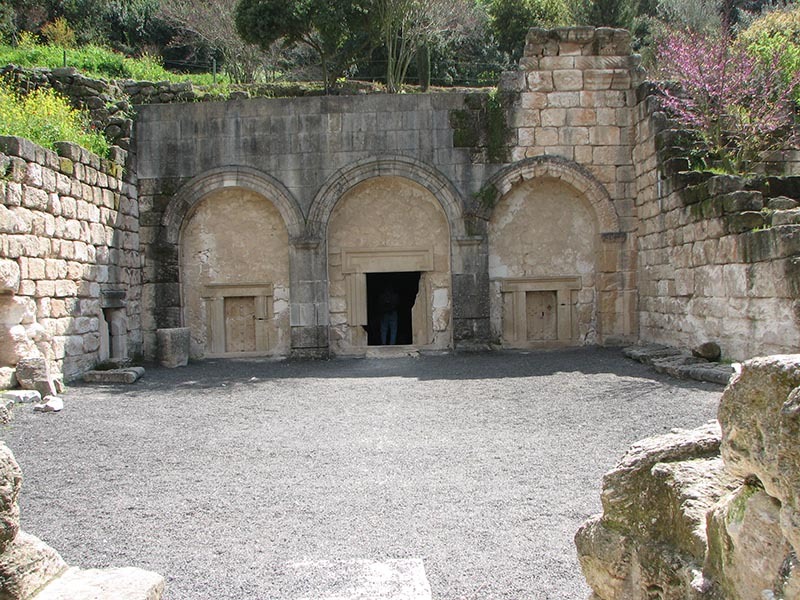
© Hebrew Wikipedia, CC BY-SA 3.0 Resized from original. (This derivative is under the same CC BY-SA license.)
World Heritage Research
Discover scientific research and academic studies that deepen our understanding of Necropolis of Bet She’arim: A Landmark of Jewish Renewal from its history and significance to its conservation, management, and contemporary challenges.
-
New Hiding Complexes in Beth She‘arim and Their Dating
Recent excavations at the Necropolis of Bet She’arim have uncovered three new hiding complexes, providing crucial evidence that these structures were likely constructed during the 2nd century CE, possibly in response to the Bar Kokhba Revolt. This discovery challenges previous dating assumptions and offers a clearer understanding of the historical context of these underground complexes in the Galilee region. The study employed excavation and documentation techniques to analyze the newly discovered complexes, contributing significantly to the broader study of Roman-period Jewish settlements and their adaptive strategies during periods of conflict.
Erlich, A., Binshtok, D., & Kaftory, R. (2022). New Hiding Complexes in Beth She‘arim and Their Dating. Jerusalem Journal of Archaeology, 3(2), 134–163. https://doi.org/10.52486/01.00003.9
View Publication Record | Read Publication