World Heritage Identification Number: 116
World Heritage since: 1988
Category: Cultural Heritage
WHE Type: Historic Cities & Urban Areas
Transboundary Heritage: No
Endangered Heritage: Yes
Country: 🇲🇱 Mali
Continent: Africa
UNESCO World Region: Africa
Map
Exploring the Rich History of the Old Towns of Djenné
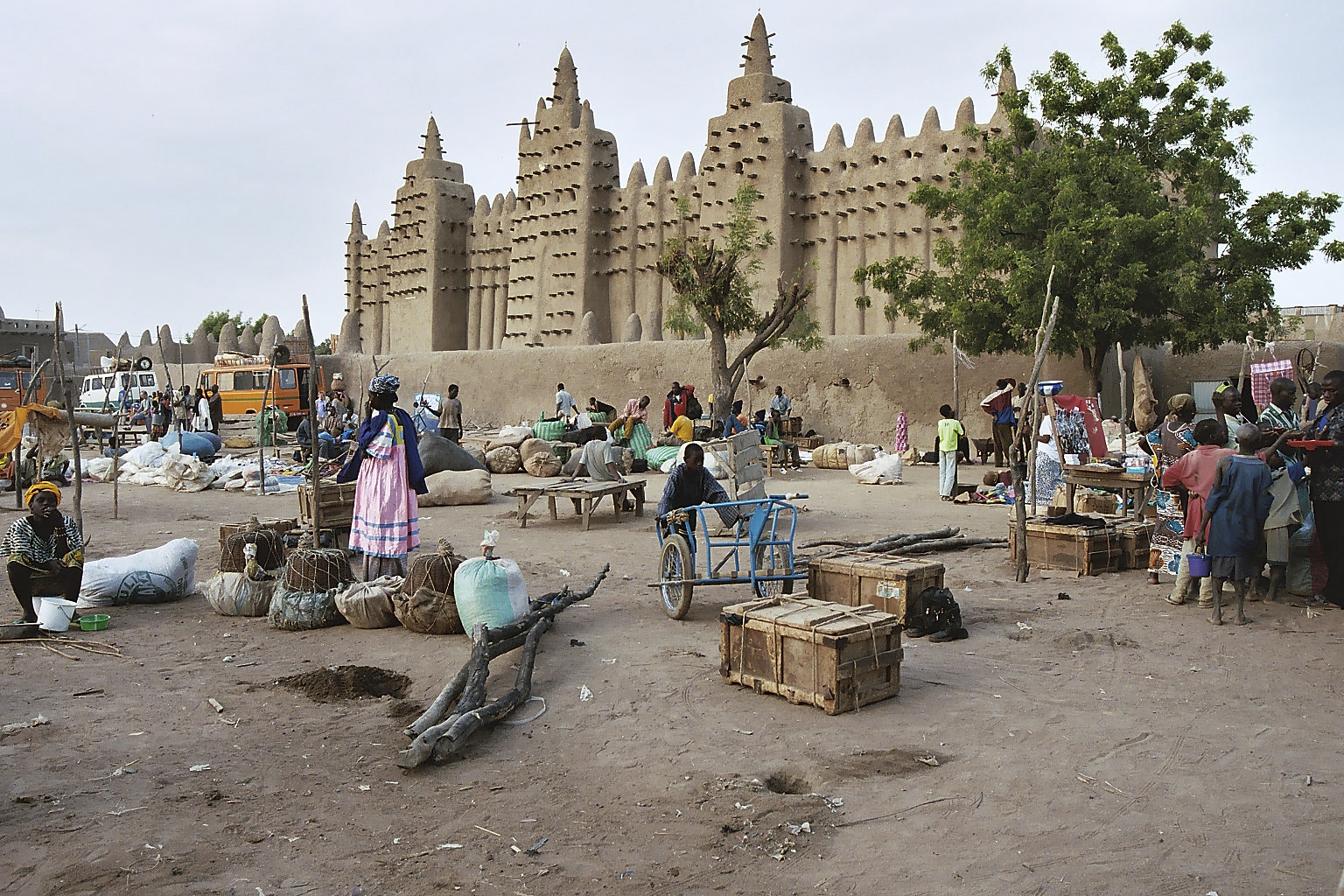
The Old Towns of Djenné, situated in the heart of Mali, West Africa, offer a unique blend of history, culture, and architectural marvel. This UNESCO World Heritage Site has been inhabited since around 250 BC, making it a significant location for understanding the region's ancient past.
More to come…UNESCO Description of the World Heritage Site
Inhabited since 250 B.C., Djenné became a market centre and an important link in the trans-Saharan gold trade. In the 15th and 16th centuries, it was one of the centres for the propagation of Islam. Its traditional houses, of which nearly 2,000 have survived, are built on hillocks (toguere) as protection from the seasonal floods.
UNESCO Justification of the World Heritage Site
Criterion (iii): Djenné-Djeno, along with Hambarketolo, Tonomba and Kaniana bears exceptional witness to the pre-Islamic civilizations on the inland Delta of the Niger. The discovery of many dwellings on the site of Djenné-Djeno (remains of traditional brick structures (djénné ferey), funerary jars) as well as a wealth of terra cotta artifacts and metal make this a major archaeological site for the study of the evolution of dwellings, industrial and craft techniques.
Criterion (iv): The ancient fabric of Djenné is an outstanding example of an architectural group of buildings illustrating a significant historic period. Influenced by Moroccan architecture (1591), and later marked by the Toucouleur Empire in 1862, the architecture of Djenné is characterized by its verticality, its buttresses punctuating the facades of the two-storey houses whose entrances are always given special attention. The reconstruction of the Mosque (1906-1907) resulted in the creation of a monument representing local religious architecture.
Encyclopedia Record: Old Towns of Djenné
The Old Towns of Djenné is an archaeological and urban ensemble located in the city of Djenné, in Mali. It comprises four archaeological sites, namely Djenné-Djeno, Hambarkétolo, Kaniana, and Tonomba. In 1988, it was inscribed by the UNESCO on the World Heritage list.Additional Site Details
Area: Not available
Number of Components: 5
(iv) — Outstanding example of a type of building or landscape
Coordinates: 13.90639 , -4.555
World Heritage Research
Discover scientific research and academic studies that deepen our understanding of Old Towns of Djenné from its history and significance to its conservation, management, and contemporary challenges.
-
Protecting architectural heritage in Djenné: a civil society point of view
A critical analysis reveals that the protection of Djenné's architectural heritage, despite its UNESCO World Heritage status, has been undermined by a lack of coordinated strategy and widespread ignorance among key stakeholders. The study highlights how international and national interventions over two decades have often disregarded the constraints imposed by the site's designation, while decision-makers, funders, and local professionals exhibit a declining awareness of both the cultural value of Djenné's architecture and the technical expertise required for its preservation. This neglect has contributed to the town's inclusion on the List of World Heritage in Danger in 2016. The research underscores the urgent need for education and sensitization efforts to empower various actors, enabling them to make informed political and technical decisions that safeguard this irreplaceable heritage.
Brunet-Jailly, J., & Scherrer, O. (2018). Protecting architectural heritage in Djenné: a civil society point of view. Journal of African Cultural Heritage Studies, 1(1), 72. https://doi.org/10.22599/jachs.23
View Publication Record | Read Publication -
Capture the wealth of heritage in a Holy City of Islam : the problem of developing tourism in Djenné in Mali
Sustainable tourism development in Djenné, Mali, hinges on balancing heritage preservation with local values and equitable wealth distribution. The study reveals that while tourism has flourished since Djenné's 1988 UNESCO World Heritage inscription, its growth is hampered by conflicts between inhabitants' expectations, local traditions, and restoration projects. To foster sustainable development, the research advocates for integrating both tangible (architectural) and intangible (cultural, religious) heritage while ensuring fair economic benefits reach the population. This approach could improve living conditions and counter marginalization driven by radical Islam, underscoring the need for culturally sensitive, community-inclusive tourism strategies.
Togola, D., & Al Karjousli, S. (2014). Capture the wealth of heritage in a Holy City of Islam : the problem of developing tourism in Djenné in Mali. Via Tourism Review, 4-5. https://doi.org/10.4000/viatourism.1530
View Publication Record | Read Publication -
Cultural Patrimony and Heritage Management in Mali: The Old Towns of Djenné and the Sanké Mon Festival
Mali's approach to cultural heritage, initially rooted in nation-building and collaboration with UNESCO, has evolved to embrace tourism-driven commodification. This study highlights the complex interplay between political projects and economic strategies, using case studies of Djenne and San—both UNESCO-listed sites—to illustrate these dynamics. It also examines the fragility of state-led nationalist efforts exposed during recent insurgencies in northern Mali, while outlining post-conflict measures to foster a shared cultural patrimony among citizens. The research combines historical analysis with fieldwork, offering insights into heritage management challenges and opportunities.
Arnoldi. (2014). Cultural Patrimony and Heritage Management in Mali: The Old Towns of Djenné and the Sanké Mon Festival. Africa Today, 61(1), 47. https://doi.org/10.2979/africatoday.61.1.47
View Publication Record | Read Publication