World Heritage Identification Number: 267
World Heritage since: 1983
Category: Cultural Heritage
WHE Type: Historic Cities & Urban Areas
Transboundary Heritage: No
Endangered Heritage: No
Country: 🇨🇭 Switzerland
Continent: Europe
UNESCO World Region: Europe and North America
Map
The Old City of Berne: A Medieval Gem in the Heart of Switzerland
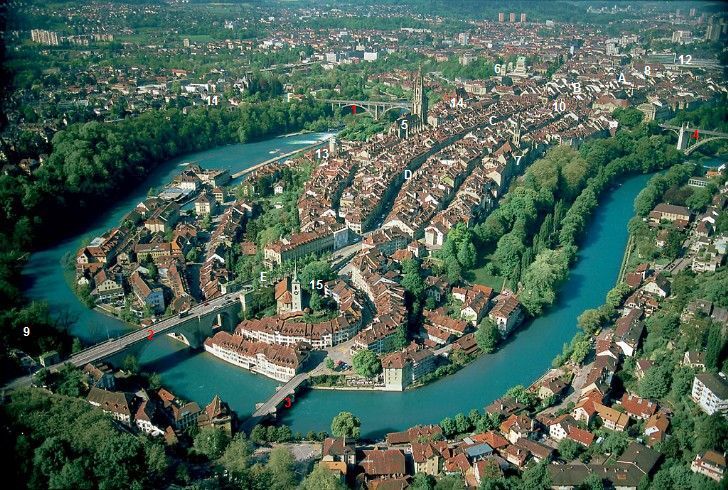
The Old City of Berne, located in the heart of Switzerland, is a testament to the country's rich history and architectural prowess. Inscribed as a UNESCO World Heritage Site in 1983, this medieval city center has managed to preserve its original character despite numerous renovations and expansions over the centuries.
Founded in the 12th century, Berne was built on a strategic hillside location, surrounded by the meandering Aare River. This geographical feature not only provided natural defense but also played a crucial role in shaping the city's unique layout. The Old City is characterized by its compact, carefully planned streets, laid out in a grid typical of Zähringer urban planning, which have remained essentially unchanged since their construction during the twelfth to the fifteenth century.
One of the most striking features of the Old City is its exceptional coherence in planning and design. The buildings, dating from various periods, exhibit a harmonious blend of architectural styles. The 15th-century arcades, for instance, add a touch of Gothic elegance, while the 16th-century fountains contribute to the city's picturesque charm.
A significant event that shaped the Old City was the great fire of 1405. After the fire, much of the city was rebuilt in sandstone, giving it a distinctive, robust appearance. Despite this catastrophic event, the Old City managed to maintain its medieval character.
In the 18th century, there were substantial construction efforts aimed at modernizing the city. However, these efforts were carefully planned to ensure that they did not compromise the Old City's historical integrity. As a result, Berne's old city has retained its medieval character, offering visitors a glimpse into Switzerland's past.
Today, the Old City of Berne is a bustling hub of activity, filled with shops, restaurants, and museums. Visitors can explore the city's many attractions, including the Zytglogge (the city's iconic clock tower), the Federal Palace (the seat of the Swiss government and the parliament), and the Bear Park, where the city's symbol, the bear, can be seen.
To wrap it up, the Old City of Berne is a must-visit destination for anyone interested in history, architecture, or simply experiencing the charm of a medieval city. Its unique layout, harmonious blend of architectural styles, and rich history make it a truly special place. Whether you're wandering through its narrow, winding streets or admiring its many landmarks, the Old City of Berne offers a captivating glimpse into Switzerland's past.
UNESCO Description of the World Heritage Site
Founded in the 12th century on a hill site surrounded by the Aare River, Berne developed over the centuries in line with a an exceptionally coherent planning concept. The buildings in the Old City, dating from a variety of periods, include 15th-century arcades and 16th-century fountains. Most of the medieval town was restored in the 18th century but it has retained its original character.
UNESCO Justification of the World Heritage Site
Criterion (iii): The Old City of Berne is a positive example of a city that has conserved its medieval urban structure whilst responding, over time, to the increasingly complex functions of a capital city of a modern State.
Encyclopedia Record: Old City (Bern)
The Old City is the medieval city center of Bern, Switzerland. Built on a narrow hill bordered on three sides by the river Aare, its compact layout has remained essentially unchanged since its construction during the twelfth to the fifteenth century. Despite a major fire in 1405, after which much of the city was rebuilt in sandstone, and substantial construction efforts in the eighteenth century, Bern's old city has retained its medieval character.Additional Site Details
Area: 84.684 hectares
Number of Components: 1
Coordinates: 46.94806 , 7.45028
World Heritage Research
Discover scientific research and academic studies that deepen our understanding of Old City of Berne from its history and significance to its conservation, management, and contemporary challenges.
-
Commoning the compact city: The role of old and new commons in urban development
Densification of urban areas, often associated with market-driven development, can instead foster sustainable outcomes through processes of commoning. A study on the Old City of Berne, Switzerland, reveals that new commons—despite their transitional and unstable nature—play a pivotal role in shaping governance during urban redevelopment. These commons, unlike old commons, excel not in long-term resource management but in renegotiating institutional arrangements during critical transition phases, advancing socially-sustainable results. The research employs a new institutionalist approach, analyzing localized negotiations among actors in a cooperative housing and green space project. It underscores the potential of new commons to counteract enclosure and commodification when supported by public action.
Verheij, J., Gerber, J.-D., & Nahrath, S. (2024). Commoning the compact city: The role of old and new commons in urban development. Geoforum, 152, 104019. https://doi.org/10.1016/j.geoforum.2024.104019
View Publication Record | Read Publication -
Modelling the spatial pattern of heatwaves in the city of Bern using a land use regression approach
A novel approach using land use regression (LUR) modeling successfully interpolated low-cost temperature data to map urban heat island (UHI) patterns during heatwaves in Bern, Switzerland. The study leveraged 60 low-cost measurement devices and 14 spatial variables with varying buffer radii to develop three accurate models for nighttime heatwave scenarios. This method demonstrates a cost-effective solution for analyzing UHI effects without relying solely on satellite data or hobby meteorologists' contributions, offering valuable insights for urban planning and heat stress mitigation in UNESCO World Heritage Sites.
Burger, M., Gubler, M., Heinimann, A., & Brönnimann, S. (2021). Modelling the spatial pattern of heatwaves in the city of Bern using a land use regression approach. Urban Climate, 38, 100885. https://doi.org/10.1016/j.uclim.2021.100885
View Publication Record | Read Publication -
Cultural Heritage, Sustainable Development, and Climate Policy: Comparing the UNESCO World Heritage Cities of Potsdam and Bern
Historic city centers, while presenting challenges due to legal constraints on building modifications, also offer unique opportunities for sustainable urban development. A comparative study of the UNESCO World Heritage cities of Potsdam (Germany) and Bern (Switzerland) reveals that their shared characteristics—such as resistance to modern urbanization and functional city concepts—can facilitate innovative climate policies. Despite national differences, both cities leverage tools like referenda and citizen participation to drive sustainability. Potsdam leads in institutionalizing climate mitigation and adaptation, while Bern serves as a role model for stakeholders. The study identifies transferable innovations, such as Potsdam’s integrative climate policy, and highlights the potential for collaboration between matching cities to balance heritage management with climate governance.
Kern, K., Irmisch, J., Odermatt, C., Haupt, W., & Kissling-Näf, I. (2021). Cultural Heritage, Sustainable Development, and Climate Policy: Comparing the UNESCO World Heritage Cities of Potsdam and Bern. Sustainability, 13(16), 9131. https://doi.org/10.3390/su13169131
View Publication Record | Read Publication -
Land as a scarce resource: the 10th conference of the PLPR, Berne, Switzerland, 15–19 February 2016
The Old City of Bern exemplifies the efficient use of limited land, showcasing high-quality urban design that contributes to its status as one of the world's most livable cities. This was highlighted during the 10th annual conference of the International Academic Association on Planning, Law, and Property Rights (PLPR), held in February 2016 at the University of Bern. The event brought together 160 participants from 39 countries to discuss 'Land as a scarce resource,' drawing parallels between the conference's topic and the medieval city's compact urban planning. The gathering set a new record for attendance, underscoring the global interest in sustainable land use and urban development.
Hengstermann, A., Holtslag-Broekhof, S., & Fux, V. (2016). Land as a scarce resource: the 10th conference of the PLPR, Berne, Switzerland, 15–19 February 2016. Town Planning Review, 87(6), 729–733. https://doi.org/10.3828/tpr.2016.46
View Publication Record | Read Publication -
Methods for determination of revitalization potential of built heritage: Lessons learned on the city of Bern
A key insight from the revitalization of Bern's Old City is that the future use of heritage buildings cannot be determined solely by predefined public methods but requires active participation from potential owners. This approach, which integrates historical significance with adaptive structuring for new purposes, was validated through multiple analyses. The study highlights that successful revitalization depends on balancing conservation goals with practical adaptations to ensure sustainable reuse. These findings offer valuable lessons for addressing similar challenges in Serbian built heritage, emphasizing the importance of collaborative decision-making and innovative design strategies.
Stanisic, G., & Kurtovic-Folic, N. (2015). Methods for determination of revitalization potential of built heritage: Lessons learned on the city of Bern. Gradjevinski Materijali I Konstrukcije, 58(1), 25–57. https://doi.org/10.5937/grmk1501025s
View Publication Record | Read Publication -
Reconstruction of the New Station Square in Berne, Switzerland
The reconstruction of the New Station Square in Bern, Switzerland, not only addressed structural safety and durability concerns but also transformed the area into an appealing entrance adjacent to the UNESCO World Heritage-listed Old City. The 2007 project, covering 40,000 m², included dismantling parts of concrete slabs and columns while adding new elements and strengthening existing ones. A key innovation was the use of post-installed inclined bonded bars to reinforce the ceiling against punching shear, a method that enhanced structural integrity. Additionally, the reconstruction optimized local transportation stops, an underground shopping center, and pedestrian flow, creating a more functional and aesthetically pleasing urban space.
Joray, D., & Diggelmann, M. (2010). Reconstruction of the New Station Square in Berne, Switzerland. IABSE Symposium, Venice 2010: Large Structures and Infrastructures for Environmentally Constrained and Urbanised Areas, 97, 724–725. https://doi.org/10.2749/222137810796063508
View Publication Record | Read Publication