World Heritage Identification Number: 1302
World Heritage since: 2009
Category: Cultural Heritage
WHE Type: Historic Cities & Urban Areas
Transboundary Heritage: No
Endangered Heritage: No
Country: 🇨🇭 Switzerland
Continent: Europe
UNESCO World Region: Europe and North America
Map
La Chaux-de-Fonds / Le Locle: A Unique Example of Watchmaking Town Planning
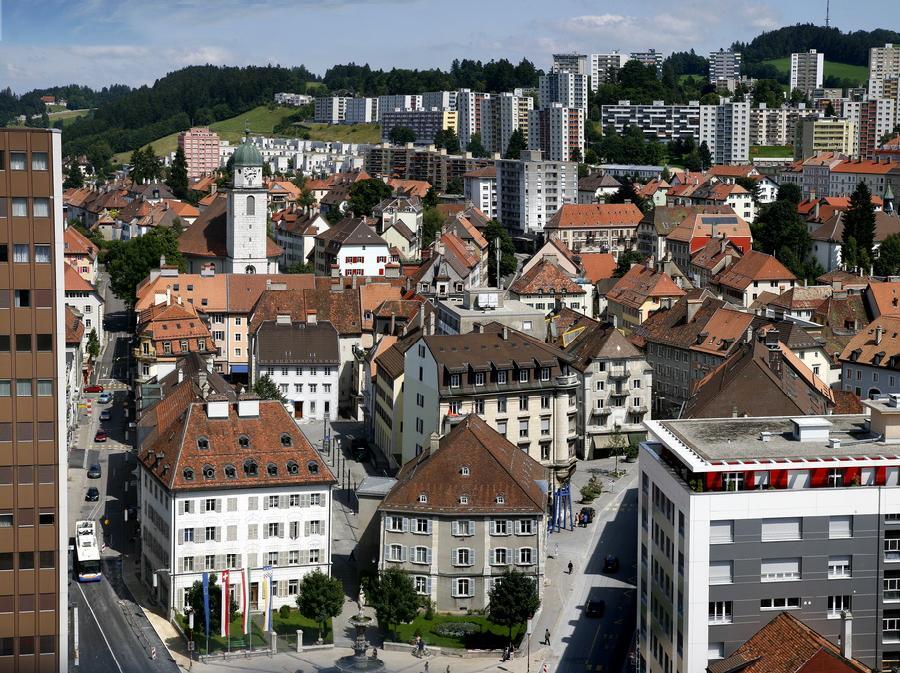
The La Chaux-de-Fonds / Le Locle watchmaking town-planning site, inscribed into the UNESCO World Heritage List in 2009, offers a unique insight into the historical development of the watchmaking industry and its impact on urban design. Situated in the Swiss Jura mountains, these two neighboring towns have maintained their distinctive planning and architecture, reflecting the specific needs of the watchmaking culture that emerged in the region during the 17th century.
More to come…UNESCO Description of the World Heritage Site
The site of La Chaux-de-Fonds / Le Locle watchmaking town-planning consists of two towns situated close to one another in a remote environment in the Swiss Jura mountains, on land ill-suited to farming. Their planning and buildings reflect watchmakers’ need of rational organization. Planned in the early 19th century, after extensive fires, the towns owed their existence to this single industry. Their layout along an open-ended scheme of parallel strips on which residential housing and workshops are intermingled reflects the needs of the local watchmaking culture that dates to the 17th century and is still alive today. The site presents outstanding examples of mono-industrial manufacturing-towns which are well preserved and still active. The urban planning of both towns has accommodated the transition from the artisanal production of a cottage industry to the more concentrated factory production of the late 19th and 20th centuries. The town of La Chaux-de-Fonds was described by Karl Marx as a “huge factory-town” in Das Kapital where he analyzed the division of labour in the watchmaking industry of the Jura.
UNESCO Justification of the World Heritage Site
Criterion (iv): La Chaux-de-Fonds and Le Locle constitute a unique urban and architectural ensemble, wholly dedicated to watchmaking from the 18th century until the present day. Watchmaking space and living space co-exist in an extremely close relationship. The rational, pragmatic, and open planning of the urban space has encouraged the sustainable development of this mono-industry, as a ‘manufacturing- town.’
Encyclopedia Record: La Chaux-de-Fonds
La Chaux-de-Fonds is a Swiss city in the canton of Neuchâtel. It is located in the Jura Mountains at an altitude of 992 metres, a few kilometres south of the French border. After Geneva, Lausanne, Biel/Bienne, and Fribourg, it is the fifth-largest city in the Romandie, the French-speaking part of the country, with a population of 36,915.Additional Site Details
Area: 283.9 hectares
Number of Components: 2
Coordinates: 47.1038888889 , 6.8327777778
World Heritage Research
Discover scientific research and academic studies that deepen our understanding of La Chaux-de-Fonds / Le Locle, Watchmaking Town Planning from its history and significance to its conservation, management, and contemporary challenges.
-
Implementing the Historic Urban Landscape (HUL) Approach: Learning from Interventions in Swiss Heritage Sites
A study of Swiss heritage sites reveals that the Historic Urban Landscape (HUL) approach is effectively integrated into local urban management practices, particularly through early involvement of stakeholders and adaptive design solutions. Analysis of 10 case reports highlights the prevalence of HUL-aligned interventions, especially in Steps 2 (participation), 4 (integration into planning frameworks), and 6 (partnerships). Swiss institutional conditions, such as legal protections for heritage sites and participatory mechanisms, play a crucial role in shaping these outcomes. The findings suggest that while the HUL approach is not universally applicable, its principles can emerge within specific governance contexts, offering insights for broader transferability.
Eudave, R. R., & Hersperger, A. M. (2026). Implementing the Historic Urban Landscape (HUL) Approach: Learning from Interventions in Swiss Heritage Sites. The Historic Environment: Policy & Practice, 17(2), 363–388. https://doi.org/10.1080/17567505.2026.2651675
View Publication Record | Read Publication -
Return Migration and Real Estate Projects: Philanthropy or Speculation? The Examples of Le Locle and Locarno (Switzerland), From the Mid-19th Century to the 1910s
Historical return migration often drove financial flows, such as remittances or capital repatriation, primarily funneling into private construction to symbolize personal success and fulfill conservative ideals. This study reveals that for two Swiss migrants—one in Le Locle and the other in Locarno—real estate development from the mid-19th century to the 1910s served as a strategic entrepreneurial venture balancing philanthropic goals with speculative motives. By analyzing these case studies, researchers demonstrate how migration-driven wealth was not merely altruistic but also a calculated investment, challenging traditional narratives of return migration's motivations.
Lorenzetti, L., & Rossinelli, F. (2025). Return Migration and Real Estate Projects: Philanthropy or Speculation? The Examples of Le Locle and Locarno (Switzerland), From the Mid-19th Century to the 1910s. Two Homelands, (62). https://doi.org/10.3986/2025.2.5
View Publication Record | Read Publication -
Questioning public histories of urban planning: an investigation of ‘urbanisme horloger’ narratives in the Unesco site of Le Locle/La Chaux-de-Fonds
A critical examination of the UNESCO World Heritage Site of La Chaux-de-Fonds / Le Locle challenges the dominant narrative that their urban planning, known as 'urbanisme horloger,' was inherently linked to the social organization of watchmaking communities. The study focuses on a key 1835 planning document by Charles-Henri Junod, revealing discrepancies between its interpretation and the broader heritage narrative. This analysis highlights both the complexities and opportunities in how planning histories are publicly disseminated and appropriated by diverse actors, offering new perspectives on urban heritage-making processes.
De Pieri, F. (2018). Questioning public histories of urban planning: an investigation of ‘urbanisme horloger’ narratives in the Unesco site of Le Locle/La Chaux-de-Fonds. Planning Perspectives, 34(2), 335–344. https://doi.org/10.1080/02665433.2018.1559756
View Publication Record | Read Publication