World Heritage Identification Number: 143
World Heritage since: 1981
Category: Cultural Heritage
WHE Type: Buildings & Architectural Ensembles
Transboundary Heritage: No
Endangered Heritage: No
Country: 🇵🇰 Pakistan
Continent: Asia
UNESCO World Region: Asia and the Pacific
Map
Makli Necropolis: A Glimpse into Sindhi Civilization (14th-18th Century)
The Historical Monuments at Makli, Thatta, located in the Pakistani province of Sindh, stand as a testament to the rich cultural heritage and historical significance of the region. Inscribed as a UNESCO World Heritage Site in 1981, this vast necropolis spans over an area of 10 kilometers and is home to approximately half a million to one million tombs.
More to come…UNESCO Description of the World Heritage Site
The capital of three successive dynasties and later ruled by the Mughal emperors of Delhi, Thatta was constantly embellished from the 14th to the 18th century. The remains of the city and its necropolis provide a unique view of civilization in Sind.
UNESCO Justification of the World Heritage Site
Criterion (iii): The historical monuments at Makli, Thatta testify in an outstanding manner to the civilization of the Sindh region from the 14th to the 18th centuries. The site preserves in a state of exceptional integrity an imposing monumental complex comprised of the remains of the necropolis, massed at the edge of the Makli plateau and covering an area of about 10 km2.
Encyclopedia Record: Makli Necropolis
Makli Necropolis is one of the largest funerary sites in the world, spread over an area of 10 kilometres near the city of Thatta, in the Pakistani province of Sindh. The site houses approximately 500,000 to 1 million tombs built over the course of a 400-year period. Makli Necropolis features several large funerary monuments belonging to royalty, various Sufi saints, and esteemed scholars. The site was inscribed as a UNESCO World Heritage Site in 1981 as an "outstanding testament" to Sindhi civilization between the 14th and 18th centuries.Additional Site Details
Area: Not available
Number of Components: 1
Coordinates: 24.76666667 , 67.9
Image
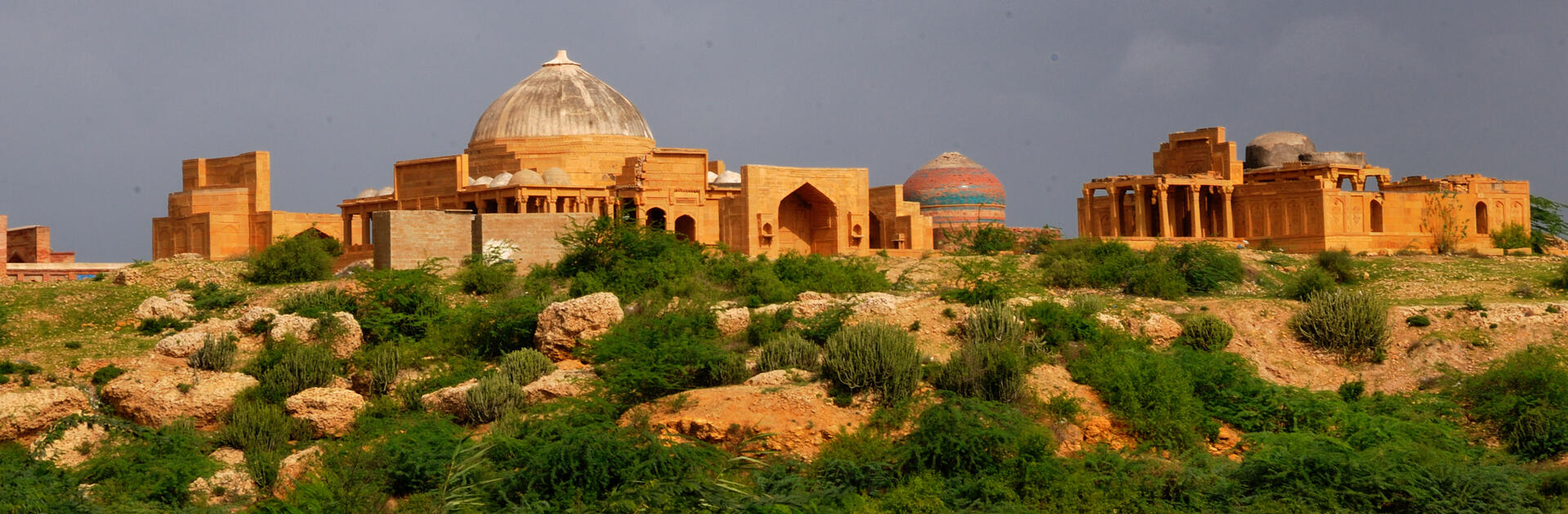
© Usman.pg, CC BY-SA 3.0 Resized from original. (This derivative is under the same CC BY-SA license.)
World Heritage Research
Discover scientific research and academic studies that deepen our understanding of Historical Monuments at Makli, Thatta from its history and significance to its conservation, management, and contemporary challenges.
-
Development of Archaeological, Religious and Ecotourism in Sindh: Lessons from the Southeast Asian Nations
Sindh, Pakistan, possesses significant potential for tourism development, yet its industry remains underdeveloped despite hosting two UNESCO World Heritage Sites: Mohenjo-Daro and the Makli Necropolis. These sites, along with Sindh's rich archaeological, religious, and cultural heritage, could attract substantial domestic and international tourists. The study highlights that Southeast Asian nations like Malaysia and Indonesia, which share similarities in religious demographics and tourism strategies, have successfully developed their tourism sectors. By adopting similar strategies—such as leveraging public-private partnerships (PPP) and focusing on religious, cultural, and ecotourism—Sindh could unlock its tourism potential, generating significant economic benefits.
Bozdar, G. M. (2025). DEVELOPMENT OF ARCHAEOLOGICAL, RELIGIOUS AND ECOTOURISM IN SINDH: LESSONS FROM THE SOUTHEAST ASIAN NATIONS. Asia-Pacific - Annual Research Journal of Far East & South East Asia, 43(43), 95–129. https://doi.org/10.47781/asiapacific.vol43.iss43.7763
View Publication Record | Read Publication -
Makli Necropolis: A Tapestry of Ethnic Respect and Interfaith Harmony in South Asian Heritage
The Makli Necropolis stands as a testament to South Asia's historical interfaith harmony and multicultural coexistence, offering profound insights into the region's pluralistic past. This study reveals how Islamic, Hindu, Persian, and indigenous cultures blended seamlessly in its architectural structures and shared cemetery spaces, reflecting mutual respect and tolerance. By analyzing Makli's religious significance and historical evolution, the research demonstrates its role as a symbol of successful cultural amalgamation amid contemporary challenges of polarization. The findings contribute to broader debates on heritage conservation, cultural diversity, and the mobilization of historical memory for shaping modern identities.
Muhammad Ali Saif. (2025). Makli Necropolis: A Tapestry of Ethnic Respect and Interfaith Harmony in South Asian Heritage. Journal of Architecture and Built Environment Research (JABER), 2(2). https://doi.org/10.51846/jaber.v2i2.4272
View Publication Record | Read Publication -
Integrating Copernicus Satellite Products and Ground-Truthing for Documenting and Monitoring the Impact of the 2022 Extreme Floods in Pakistan on Cultural Heritage
A novel methodology combining Copernicus satellite products (Sentinel-1 and 2) with ground-truthing reveals the previously underdocumented impact of Pakistan's 2022 floods on UNESCO World Heritage Sites and national cultural heritage. The study, conducted by a multidisciplinary team, analyzed damage to sites in Khyber Pakhtunkhwa and Sindh using remote sensing data and geospatial datasets, providing critical evidence for risk management. Unlike prior assessments focused on infrastructure, this approach highlights the vulnerability of archaeological sites to climate-induced disasters. The findings underscore the feasibility of replicating this method for future disaster mapping and decision-making, aligning with national and international conservation frameworks.
Khan, M. Y., Zaina, F., Muhammad, S., & Tapete, D. (2023). Integrating Copernicus Satellite Products and Ground-Truthing for Documenting and Monitoring the Impact of the 2022 Extreme Floods in Pakistan on Cultural Heritage. Remote Sensing, 15(10), 2518. https://doi.org/10.3390/rs15102518
View Publication Record | Read Publication -
Numerical Modelling of Soil-Nail and Secant Pile in Plaxis 2D: A Case Study of Tomb of Jam Nizam-al-Din Samoo, Makkli Thatta
A numerical analysis using Plaxis 2D reveals that secant piles can significantly reduce the settlement of the Tomb of Jam Nizam-al-Din Samoo, a UNESCO World Heritage Site at Makli, Thatta. The study found that installing secant piles of 12 meters effectively mitigates slope degradation-induced subsidence, offering an economical alternative to retaining walls. Additionally, soil nails installed on the eastern side of the slope improved its Factor of Safety (FOS), reducing the risk of failure and potential tilting or collapse of the tomb. The FOS decreased from 1.36 to 1.10 as the slope angle increased from 45° to 35°, highlighting the critical role of structural interventions in preserving heritage structures on unstable terrains.
Shah, S. R. A., Kumar, A., Ali, T. H., Hakro, M. R., & Zardari, M. A. (2021). Numerical Modelling of Soil-Nail and Secant Pile in Plaxis 2D: A Case Study of Tomb of Jam Nizam-al-Din Samoo, Makkli Thatta. Civil and Environmental Engineering, 17(2), 706–717. https://doi.org/10.2478/cee-2021-0070
View Publication Record | Read Publication -
Identify the Archaeological Research of Thatta District Through Geo-Spatial Technologies: A Case Study of Makli Graveyard and Banbhore Fort
Archaeological research on the UNESCO World Heritage Sites of Makli Graveyard and Banbhore Fort in Thatta, Sindh Province, reveals significant insights into the region's historical civilization through advanced geospatial technologies. The study, utilizing Landsat-8 satellite imagery and Digital Elevation Models (DEM), demonstrates how these sites have thrived despite geographical vulnerabilities, such as proximity to rivers and environmental threats. Banbhore Fort stands out as Sindh’s most important port, showcasing resilience and historical significance. The research highlights the effectiveness of remote sensing in classifying land cover patterns and artifacts, providing a comprehensive spatial and temporal analysis of the region's archaeological landscape.
Rehman, Z. U., Gul, A., Kazmi, S. J. H., & Ahmed, D. (2020). Identify the Archaeological Research of Thatta District Through Geo-Spatial Technologies: A Case Study of Makli Graveyard and Banbhore Fort. Pakistan Journal of Scientific & Industrial Research Series A: Physical Sciences, 63(2), 94–100. https://doi.org/10.52763/pjsir.phys.sci.63.2.2020.94.100
View Publication Record | Read Publication