World Heritage Identification Number: 140
World Heritage since: 1980
Category: Cultural Heritage
WHE Type: Religious Sites & Sacred Architecture
Transboundary Heritage: No
Endangered Heritage: No
Country: 🇵🇰 Pakistan
Continent: Asia
UNESCO World Region: Asia and the Pacific
Map
Exploring the Buddhist Ruins of Takht-i-Bahi and Sahr-i-Bahlol: A Journey Through Ancient Gandhara
The Buddhist Ruins of Takht-i-Bahi and Neighbouring City Remains at Sahr-i-Bahlol, inscribed as a UNESCO World Heritage Site in 1980, offer a unique glimpse into the rich cultural history of ancient Gandhara. Located in Mardan, Khyber-Pakhtunkhwa, Pakistan, these archaeological sites are significant relics of Buddhism that have survived the passage of time remarkably well.
More to come…UNESCO Description of the World Heritage Site
The Buddhist monastic complex of Takht-i-Bahi (Throne of Origins) was founded in the early 1st century. Owing to its location on the crest of a high hill, it escaped successive invasions and is still exceptionally well preserved. Nearby are the ruins of Sahr-i-Bahlol, a small fortified city dating from the same period.
UNESCO Justification of the World Heritage Site
Criterion (iv): The Buddhist Ruins of Takht-i-Bahi and Neighbouring City Remains at Sahr-i-Bahlol in their setting, architectural form, design and construction techniques are most characteristic examples of the development of monastic and urban communities in the Gandharan region between the 1st to 7th century AD.
Encyclopedia Record: Takht-i-Bahi
Takht-i-Bahi, is an Indo-Parthian archaeological site of an ancient Buddhist monastery in Mardan, Khyber-Pakhtunkhwa, Pakistan. The site is considered among the most important relics of Buddhism in all of what was once Gandhara.Additional Site Details
Area: 50.73 hectares
Number of Components: 2
Coordinates: 34.32083333 , 71.94583333
Image
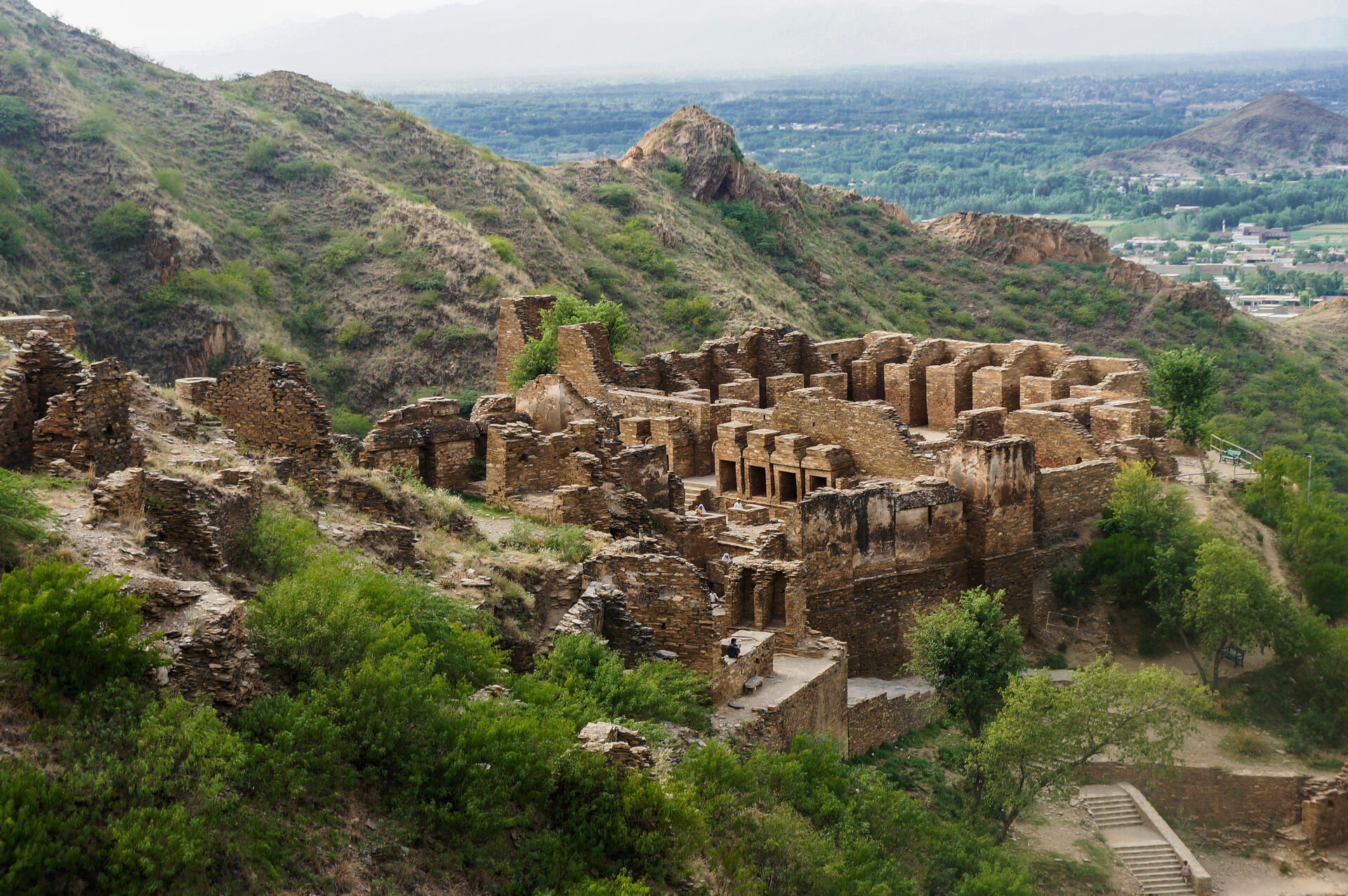
© Asif Nawaz, CC BY-SA 3.0 Resized from original. (This derivative is under the same CC BY-SA license.)
World Heritage Research
Discover scientific research and academic studies that deepen our understanding of Buddhist Ruins of Takht-i-Bahi and Neighbouring City Remains at Sahr-i-Bahlol from its history and significance to its conservation, management, and contemporary challenges.
-
Leveraging neural networks to model tourist behaviour for sustainable heritage conservation
A significant finding from this study is that ecological and socio-cultural factors play the most pivotal roles in sustaining UNESCO World Heritage Sites, particularly those in Pakistan. The research leverages artificial neural network (ANN) algorithms to analyze tourist satisfaction data collected from 417 national tourists across six heritage sites, including the Buddhist Ruins of Takht-i-Bahi and Sahr-i-Bahlol. Using a five-point Likert scale, the study identifies that while ecological perspectives are most influential in achieving sustainability, socio-cultural factors also have a notable positive impact. Economic factors, however, were found to be the least influential. This data-driven analysis offers valuable insights for policymakers, providing a foundation for economic modeling, preservation strategies, marketing, and policy implementation aimed at enhancing sustainable heritage conservation.
Waleed, AlZubi, A. A., & Shah, W. U. (2026). Leveraging neural networks to model tourist behaviour for sustainable heritage conservation. Scientific Reports, 16(1). https://doi.org/10.1038/s41598-026-49345-x
View Publication Record | Read Publication -
Unveiling the Prospects, Potential and Challenges of Archaeological Tourism in Pakistan
Pakistan's archaeological tourism, particularly at UNESCO World Heritage Sites like the Buddhist Ruins of Takht-i-Bahi, holds significant potential for economic growth and cultural preservation but faces substantial challenges. These include inadequate infrastructure, poor coordination among departments, lack of private investment, and limited digital marketing efforts. The study identifies five key strategies to address these issues: developing robust infrastructure, promoting sustainable tourism practices, engaging local communities, enhancing digital marketing, and strengthening public-private partnerships. By implementing these measures, Pakistan can effectively preserve its heritage while boosting tourism-related economic benefits.
Zubair Akhtar, & Muhammad Mohsin. (2025). Unveiling the Prospects, Potential and Challenges of Archaeological Tourism in Pakistan. ACADEMIA International Journal for Social Sciences, 4(1), 1283–1291. https://doi.org/10.63056/acad.004.03.0724
View Publication Record | Read Publication -
Reconstructing the Buddhist’s Monastic Society in Hazara from the 3rd Century BC to 5th Century CE: An Archaeological and Historical Approach
Archaeological and historical evidence from the UNESCO World Heritage Site of Takht-i-Bahi reveals the early establishment of a Buddhist monastic society in Hazara, Pakistan, spanning from the 3rd century BC to the 5th century CE. This study challenges the notion that Buddhism's spread was solely attributed to Emperor Ashoka, highlighting instead its independent development in this region. Key findings include inscriptions, stupas, and monastic remains that provide insights into the organization and practices of Buddhist communities during this period. The research employs a multidisciplinary approach, integrating archaeological data with textual analysis, to reconstruct the social structure and religious dynamics of Hazara's Buddhist society.
Zahoor, M., & Shakirullah. (2024). Reconstructing the Buddhist’s Monastic Society in Hazara from the 3rd Century BC to 5th Century CE: An Archaeological and Historical Approach. Central Asia, 93(Winter), 85–106. https://doi.org/10.54418/ca-93.208
View Publication Record | Read Publication -
Critical Review of Pakistani Current Legislation on Sustainable Protection of Cultural Heritage
Pakistan's current legislation on cultural heritage, rooted in British colonial-era frameworks with limited post-independence updates, remains the cornerstone for protecting archaeological sites and monuments like Takht-i-Bahi. However, the study highlights a critical gap: while these laws are comprehensive and universally applicable, they lack sufficient amendments or modernized guidelines to address contemporary threats to heritage preservation effectively. The research emphasizes an urgent need for advanced management policies that bridge historical legality with sustainable practices, ensuring these sites—symbols of Pakistan's past—endure for future generations.
Khan, N. A., Nuti, C., Monti, G., & Micheli, M. (2022). Critical Review of Pakistani Current Legislation on Sustainable Protection of Cultural Heritage. Sustainability, 14(6), 3633. https://doi.org/10.3390/su14063633
View Publication Record | Read Publication