World Heritage Identification Number: 708
World Heritage since: 1994
Category: Cultural Heritage
WHE Type: Buildings & Architectural Ensembles
Transboundary Heritage: No
Endangered Heritage: No
Country: 🇬🇪 Georgia
Continent: Asia
UNESCO World Region: Europe and North America
Map
Historical Monuments of Mtskheta: A Testament to Ancient Georgian Architecture and Culture
The Historical Monuments of Mtskheta, inscribed as a UNESCO World Heritage Site in 1994, stand as a testament to the rich architectural and cultural heritage of ancient Georgia. Located in the region of Mtskheta-Mtianeti, approximately 20 kilometers north of Tbilisi, Mtskheta is one of the oldest continually inhabited cities in the world, nestled at the confluence of the Kura and Aragvi rivers.
More to come…UNESCO Description of the World Heritage Site
The historic churches of Mtskheta, former capital of Georgia, are outstanding examples of medieval religious architecture in the Caucasus. They show the high artistic and cultural level attained by this ancient kingdom.
UNESCO Justification of the World Heritage Site
Criterion (iii): The historical monuments of Mtskheta bear testimony to the high level of art and culture of the vanished Kingdom of Georgia, which played an outstanding role in the medieval history of its region. They express the introduction and diffusion of Christianity to the Caucasian mountain region and bear testimony of the social, political and economic evolution of the region since the late 3rd millennium BC.
Criterion (iv): The historic churches of Mtskheta, including Jvari Monastery, Svetitskhoveli Cathedral and Samtavro Monastery, are outstanding examples of medieval ecclesiastical architecture in the Caucasus region, and represent different phases of the development of this building typology, ranging from the 4th to the 18th centuries.
Encyclopedia Record: Mtskheta
Mtskheta is a city in the region of Mtskheta-Mtianeti, Georgia. It is one of the oldest continuously inhabited cities in the world. It is located approximately 20 km (12 mi) north of Tbilisi, at the confluence of the Kura and Aragvi rivers. Currently a small provincial capital, for nearly a millennium until the 5th century AD, Mtskheta was a large fortified city and a significant economic and political center of the Kingdom of Iberia.Additional Site Details
Area: 3.85 hectares
Number of Components: 3
(iv) — Outstanding example of a type of building or landscape
Coordinates: 41.8422777778 , 44.7210277778
Image
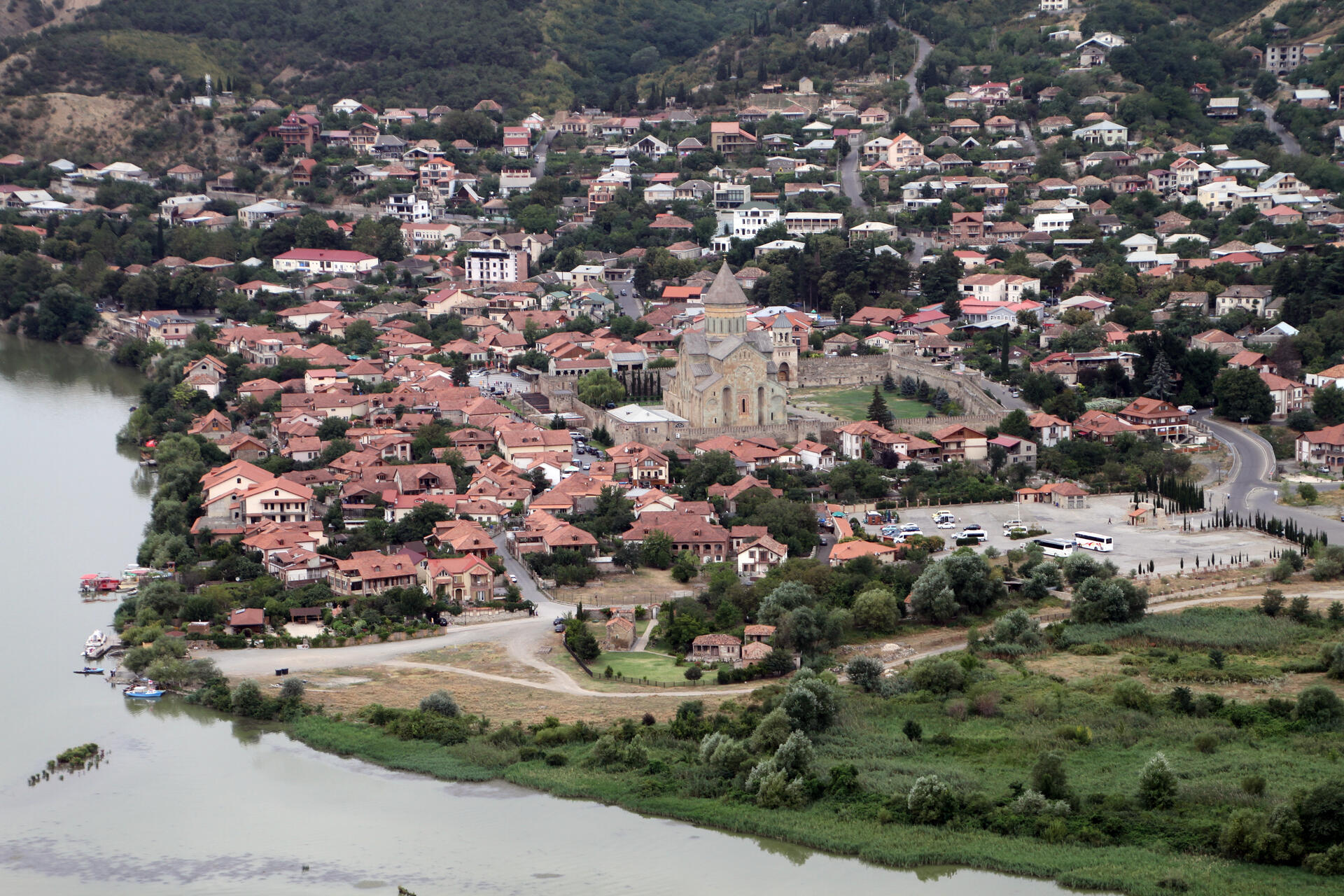
© Gerd Eichmann, CC BY-SA 4.0 Resized from original. (This derivative is under the same CC BY-SA license.)
World Heritage Research
Discover scientific research and academic studies that deepen our understanding of Historical Monuments of Mtskheta from its history and significance to its conservation, management, and contemporary challenges.
-
Circle of the Authors of the Sukhum Diocese Publication “Employee of the Transcaucasian Mission”. D.I. Gulia. K.D. Machavariani
The magazine 'Employee of the Transcaucasian Mission' (1912–1916), the first printed organ of the Sukhum diocese, significantly contributed to the development of Abkhaz culture, science, and literature through the works of D.I. Gulia and K.D. Machavariani. These educators, known for their role in creating the 'Abkhaz Alphabet,' published influential articles that addressed contemporary needs and historical preservation, such as Gulia's 'What Abkhazia Needs' and Machavariani's 'The Ancient Bedia Temple and Its Treasures.' Their publications, guided by Bishop Andrey (Ukhtomsky), reflected a structured program aligned with the diocese's goals. The study analyzes the cultural and historical context of these works, revealing their importance in shaping the authors' creative paths.
Sterlikova, S. A. (2025). Circle of the Authors of the Sukhum Diocese Publication “Employee of the Transcaucasian Mission”. D.I. Gulia. K.D. Machavariani. Abkhazia in Russian Literature of the 19th — 20th Centuries: In 3 Vols. Vol. 3, 401–418. https://doi.org/10.22455/arl-2025-3-401-418
View Publication Record | Read Publication -
Landscape functions: Some methodological issues for urban planning from a case study of Mtskheta, Georgia
A study on Mtskheta, Georgia's historical capital, identifies five critical landscape functions—urban, environmental protection, environment restoration, recreation, and resource production—that highlight the ecological value of landscape planning. The research emphasizes the importance of integrating landscape-ecological factors, socioeconomic influences, sustainability, and potential in urban planning. By analyzing structural and functional peculiarities, current conditions, and societal expectations, the study provides a methodological framework for defining landscape functions, contributing valuable insights to conservation efforts and sustainable development in UNESCO World Heritage Sites.
Elizbarashvili, N., Meladze, G., Gordeziani, T., Sandodze, G., Grigolia, L., & Gudzuadze, G. (2024). Landscape functions: Some methodological issues for urban planning from a case study of Mtskheta, Georgia. Geografie, 129(2), 145–158. https://doi.org/10.37040/geografie.2024.010
View Publication Record | Read Publication -
Heritage Landscape and Historical Context – Essence and Principles of Planning in Georgia
Georgian cultural heritage landscapes exhibit unique principles of harmonious coexistence between society and nature, rooted in traditions of grain cultivation (wheat) and viticulture (vines). Key planning principles—relevance, socio-economic tension, and legal regulations—shape these landscapes. The study highlights the need for further research to motivate Georgian geographers in addressing gaps in this field. By analyzing historical and cultural units, it provides insights into sustainable heritage management, contributing to global discussions on landscape preservation.
Elizbarashvili, N., Bubashvili, L., Gurgenidze, M., Manvelidze, K., Elizbarashvili, R., & Abramishvili, S. (2024). Heritage Landscape and Historical Context – Essence and Principles of Planning in Georgia. Global Journal of Botanical Science, 12, 1–6. https://doi.org/10.12974/2311-858x.2024.12.01
View Publication Record | Read Publication -
Multicultural Georgia: The Territorial and Ideological Foundation for Caucasian Unity
Georgia's multicultural heritage, shaped by centuries of migration and interaction with diverse ethnic groups, serves as both a territorial and ideological foundation for unity in the Caucasus. The study reveals that periodic migrations of Greeks, Jews, Armenians, Persians, Turkmens, and others have significantly influenced Georgia's nation-state development. Key findings include the ancient Greek settlements linked to Black Sea colonization (VIII-VI c. BC), Jewish colonies dating back to at least 169 BC in Mtskheta, and waves of Armenian refugees seeking asylum from political or religious persecution in Persia and the Ottoman Empire. Additionally, Assyrian communities resettled in Georgia during the 18th century onwards, further enriching its multicultural tapestry. The research approach involves a historical analysis of migration patterns, ethnic interactions, and their impacts on Georgian statehood, drawing from ancient historiography and scholarly sources.
Khorava, B., & Jojua, D. (2024). Multicultural Georgia: The Territorial and Ideological Foundation for Caucasian Unity. International Scientific Journal “The Caucasus and the World”. https://doi.org/10.52340/isj.2024.28.08
View Publication Record | Read Publication -
Храмы Ани в контексте армяно-грузинских архитектурных взаимосвязей второй половины X — первой половины XI века. К постановке проблемы
A new perspective on Armenian-Georgian architectural interrelations reveals active and intensive exchanges between the two regions during the late 10th to early 11th centuries, a period marked by the flourishing of Ani in Armenia and significant cathedral construction in Georgia. The study identifies striking similarities in church typology and decorative forms—such as combined squinch-pendentive transitions, pseudo-Ionic capitals, and conch niche designs—that suggest not just parallel development or shared roots but evidence of direct cultural exchange between elites and master builders. Preliminary findings highlight the potential for deeper analysis, including the comparison of Tayk’s (Tao) cathedrals with Ani Cathedral and Samtavro in Mtskheta, pointing to a dynamic period of architectural innovation. This research was supported by the Russian Science Foundation.
Казарян, Армен Юрьевич, & Баева, Ольга Владимировна. (2024). Churches of Ani in the Context of Armenian-Georgian Architectural Interrelations of the Second Half of the 10th – First Half of the 11th Century: Addressing the Problem. Actual Problems of Theory and History of Art, 14, 170–181. https://doi.org/10.18688/aa2414-2-12
View Publication Record | Read Publication -
Potential and Prospects of Renovation of Historic Dwelling Houses in Georgia (Mtskheta Case Study)
Renovation of historic dwelling houses in Mtskheta, Georgia, demonstrates that minimal structural interventions can significantly enhance living space and comfort while preserving architectural integrity. The study found that by replacing damaged roofs with reinforced concrete belts and tiles, and transitioning from four-slope to two-slope roofs where necessary, the renovation process increased floor height and created organized free space in most houses. This approach added 30-40% of additional living area without altering the perimeter or violating the historical structure's integrity. The method proved effective for modernizing existing residential buildings while adhering to cultural heritage conservation standards, offering a potential model for similar renovations in other Georgian cities and districts.
Churadze, N. (2023). Potential and Prospects of Renovation of Historic Dwelling Houses in Georgia (Mtskheta Case Study). Caucasus Journal of Social Sciences, 4(1), 55–64. https://doi.org/10.62343/cjss.2011.61
View Publication Record | Read Publication -
Some Aspects of Rehabilitation of Historical Town (Town Mtskheta)
Rehabilitation of historical towns, particularly those with UNESCO World Heritage status, is critical for preserving cultural heritage while fostering sustainable development. This study highlights key aspects of rehabilitating Mtskheta, a historical town in Georgia, focusing on architectural and urban planning challenges tied to tourism growth. It proposes generalized recommendations for small cities' development, emphasizing the preservation of historical districts and the integration of traditional craftsmanship. The research underscores Georgia's unique potential for diverse tourism, linking cultural conservation with socio-economic benefits.
Churadze, N. (2023). Some Aspects of Rehabilitation of Historical Town (Town Mtskheta). Caucasus Journal of Social Sciences, 3(1), 20–28. https://doi.org/10.62343/cjss.2010.32
View Publication Record | Read Publication