World Heritage Identification Number: 777
World Heritage since: 1996
Category: Cultural Heritage
WHE Type: Religious Sites & Sacred Architecture
Transboundary Heritage: No
Endangered Heritage: No
Country: 🇦🇲 Armenia
Continent: Asia
UNESCO World Region: Europe and North America
Map
Monasteries of Haghpat and Sanahin: A Testament to Armenian Architectural Mastery
The Monasteries of Haghpat and Sanahin, nestled in the picturesque landscape of the Tumanian region in Armenia, stand as a testament to the architectural prowess and cultural significance of the Kiurikian dynasty (10th to 13th century). Inscribed as a UNESCO World Heritage Site in 1996, these two Byzantine monasteries have played pivotal roles as centers of learning and spiritual enlightenment.
More to come…UNESCO Description of the World Heritage Site
These two Byzantine monasteries in the Tumanian region from the period of prosperity during the Kiurikian dynasty (10th to 13th century) were important centres of learning. Sanahin was renown for its school of illuminators and calligraphers. The two monastic complexes represent the highest flowering of Armenian religious architecture, whose unique style developed from a blending of elements of Byzantine ecclesiastical architecture and the traditional vernacular architecture of the Caucasian region.
UNESCO Justification of the World Heritage Site
Criterion (ii): The monasteries of Sanahin and Haghpat are unique by virtue of their blending of elements of both Byzantine church architecture and traditional vernacular building styles of this region.
Criterion (iv): The monasteries of Sanahin and Haghpat are outstanding examples of the ecclesiastical architecture that developed in Armenia from the 10th to the 13th century.
Encyclopedia Record: Haghpat Monastery
Haghpat Monastery, also known as Haghpatavank, is a medieval Armenian monastery complex in Haghpat, Armenia, built between the 10th and 13th century.Additional Site Details
Area: 2.65 hectares
Number of Components: 3
(iv) — Outstanding example of a type of building or landscape
Coordinates: 41.095 , 44.71028
Image
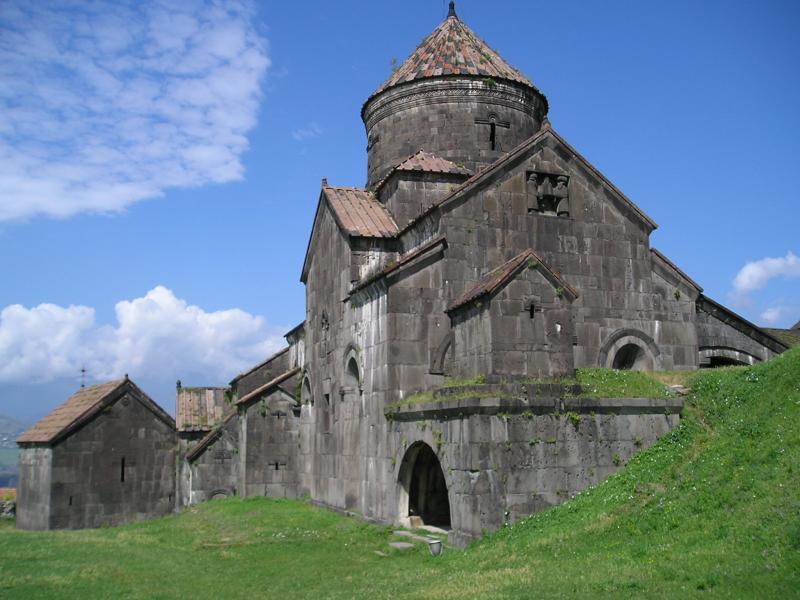
Unknown, Public domain
World Heritage Research
Discover scientific research and academic studies that deepen our understanding of Monasteries of Haghpat and Sanahin from its history and significance to its conservation, management, and contemporary challenges.
-
Mesrob z Kaffy († 1624) – ostatni przedunijny arcybiskup „wszystkich Ormian obojga płci, mieszkających we Lwowie, Kijowie, Łucku i Zamościu”
Mesrop of Kaffa (†1624) stands as the last pre-Union Armenian archbishop overseeing communities across Lviv, Kiev, Lutsk, and Zamość before the union with the Holy See. Born in a mixed Armenian-Ruthenian family in Moldavia, his life traversed Crimea, Armenia, and Poland, where he was ordained and rose through ecclesiastical ranks. His journey—marked by pilgrimages, manuscript searches, and formal appointments—culminated in his recognition as archbishop of Lviv in 1623. Mesrop’s legacy includes patronage of Armenian churches, notably founding an altar in Kamieniec Podolski, and a documented will in Kipchak-Armenian ethnolect. The study reconstructs his life through historical records, including royal decrees and chronicles, offering insight into the socio-religious dynamics of pre-Union Armenian communities in Eastern Europe.
Stopka, K. (2025). Mesrob z Kaffy († 1624) – ostatni przedunijny arcybiskup „wszystkich Ormian obojga płci, mieszkających we Lwowie, Kijowie, Łucku i Zamościu”. Lehahayer, 11, 183–217. https://doi.org/10.12797/lh.11.2024.11.02
View Publication Record | Read Publication -
The Frescoes of the Haghpat Monastery in the Historical-Confessional Context of the 13th Century
Frescoes from the Haghpat Monastery, dating to the 13th century, reveal a complex interplay of religious and political dynamics during two distinct phases. The earlier frescoes, executed under the patronage of Zakare in the early 1200s, featured bilingual Orthodox Armenian inscriptions, signifying a period of rising Armenian-Chalcedonian influence despite the monastery's non-Chalcedonian affiliation. A later renovation in the 1280s, commissioned by the Artsrunid family, aligned with the Armenian National Church, reflecting shifting confessional loyalties post-earthquake. This study deciphers these frescoes as markers of historical transitions, providing insight into the monastery's evolving religious and political landscape during a pivotal era.
Hakobyan, Z. A. (2021). The Frescoes of the Haghpat Monastery in the Historical-Confessional Context of the 13th Century. Actual Problems of Theory and History of Art, 11, 256–267. https://doi.org/10.18688/aa2111-02-21
View Publication Record | Read Publication -
Diagnosis of Tourism Enhancement of the UNESCO World Heritage Ensemble of Apostolic Churches of Armenia
Armenia's UNESCO World Heritage Sites, including the Monasteries of Haghpat and Sanahin, exhibit significant but underutilized tourism potential. Despite their historical significance (dating back to the 4th century), spiritual relevance, and architectural uniqueness, some sites experience low public visitation. This study, pioneering in Armenia, diagnoses the current state of these sites through observational fieldwork, bibliographic review, and heritage inventory preparation. It evaluates both tourism appeal and intrinsic values using technical criteria, revealing that the Monastery of Geghard and the Cathedral of Echmiatsin stand out due to their accessibility, conservation status, and attractiveness. The research proposes heritage enhancement tools to improve physical and intellectual access, aiming to boost sustainable tourism while preserving these cultural treasures.
Sanasaryan, A., & Viñals, M. J. (2020). DIAGNOSIS OF TOURISM ENHANCEMENT OF THE UNESCO WORLD HERITAGE ENSEMBLE OF APOSTOLIC CHURCHES OF ARMENIA. The International Archives of the Photogrammetry, Remote Sensing and Spatial Information Sciences, XLIV-M-1-2020, 551–557. https://doi.org/10.5194/isprs-archives-xliv-m-1-2020-551-2020
View Publication Record | Read Publication -
Open access web mapping as a virtual survey tool for cultural heritage: an application to the Armenian religious architecture documented by Paolo Cuneo
A recent study highlights the potential of open access web mapping as a powerful virtual survey tool for assessing and monitoring cultural heritage sites, particularly those vulnerable to natural hazards like earthquakes. The research demonstrates how interdisciplinary integration of ICT tools can enhance conservation efforts by providing restorers and structural engineers with accessible, graphical data representations. Focusing on the Monastery of Haghpat in Armenia, the study evaluates user perspectives on these platforms, drawing from the legacy of architect Paolo Cuneo's documentation work. By leveraging modern web-based mapping technologies, the research offers a practical approach to risk management for historical and architectural assets, bridging traditional expertise with contemporary digital solutions.
Marra, A., & Fabbrocino, G. (2020). Open access web mapping as a virtual survey tool for cultural heritage: an application to the Armenian religious architecture documented by Paolo Cuneo. DISEGNARECON. https://doi.org/10.20365/DISEGNARECON.25.2020.7
View Publication Record | Read Publication -
Theoretical Model of Restoration of Bardzrakash Monastery Complex of the X-XIII Centuries
A theoretical model for the restoration of Bardzrakash Monastery Complex, dating from the 10th to 13th centuries, reveals key architectural features and planning organization. The study proposes solutions for the eastern and western facades of the small church, substantiates tholobate and dome shapes, and determines the contours of Surp Astvatsatsin church's facades. It also presents a hypothesis on the completion of the monastery gavit's main part. The model is based on analysis of building ruins, measurement data, photofixation, and descriptions, with chronologically and territorially close monuments like Goshavank, Haghartsin, and Haghpat serving as analogues for reconstructing lost elements.
Baragamyan, B. O. (2019). THEORETICAL MODEL OF RESTORATION OF BARDZRAKASH MONASTERY COMPLEX OF THE X-XIII CENTURIES. Манускрипт, 12(8), 165–168. https://doi.org/10.30853/manuscript.2019.8.33
View Publication Record | Read Publication