World Heritage Identification Number: 781
World Heritage since: 1996
Category: Cultural Heritage
WHE Type: Historic Cities & Urban Areas
Transboundary Heritage: No
Endangered Heritage: No
Country: 🇪🇸 Spain
Continent: Europe
UNESCO World Region: Europe and North America
Map
The Historic Walled Town of Cuenca: A Medieval Gem in Castilla-La Mancha, Spain
The Historic Walled Town of Cuenca, inscribed as a UNESCO World Heritage Site in 1996, stands as a testament to the rich history and architectural prowess of medieval Spain. Nestled within the autonomous community of Castilla-La Mancha, this remarkable city serves as the capital of the province of Cuenca, offering visitors a unique blend of ancient charm and breathtaking natural beauty.
More to come…UNESCO Description of the World Heritage Site
Built by the Moors in a defensive position at the heart of the Caliphate of Cordoba, Cuenca is an unusually well-preserved medieval fortified city. Conquered by the Castilians in the 12th century, it became a royal town and bishopric endowed with important buildings, such as Spain's first Gothic cathedral, and the famous casas colgadas (hanging houses), suspended from sheer cliffs overlooking the Huécar river. Taking full advantage of its location, the city towers above the magnificent countryside.
UNESCO Justification of the World Heritage Site
Criterion (ii): The Old Town of Cuenca is an outstanding example of the medieval fortress town that has preserved its original townscape remarkably intact along with many excellent examples of religious and secular architecture from the 12th to 18th centuries.
Criterion (v): Cuenca is also exceptional because the walled town blends into and enhances the fine rural and natural landscape within which it is situated.
Encyclopedia Record: Cuenca, Spain
Cuenca is a city and municipality of Spain located in the autonomous community of Castilla–La Mancha and the capital of the province of Cuenca.Additional Site Details
Area: 22.79 hectares
Number of Components: 4
(v) — Outstanding example of traditional human settlement
Coordinates: 40.07662 , -2.13174
Image
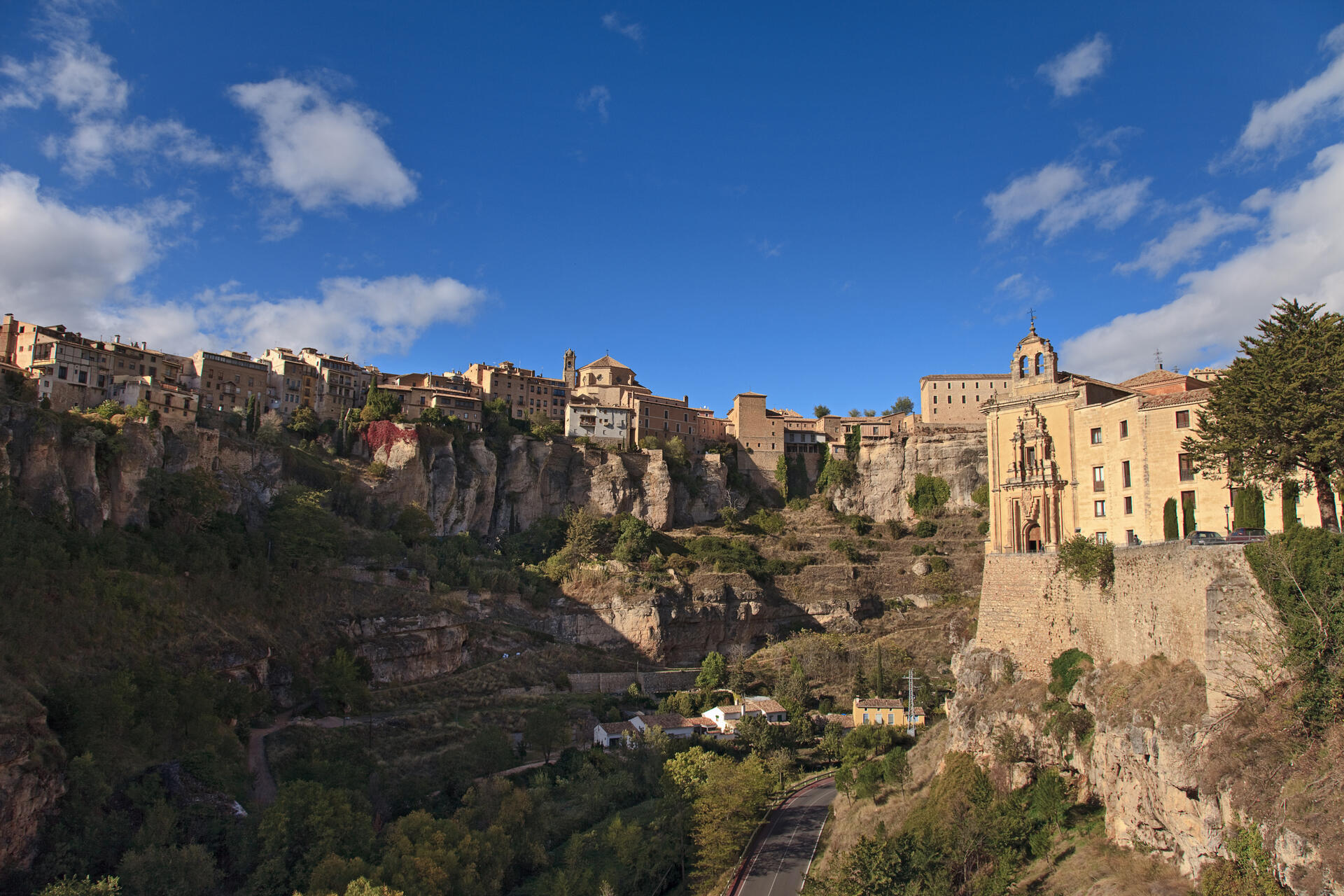
© Tomás Fano, CC BY-SA 2.0 Resized from original. (This derivative is under the same CC BY-SA license.)
World Heritage Research
Discover scientific research and academic studies that deepen our understanding of Historic Walled Town of Cuenca from its history and significance to its conservation, management, and contemporary challenges.
-
From Ruin to Resource: The Role of Heritage and Structural Rehabilitation in the Economic and Territorial Regeneration of Rural Areas
Abandoned historic settlements can be revitalized as cultural resources to spur economic and territorial regeneration, particularly in rural areas facing depopulation. This study demonstrates that integrating heritage conservation with adaptive reuse—such as temporary occupation and flexible land use—can transform ruins into viable assets without requiring permanent repopulation. Using the ruins of Moya (Cuenca, Spain) as a case study, researchers developed an integrated strategy combining structural rehabilitation, vernacular fabric preservation, and functional area organization. The approach emphasizes activating monumental heritage while respecting historical identity, offering a replicable model for sustainable development in declining rural environments. Evaluated against national and international examples, this framework bridges physical restoration with economic and educational programs to strengthen local economies and territorial cohesion.
Barelles-Vicente, E., Torner-Feltrer, M. E., Llinares Millán, J., & Aparicio-Fernández, C. (2025). From Ruin to Resource: The Role of Heritage and Structural Rehabilitation in the Economic and Territorial Regeneration of Rural Areas. Land, 14(9), 1765. https://doi.org/10.3390/land14091765
View Publication Record | Read Publication -
Interventions And Acoustic Nuances In The Soundwalks With Daumal And ISO 12913 Methods In Elche, Cuenca And Faro
Soundwalks using the Daumal Method, which involve participants with visually impaired guides and notaries, significantly enhance auditory perception of urban environments. This approach, tested in Elche, Cuenca, and Faro, demonstrates that structured group interventions—where roles are rotated—foster deeper sound awareness among participants. The study found that guided exploration, combined with expert-led interventions highlighting acoustic nuances like spatial qualities and material properties, leads to higher participant satisfaction compared to traditional soundwalks. This method offers a novel, participatory way to educate individuals about the auditory dimensions of cities, aligning with ISO 12913 standards for soundscapes.
daumal i domènech, f., Vida Manzano, J., Herguedas, S., & Silva Antunes, S. (2025). Interventions And Acoustic Nuances In The Soundwalks With Daumal And ISO 12913 Methods In Elche, Cuenca And Faro. Proceedings of the 11th Convention of the European Acoustics Association Forum Acusticum / EuroNoise 2025, 4583–4590. https://doi.org/10.61782/fa.2025.0490
View Publication Record | Read Publication -
Changes in guests’ hotel evaluations due to covid-19: The case of the world heritage city of Cuenca
Guest satisfaction in hotels within the UNESCO World Heritage city of Cuenca improved during the later stages of the COVID-19 pandemic, though ratings remained below pre-pandemic levels. The study analyzed 1595 hotel reviews from the Booking platform, revealing that service quality was a critical factor in guest satisfaction. An ANOVA analysis identified key influences on satisfaction, including urban/rural location, traveler type, nationality, gender, and room type. Despite challenges posed by the pandemic, hotels that maintained or enhanced their services saw positive outcomes, suggesting that prioritizing high-quality service can mitigate negative impacts on guest evaluations.
ALFARO-NAVARRO, J. L., & ANDRÉS-MARTÍNEZ, M.-E. (2023). Changes in guests’ hotel evaluations due to covid-19: The case of the world heritage city of Cuenca. Tourism and Hospitality Management, 30(1), 1–13. https://doi.org/10.20867/thm.30.1.1
View Publication Record | Read Publication -
Architectural and cultural heritage as a driver of social change in rural areas: 10 years (2009–2019) of management and recovery in Huete, a town of Cuenca, Spain
A decade of heritage management in Huete, Spain, demonstrates that architectural and cultural preservation can drive significant social change in rural areas. The study found that targeted restoration efforts and community engagement not only revitalized historic buildings but also fostered local empowerment, innovation, and economic growth through tourism. Researchers used Participatory Impact Pathway Analysis (PIPA) and Positive Social Change (PSC) frameworks to assess the impact of the Fundación Huete Futuro's initiatives between 2009 and 2019. The results revealed that integrating social participation into heritage planning shifted local perceptions, turning cultural assets into tools for development while promoting sustainable rural growth.
Quintana, D. C., Díaz-Puente, J. M., & Gallego-Moreno, F. (2022). Architectural and cultural heritage as a driver of social change in rural areas: 10 years (2009–2019) of management and recovery in Huete, a town of Cuenca, Spain. Land Use Policy, 115, 106017. https://doi.org/10.1016/j.landusepol.2022.106017
View Publication Record | Read Publication -
Urban Scene Protection and Unconventional Practices—Contemporary Landscapes in World Heritage Cities of Spain
Outdated protection policies in UNESCO World Heritage Sites often conflict with contemporary values, such as informality and creativity, leading to a mismatch between heritage preservation and modern cultural practices. This study highlights how the Historic Urban Landscape approach can adapt local appraisal methods to better reflect social value. By analyzing Spanish World Heritage cities like Cuenca, it demonstrates that participatory heritage-making and ethical evaluations are crucial for reconciling traditional protection frameworks with evolving contemporary landscapes.
García-Esparza, J. A. (2022). Urban Scene Protection and Unconventional Practices—Contemporary Landscapes in World Heritage Cities of Spain. Land, 11(3), 324. https://doi.org/10.3390/land11030324
View Publication Record | Read Publication -
Perfil, motivación y satisfacción del visitante turístico: el caso de Cuenca, ciudad patrimonio de la humanidad
A key insight from this study is that visitor motivation serves as an effective criterion for segmenting tourists in Cuenca to tailor services and products more precisely. The research also reveals that tourist satisfaction is closely tied to their motivations, except for 'general satisfiers,' which suggests targeted marketing strategies could enhance visitor experience. To uncover these findings, the study employed two questionnaires to gather data on sociodemographic factors, travel characteristics, and motivations from visitors. Statistical analysis using SPSS further validated these relationships. Additionally, the research highlights the importance of promoting Cuenca through potential source markets and leveraging digital channels, while emphasizing the significance of destination image in attracting tourists.
López Díaz, G. S., & Sastre Espada, J. (2021). Perfil, motivación y satisfacción del visitante turístico: el caso de Cuenca, ciudad patrimonio de la humanidad. Ayana. Revista de Investigación En Turismo, 9. https://doi.org/10.24215/27186717e009
View Publication Record | Read Publication -
Loss Estimation for Typical Adobe Façades of Cuenca (Ecuador) Due to Earthquake Scenarios
Researchers have developed fragility curves to assess the seismic vulnerability of adobe façade walls, a common construction material in earthquake-prone regions. Focusing on 45 buildings in Cuenca, Ecuadorthis study identified critical failure mechanisms under out-of-plane loading and estimated repair costs post-earthquake scenarios. The analysis, based on demand versus capacity assessments across varying seismic intensities, classified structures by vulnerability and provided a framework for replicating the method in similar adobe-dominated areas. Findings highlight the need for targeted interventions to mitigate risks in historic and vulnerable constructions.
Cárdenas-Haro, X., Tarque, N., Todisco, L., & León, J. (2021). Loss Estimation for Typical Adobe Façades of Cuenca (Ecuador) Due to Earthquake Scenarios. International Journal of Architectural Heritage, 17(5), 788–814. https://doi.org/10.1080/15583058.2021.1977417
View Publication Record | Read Publication