World Heritage Identification Number: 588
World Heritage since: 1991
Category: Natural Heritage
WHE Type: Natural Landscapes & Geographic Features
Transboundary Heritage: No
Endangered Heritage: No
Country: 🇷🇴 Romania
Continent: Europe
UNESCO World Region: Europe and North America
Map
The Danube Delta: A Biodiverse European River Delta
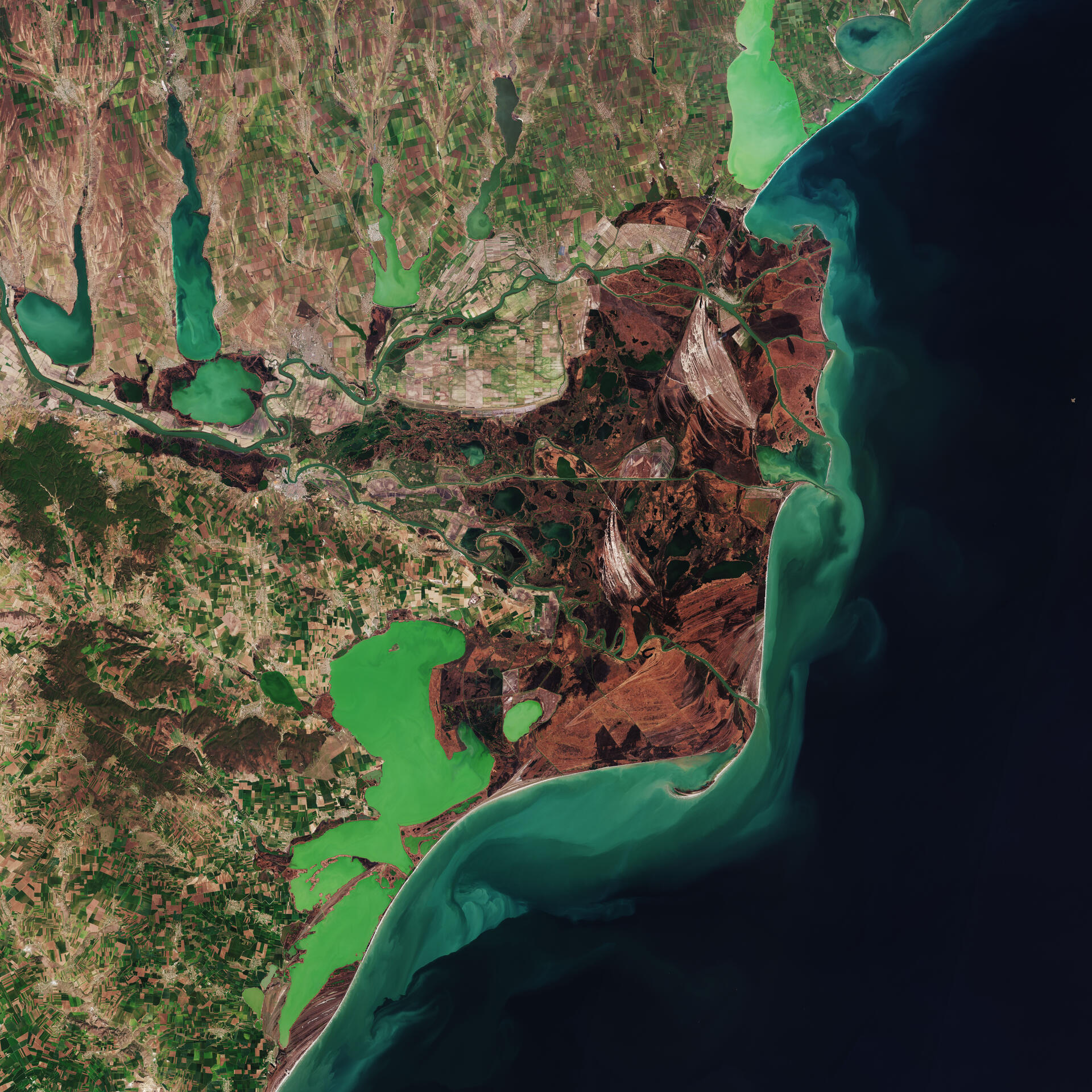
The Danube Delta, inscribed as a UNESCO World Heritage Site in 1991, is the second largest river delta in Europe, surpassed only by the Volga Delta. This expansive wetland ecosystem, covering approximately 4,150 square kilometers, is primarily situated within Romania, with a minor portion extending into Ukraine. When considering the Razim–Sinoe lagoon complex, geologically and ecologically linked to the delta proper, the total area encompasses 5,800 square kilometers.
The Danube Delta is formed where the mighty Danube River meets the Black Sea. The delta’s formation began approximately 6,000–10,000 years ago, as Black Sea levels stabilized and sediment carried by the Danube accumulated at its mouth along the Black Sea coast. Over time, the delta has evolved into a complex network of channels, lakes, and marshes that provide critical habitat for an abundance of plant and animal life.
One of the delta's most striking features is its biodiversity. More than 300 bird species call the Danube Delta home, making it one of the most important bird sanctuaries in Europe. These avian inhabitants include rare species such as the Dalmatian pelican, white-tailed eagle, and pygmy cormorant. Additionally, the delta supports around 45 resident freshwater fish species, while records identify between 75 and 135 fish species in total when migratory and marine visitors are included, including anadromous sturgeon, as well as catfish, pike, and zander.
The delta's rich biodiversity can be attributed to its diverse habitats. Freshwater lakes, brackish water lagoons, and saltwater estuaries create a gradient of salinity that supports a wide range of aquatic life. The delta's marshlands also provide essential nesting and feeding grounds for migratory birds. Furthermore, the delta's forests, reeds, and steppe grasslands offer shelter and food sources for various terrestrial animals, such as wild boars and wolves.
In addition to its natural beauty and abundant wildlife, the Danube Delta holds significant cultural value. The delta has been inhabited for thousands of years, with evidence of human settlement dating back to the Neolithic period. Today, the delta is home to several ethnic groups, including Romanians, Ukrainians, and Lipovans, each bringing their unique traditions and customs to the region.
Preserving the Danube Delta's natural and cultural heritage is crucial for future generations. Efforts to protect the delta include designating large areas as protected nature reserves, implementing sustainable tourism practices, and promoting conservation awareness among local communities. By preserving this remarkable ecosystem, we ensure not only the survival of its incredible biodiversity but also the continued enjoyment of its beauty and cultural significance for generations to come.
UNESCO Description of the World Heritage Site
The waters of the Danube, which flow into the Black Sea, form the largest and best preserved of Europe's deltas. The Danube delta hosts over 300 species of birds as well as 45 freshwater fish species in its numerous lakes and marshes.
Encyclopedia Record: Danube Delta
The Danube Delta is the second largest river delta in Europe, after the Volga Delta, and is the best preserved on the continent. Occurring where the Danube River empties into the Black Sea, most of the Danube Delta lies in Romania, with a small part located in Ukraine. Its approximate surface area is 4,152 square kilometres, of which 3,446 km2 (1,331 sq mi) is in Romania. With the lagoons of Razim–Sinoe, located south of the main delta, the total area of the Danube Delta is 5,165 km2 (1,994 sq mi). The Razim–Sinoe lagoon complex is geologically and ecologically related to the delta proper; the combined territory is listed as a World Heritage Site.Additional Site Details
Area: 312,440 hectares
Number of Components: 1
(x) — Contains most important habitats for biodiversity
Coordinates: 45.08333 , 29.5
IUCN World Heritage Outlook
The 2025 Conservation Outlook on Danube Delta reports the following assessment:
Source: International Union for Conservation of Nature (IUCN) · View assessment
World Heritage Research
Discover scientific research and academic studies that deepen our understanding of Danube Delta from its history and significance to its conservation, management, and contemporary challenges.
-
The Danube Delta
The Danube Delta has undergone five distinct evolutionary phases since its formation during the Quaternary period, primarily driven by sediment deposition from the Danube River. These phases—spanning from 11700 to 2500 years BP—were identified through multi-disciplinary analyses including geomorphology, radiocarbon dating, and faunal studies. The research reveals a dynamic transition from the Initial Letea-Caraorman Spit to more complex deltaic formations like the St. George I and Sulina Deltas, culminating in modern structures such as the St. George II, Kilia, and Cosna-Sinoie Deltas. Additionally, the study highlights significant anthropogenic impacts on the delta over the last two centuries, providing critical insights into its geological history and current challenges.
Panin, N., Tiron Duţu, L., & Duţu, F. (2016). The Danube Delta. Méditerranée, 126, 37–54. https://doi.org/10.4000/mediterranee.8186
View Publication Record | Read Publication -
Crayfish plague pathogen detected in the Danube Delta – a potential threat to freshwater biodiversity in southeastern Europe
Researchers have detected the crayfish plague pathogen, Aphanomyces astaci, in the highly protected Danube Delta, posing a significant threat to native freshwater biodiversity. Using sensitive real-time PCR testing, 13 out of 40 native narrowclawed crayfish (Astacus leptodactylus) tested positive for the pathogen, indicating its widespread presence in the region. The study suggests that A. astaci may have persisted locally or spread via long-range dispersal, potentially jeopardizing European crayfish populations and freshwater ecosystems across southeastern Europe, previously considered plague-free. This discovery highlights the urgent need for conservation measures to mitigate the impact of invasive species and pathogens on vulnerable aquatic environments.
Schrimpf, A., Pârvulescu, L., Copilaș-Ciocianu, D., Petrusek, A., & Schulz, R. (2012). Crayfish plague pathogen detected in the Danube Delta – a potential threat to freshwater biodiversity in southeastern Europe. Aquatic Invasions, 7(4), 503–510. https://doi.org/10.3391/ai.2012.7.4.007
View Publication Record | Read Publication -
Crossing trails in the marshes: rigidity and flexibility in the governance of the Danube Delta
Environmental governance in the Danube Delta is shaped by rigid path dependencies and flexible interdependencies, with direct citizen participation alone risking reinforcement of informal institutions. The study combines path dependence theory and social systems theory to analyze governance evolution, revealing that effective reforms require collaboration across multiple institutions rather than isolated citizen engagement. This insight challenges conventional approaches to participatory governance in UNESCO World Heritage Sites like the Danube Delta.
Van Assche, K., Beunen, R., Jacobs, J., & Teampau, P. (2011). Crossing trails in the marshes: rigidity and flexibility in the governance of the Danube Delta. Journal of Environmental Planning and Management, 54(8), 997–1018. https://doi.org/10.1080/09640568.2010.547687
View Publication Record | Read Publication -
Delineating Locals: Transformations of Knowledge/Power and the Governance of the Danube Delta
Governance policies for the Danube Delta co-create a marginalized 'local' identity, shaped by power/knowledge dynamics that silence and exoticize communities. This study reveals how policies, emerging from multiple government levels, evolve through constant interaction with other power structures, leading to the subjugation of local actors. Using a Foucauldian framework, it analyzes policy emergence, enactment, and implementation to highlight the implications for participatory natural resource governance. The findings underscore the need to recognize and address these processes in environmental management strategies.
Van Assche, K., Duineveld, M., Beunen, R., & Teampau, P. (2011). Delineating Locals: Transformations of Knowledge/Power and the Governance of the Danube Delta. Journal of Environmental Policy & Planning, 13(1), 1–21. https://doi.org/10.1080/1523908x.2011.559087
View Publication Record | Read Publication