World Heritage Identification Number: 1054
World Heritage since: 2001
Category: Cultural Heritage
WHE Type: Religious Sites & Sacred Architecture
Transboundary Heritage: No
Endangered Heritage: No
Country: 🇵🇱 Poland
Continent: Europe
UNESCO World Region: Europe and North America
Map
The Churches of Peace in Jawor and Świdnica: A Testament to Religious Freedom
The Churches of Peace in Jawor and Świdnica, located in Lower Silesia, Poland, stand as remarkable examples of architectural ingenuity and religious tolerance. Inscribed as a UNESCO World Heritage Site in 2001, these churches offer a unique insight into the tumultuous history of the region during the Thirty Years' War (1618-1648).
More to come…UNESCO Description of the World Heritage Site
The Churches of Peace in Jawor and Świdnica, the largest timber-framed religious buildings in Europe, were built in the former Silesia in the mid-17th century, amid the religious strife that followed the Peace of Westphalia. Constrained by the physical and political conditions, the Churches of Peace bear testimony to the quest for religious freedom and are a rare expression of Lutheran ideology in an idiom generally associated with the Catholic Church.UNESCO Justification of the World Heritage Site
Criterion (iii): The Churches of Peace are outstanding testimony to an exceptional act of tolerance on the part of the Catholic Habsburg Emperor towards Protestant communities in Silesia in the period following the Thirty Years’ War in Europe.
Criterion (iv): As a result of conditions imposed by the Emperor, the Churches of Peace required the builders to implement pioneering constructional and architectural solutions of a scale and complexity unknown before or since in wooden architecture. The success may be judged by their survival to the present day.
Criterion (vi): The Churches of Peace bear exceptional witness to a particular political development in Europe in the 17th century of great spiritual power and commitment.
Encyclopedia Record: Churches of Peace
The Churches of Peace in Jawor and Świdnica in Lower Silesia. Poland, are 17th-century churches, named after the Peace of Westphalia of 1648.Additional Site Details
Area: 0.23 hectares
Number of Components: 2
(iv) — Outstanding example of a type of building or landscape
(vi) — Directly associated with events or living traditions
Coordinates: 51.05427778 , 16.19594444
Image
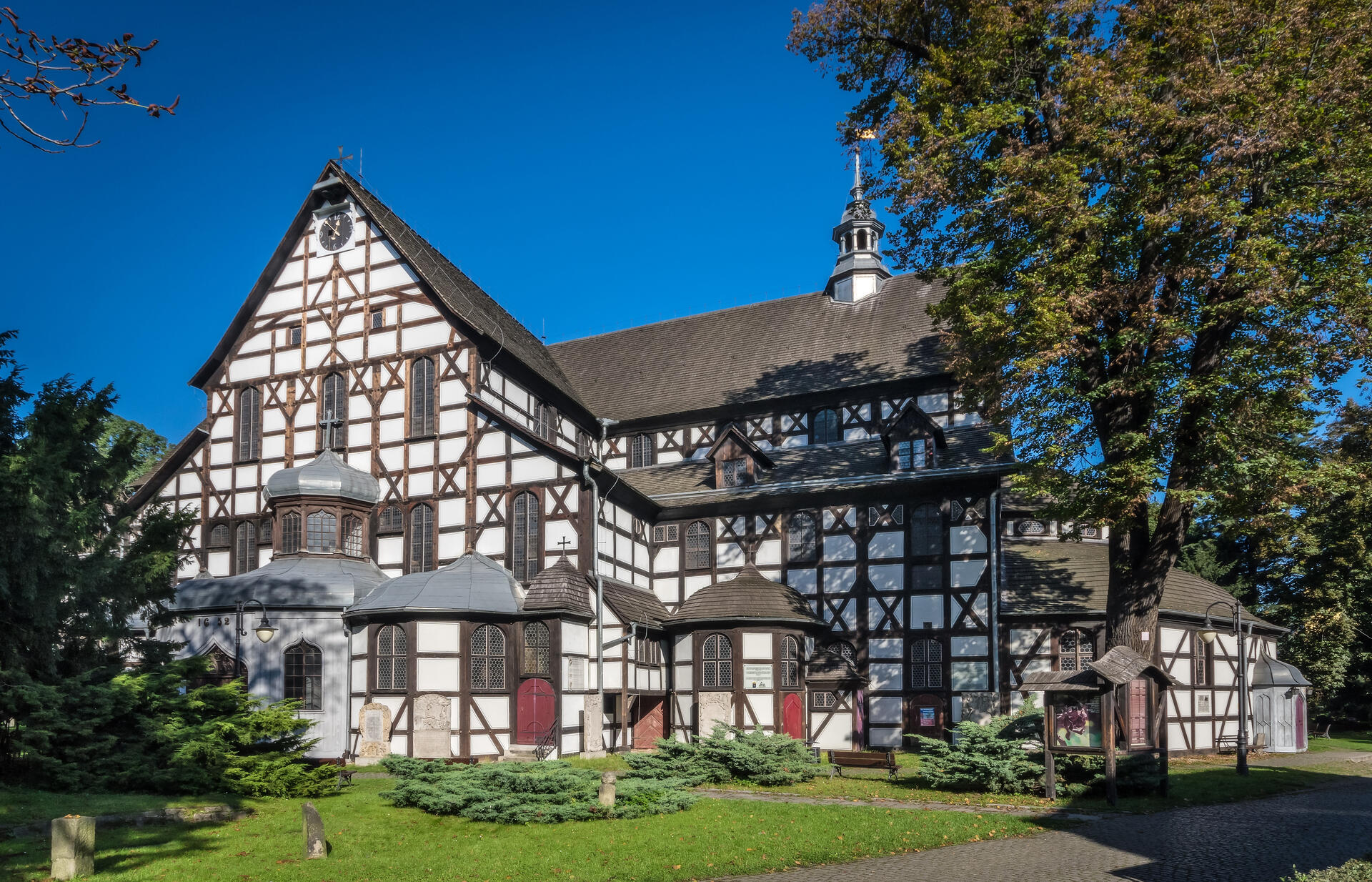
© Jar.ciurus, CC BY-SA 3.0 pl Resized from original. (This derivative is under the same CC BY-SA license.)
World Heritage Research
Discover scientific research and academic studies that deepen our understanding of Churches of Peace in Jawor and Świdnica from its history and significance to its conservation, management, and contemporary challenges.
-
The Incarnate Word. The Bethlehem of Krzeszów and the mysticism of Infant Jesus (Chapter 5)
A unique Nativity foundation, commissioned between 1674 and 1677 by Abbot Bernhard Rosa near Krzeszów, stands out for its intricate sculptural representation of the Grotto of the Nativity in Bethlehem. This chapel, designed as a faithful copy of the original site, embodied a profound mysticism centered on the Infant Jesus, as elaborated in Abbot Rosa's prayer book 'Liebliche Rose von Jericho'. Historical records from Jesuit chronicles and other sources reveal that Nativity piety, characterized by elaborate scenes and plays, was already prevalent in Silesia from the late 16th century. This study highlights the significance of this foundation not only for its architectural and artistic merit but also for its deep spiritual and cultural impact, blending historical documentation with a detailed analysis of its mysticism.
(Ed.). (2025). 5. The Incarnate Word. The Bethlehem of Krzeszów and the mysticism of Infant Jesus. Art and Mysticism in Silesia in the Baroque Period, 243–296. https://doi.org/10.13109/9783666500879.243
View Publication Record | Read Publication -
Bronisław Buliński (1934–2021) Sixty Years in the Service of Saving Monuments of Wooden Architecture
Bronisław Buliński's six decades of dedication to preserving Poland's wooden architecture, including UNESCO-listed sites, exemplify the profound impact of expertise and commitment on cultural heritage conservation. His work, particularly in restoring churches and orthodox churches in south-eastern Poland, highlights the intersection of art history and practical preservation efforts. The study underscores how specialized knowledge and hands-on experience can rescue and maintain these monuments, ensuring their legacy for future generations.
Kurek, J. (2023). BRONISŁAW BULIŃSKI (1934–2021) SIXTY YEARS IN THE SERVICE OF SAVING MONUMENTS OF WOODEN ARCHITECTURE. Space&FORM, 2023(54), 139–152. https://doi.org/10.21005/pif.2023.54.e-01
View Publication Record | Read Publication -
Confessional aspects of the architecture of wooden protestant churches in Eastern Europe in the 17th –18th centuries
A distinct architectural phenomenon emerged among Protestant communities in Eastern Europe following the Thirty Years' War and the Sopron Seim, where wooden churches diverged significantly from local Catholic traditions. These 'churches of peace' and 'particular churches,' built between 1650–1770s, adopted North German or Scandinavian construction techniques, distinguishing them through cross-planned designs and innovative building methods. Unlike traditional Slavic wooden architecture, these structures served as symbols of self-identification for minority Protestant groups, often of Polish or Slovak descent, who used their grandiose, ark-like designs to assert cultural and religious distinction amid Catholic majorities. The study concludes that this architectural departure not only enriched Eastern Europe's cultural landscape but also offered a tangible alternative to dominant Catholic and Greek Catholic styles, reflecting the region's complex confessional dynamics during a turbulent period.
Khodakovsky, E. V. (2023). Confessional aspects of the architecture of wooden protestant churches in Eastern Europe in the 17th –18th centuries. Studia Slavica et Balcanica Petropolitana, 33(1), 55–67. https://doi.org/10.21638/spbu19.2023.105
View Publication Record | Read Publication -
Typology and Analysis of Sacral Wooden Architecture in the Lubuskie Voivodship
Research on wooden churches in Lubuskie voivodeship reveals seven distinct typologies of sacral wooden architecture, showcasing their historical and stylistic significance. These structures, many under conservation protection, highlight the region's unique log and half-timbered building traditions. The study emphasizes the importance of ongoing renovation efforts, including complete conservation and revitalization projects, to preserve this valuable cultural heritage. The findings underscore the role of local architectural practices in shaping the identity of these monuments.
Rutyna, H. (2022). TYPOLOGY AND ANALYSIS OF SACRAL WOODEN ARCHITECTURE IN THE LUBUSKIE VOIVODSHIP. Space&FORM, 2022(51), 263–310. https://doi.org/10.21005/pif.2022.51.e-02
View Publication Record | Read Publication -
"Miejsca pamięci" Pierre'a Nory i społeczny aspekt zagadnień konserwacji dziedzictwa budowlanego
The concept of 'lieux de mémoire' (sites of memory) offers valuable insights for the preservation and interpretation of legally protected historic structures, such as the Peace Churches of Jawor and Świdnica. This study bridges theoretical frameworks—particularly those by Pierre Nora and Alois Riegl—with practical conservation challenges, revealing how social dimensions can be integrated into heritage management. By applying methodological guidance from Aleida and Jan Assmann on cultural memory, the research demonstrates that identifying sites of memory through their unique characteristics can enhance the understanding and protection of built heritage. The analysis, grounded in the 'Peace Church of Jawor as a Site of Memory' project, highlights the potential for studying societal aspects of conservation, providing actionable recommendations for future heritage practices.
Krawczyk, J., & Balcer, M. (2021). “Miejsca pamięci” Pierre’a Nory i społeczny aspekt zagadnień konserwacji dziedzictwa budowlanego. Protection of Cultural Heritage, (12), 1–12. https://doi.org/10.35784/odk.2673
View Publication Record | Read Publication -
Kościoły Pokoju w Jaworze i Świdnicy – Prace Konserwatorskie Wnętrza i Wyposażenia, Jako Przykład Ochrony Budowli Wpisanych na Listę Światowego Dziedzictwa
Conservation efforts on the Churches of Peace in Jawor and Świdnica, inscribed as UNESCO World Heritage Sites, successfully preserved their 17th- to 18th-century interior decorations and furnishings while maintaining their original function. The study highlights that UNESCO recognition was pivotal in prioritizing authenticity preservation during conservation work, ensuring these unique religious monuments endured despite historical challenges. The research focuses on the principles and outcomes of conservation practices applied since the 1990s, demonstrating how systematic restoration can safeguard cultural heritage without compromising historical integrity.
Korpała, M. (2017). KOŚCIOŁY POKOJU W JAWORZE I ŚWIDNICY – PRACE KONSERWATORSKIE WNĘTRZA I WYPOSAŻENIA, JAKO PRZYKŁAD OCHRONY BUDOWLI WPISANYCH NA LISTĘ ŚWIATOWEGO DZIEDZICTWA. Protection of Cultural Heritage, (4), 83–92. https://doi.org/10.24358/odk_2017_04_08
View Publication Record | Read Publication -
Problemy Zarządzania Miejscem Światowego Dziedzictwa UNESCO na Przykładzie Planu Zarządzania dla Kościółów Pokoju w Jaworze i Świdnicy
Effective management of UNESCO World Heritage Sites (WHS) requires tailored strategies that address unique challenges, as demonstrated by the 'Churches of Peace in Jawor and Świdnica' case study. This collaborative Polish-German project (2012–2014) identified key principles for sustainable preservation, drawing from a German UNESCO textbook and subsequent research. The findings highlight the necessity for adaptive management plans that balance cultural heritage protection with contemporary needs, while also incorporating lessons from post-2014 literature on cultural heritage conservation. This study underscores the importance of international cooperation in developing robust frameworks for WHS management.
Affelt, W. J. (2017). PROBLEMY ZARZĄDZANIA MIEJSCEM ŚWIATOWEGO DZIEDZICTWA UNESCO NA PRZYKŁADZIE PLANU ZARZĄDZANIA DLA KOŚCIOŁÓW POKOJU W JAWORZE I ŚWIDNICY. Protection of Cultural Heritage, (4), 105–120. https://doi.org/10.24358/odk_2017_04_10
View Publication Record | Read Publication