World Heritage Identification Number: 102
World Heritage since: 1980
Category: Cultural Heritage
WHE Type: Historic Cities & Urban Areas
Transboundary Heritage: No
Endangered Heritage: No
Country: 🇩🇿 Algeria
Continent: Africa
UNESCO World Region: Arab States
Map
Al Qal'a of Beni Hammad: A Fortified Palatine City in Algeria
The Al Qal'a of Beni Hammad, located in the Hodna Mountains northeast of M'Sila, Algeria, stands as a testament to the architectural prowess and political power of the Hammadid dynasty during the Middle Ages. This fortified palatine city, now in ruins, was the first capital of the Hammadids, established in 1007 and abandoned in 1152.
More to come…UNESCO Description of the World Heritage Site
In a mountainous site of extraordinary beauty, the ruins of the first capital of the Hammadid emirs, founded in 1007 and demolished in 1152, provide an authentic picture of a fortified Muslim city. The mosque, whose prayer room has 13 aisles with eight bays, is one of the largest in Algeria.
UNESCO Justification of the World Heritage Site
Criterion (iii): The Qal'a of Beni Hammad bears exceptional testimony to the Hammadid civilization now disappeared. Founded in 1007 as a military stronghold, it was elevated to the level of metropolis. It has influenced the development of Arab architecture as well as other civilizing influences, including the Maghreb, Andalusia and Sicily. The archaeological and monumental vestiges of the Qal'a of Beni Hammad, among which are included the Great mosque and its minaret as well as a series of palaces, constitute the principal resources that testify to the wealth and influence of this Hammadid civilization.
Encyclopedia Record: Qal'at Bani Hammad
Qal'at Bani Hammad, also known as Qal'a Bani Hammad or Qal'at of the Beni Hammad, is a fortified palatine city in Algeria. Now in ruins, in the 11th century, it served as the first capital of the Hammadid dynasty. It is in the Hodna Mountains northeast of M'Sila, at an elevation of 1,418 metres (4,652 ft), and receives abundant water from the surrounding mountains. The site is near the town of Maadid, about 225 kilometres (140 mi) southeast of Algiers, in the Maghreb.Additional Site Details
Area: 150 hectares
Number of Components: 1
Coordinates: 35.81844 , 4.78684
Image
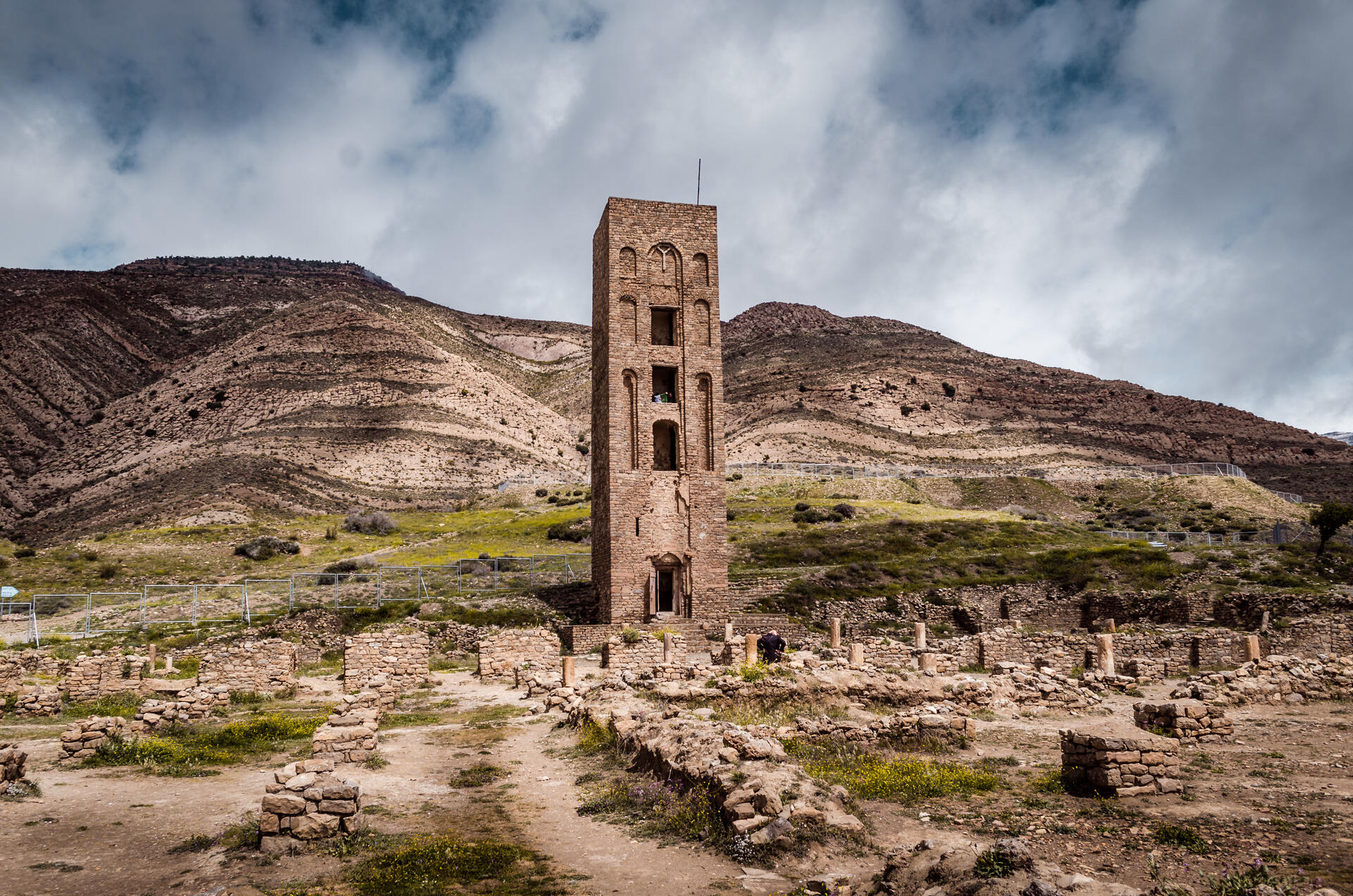
© R hakka, CC BY-SA 4.0 Resized from original. (This derivative is under the same CC BY-SA license.)
World Heritage Research
Discover scientific research and academic studies that deepen our understanding of Al Qal'a of Beni Hammad from its history and significance to its conservation, management, and contemporary challenges.
-
Applying Hierarchical Analysis Process to Rank Tourist Destinations
A hierarchical analysis reveals that natural sites, particularly Chott El Hodna, and historical landmarks like the Beni Hammad Fort are the most significant tourist attractions in M'sila province, Algeria. These findings, derived from expert interviews using the Analytic Hierarchy Process (AHP), show that natural criteria dominate with 41.9% importance, followed by historical and civilizational factors at 33.8%. The study underscores the need for targeted improvements in these areas to enhance their appeal, while cultural and accessibility aspects, though less prioritized, still require attention. This AHP-based model offers a structured approach to ranking tourist destinations, providing actionable insights for conservation and development efforts.
Moussai, A., & Guessas, T. (2026). Applying Hierarchical Analysis Process to Rank Tourist Destinations. Prace Naukowe Uniwersytetu Ekonomicznego We Wrocławiu, 70(2), 27–40. https://doi.org/10.15611/pn.2026.2.03
View Publication Record | Read Publication -
A systematic analysis of conservation the world archaeological site al Qal’a Bani Hammed in Algeria
A systematic analysis of the UNESCO World Heritage Site Al Qal'a of Beni Hammad in Algeria reveals that integrating technical evaluation with political decision-making can significantly reduce bias in determining archaeological protection perimeters. The study employs Geographic Information System (GIS) and Multiple-Criteria Decision Analysis (MCDA) to precisely analyze factors controlling the protection area, offering a scientifically grounded alternative to traditional conservation planning. This approach aims to balance theoretical references with practical considerations, ensuring more accurate and objective protection strategies for urban heritage sites.
Saouchi, S., & Khalfallah, B. (2022). A systematic analysis of conservation the world archaeological site al Qal’a Bani Hammed in Algeria. Bulletin of the Serbian Geographical Society, 102(2), 223–238. https://doi.org/10.2298/gsgd2202223s
View Publication Record | Read Publication -
Modal identification and dynamic analysis of a 1000 years old historic minaret of Kalaa Beni-Hammad
A 1000-year-old historic minaret at UNESCO World Heritage Site Al Qal'a of Beni Hammad exhibits significant material deterioration, with its rubble stone masonry elastic modulus among the lowest recorded for such structures. This finding was derived from a two-stage finite element (FE) model update using modal identification and frequency response function (FRF) correlation techniques, revealing critical stress zones and guiding the proposal of a steel tie retrofit system to enhance seismic performance. The study also highlights the value of these characterization results in expanding the database for historic monuments, offering insights that could inform conservation strategies worldwide.
Bourahla, N., Assameur, Z., Abed, M., & Mébarki, A. (2021). Modal identification and dynamic analysis of a 1000 years old historic minaret of Kalaa Beni-Hammad. ENP Engineering Science Journal, 1(2), 62–68. https://doi.org/10.53907/enpesj.v1i2.56
View Publication Record | Read Publication -
Ifriqiya and the Central Maghreb
Recent advancements in Islamic archaeology have significantly expanded our understanding of North Africa's historical development, particularly through the study of Ifriqiya and the Central Maghreb. This region, encompassing modern-day Tunisia, Algeria, and western coastal Libya, has seen a surge in archaeological projects since the 1990s, providing substantial evidence that challenges long-standing models. The Qal'a of Beni Hammad in Algeria, one of the earliest Islamic sites excavated by European archaeologists in the late 19th century, stands as a testament to this progress. While the field was dominated by art historians for much of the 20th century, contemporary research now integrates multi-disciplinary approaches to revisit and refine our knowledge of palatial-cities, mosques, ribats, and fortresses, revealing new insights into the region's complex history.
Fenwick, C. (2020). Ifriqiya and the Central Maghreb. The Oxford Handbook of Islamic Archaeology, 243–266. https://doi.org/10.1093/oxfordhb/9780199987870.013.9
View Publication Record | Read Publication