World Heritage Identification Number: 1258
World Heritage since: 2007
Category: Natural Heritage
WHE Type: Protected Areas & National Parks
Transboundary Heritage: No
Endangered Heritage: No
Country: 🇪🇸 Spain
Continent: Europe
UNESCO World Region: Europe and North America
Map
Teide National Park: A Geological Marvel on Tenerife Island
Teide National Park, situated on the island of Tenerife in the Canary Islands, Spain, is a testament to the breathtaking beauty and geological significance of oceanic islands. Inscribed as a UNESCO World Heritage Site in 2007, this protected area showcases the Teide-Pico Viejo stratovolcano complex, crowned by Mount Teide, the highest peak on Spanish soil, rising to 3,718 meters (12,198 feet). Measured from the ocean floor, the volcanic structure ascends roughly 7,500 meters (24,600 feet), making it one of the tallest volcanic edifices on Earth.
The visual spectacle of Teide National Park is enhanced by distinctive atmospheric conditions that create a dynamic and ever-changing landscape. One of the most striking phenomena is the “sea of clouds” (mar de nubes), which frequently forms below the mountain slopes. This effect occurs when moist trade winds from the Atlantic rise along Tenerife’s northern flanks and condense at a stable inversion layer, creating a dense blanket of clouds that contrasts dramatically with the sunlit volcanic summit above.
Mount Teide, an active volcano, has played a crucial role in shaping the geology of Tenerife, with successive eruptions building up the volcano over time. The broader volcanic complex of Las Cañadas began forming millions of years ago, while the present Teide–Pico Viejo stratovolcano emerged after the collapse of the earlier Las Cañadas edifice roughly 170,000–200,000 years ago, forming the vast Las Cañadas Caldera that dominates the park today.
Although the most recent eruption on Tenerife occurred in 1909 at the Chinyero vent on the island’s northwest rift zone, Teide itself continues to exhibit minor fumarolic activity near its summit and remains under continuous scientific monitoring. The cone-shaped structure consists primarily of basaltic lavas as well as more evolved volcanic rocks such as phonolite, and it is surrounded by extensive lava flows, ash deposits, and striking rock formations that vividly illustrate the geological processes shaping oceanic islands.
Beyond its geological importance, Teide National Park is also notable for its specialized high-altitude biodiversity. The park hosts a variety of plant species uniquely adapted to its arid volcanic environment, many of them endemic to the Canary Islands. Among the most iconic is Echium wildpretii, whose towering red flower spikes bloom spectacularly against the dark lava fields.
Hardy shrubs such as Spartocytisus supranubius further characterize the landscape. At lower elevations within the park, stands of Canary Island pine (Pinus canariensis) provide a transitional zone between forest and volcanic highland. These diverse habitats together create a sanctuary for specialized flora and fauna uniquely suited to this dramatic environment.
In addition to its natural wonders, Teide National Park offers visitors numerous opportunities for exploration and discovery. Hiking trails traverse the volcanic terrain, leading through lava fields, caldera walls, and panoramic viewpoints that reveal sweeping vistas of Tenerife and neighboring islands. The cable car service, Teleférico del Teide, carries visitors close to the summit, where carefully managed access allows for extraordinary views across the Atlantic.
The park’s exceptional air quality, low light pollution, and high altitude also make it a premier global destination for astrophysical research. It hosts the Teide Observatory (Observatorio del Teide), which, together with the Roque de los Muchachos Observatory on La Palma, forms part of one of the world’s most important centers for solar and night-sky observation. The area is officially recognized as a Starlight Tourist Destination, reflecting both its scientific value and its extraordinary clarity of the night sky.
Beyond its physical grandeur, the park holds deep cultural and spiritual significance. To the Guanches, the indigenous inhabitants of Tenerife, the mountain was known as Echeyde, a sacred site believed to be the home of the demon Guayota. According to legend, Guayota imprisoned the sun god Magec within the volcano, plunging the world into darkness until the supreme deity Achamán intervened and restored cosmic order.
In summary, Teide National Park stands as a remarkable example of the geological forces that shape oceanic islands. Its extraordinary volcanic structures, specialized ecosystems, and dramatic landscapes combine to create one of Europe’s most distinctive natural monuments. As a UNESCO World Heritage Site, it serves as both a scientific treasure and a powerful reminder of the dynamic processes that continue to shape our planet.
UNESCO Description of the World Heritage Site
Situated on the island of Tenerife, Teide National Park features the Teide-Pico Viejo stratovolcano that, at 3,718 m, is the highest peak on Spanish soil. Rising 7,500 m above the ocean floor, it is regarded as the world’s third-tallest volcanic structure and stands in a spectacular environment. The visual impact of the site is all the greater due to atmospheric conditions that create constantly changing textures and tones in the landscape and a ‘sea of clouds’ that forms a visually impressive backdrop to the mountain. Teide is of global importance in providing evidence of the geological processes that underpin the evolution of oceanic islands.
UNESCO Justification of the World Heritage Site
Criterion (vii): Mount Teide is a striking volcanic landscape dominated by the jagged Las Cañadas escarpment and a central volcano that makes Tenerife the third tallest volcanic structure in the world. Within this landscape is a superlative suite of landforms that reveal different phases of construction and remodeling of the volcanic complex and highlight its unique geodiversity. The visual impact is emphasized by atmospheric conditions that create constantly changing textures and tones in the landscape and a ‘sea of clouds' that forms a visually impressive backdrop to the mountain.
Criterion (viii): Teide National Park is an exceptional example of a relatively old, slow moving, geologically complex and mature volcanic system. It is of global importance in providing diverse evidence of the geological processes that underpin the evolution of oceanic islands, and these values complement those of existing volcanic properties on the World Heritage List, such as the Hawaii Volcanoes National Park. It offers a diverse and accessible assemblage of volcanic features and landscapes in a relatively limited area. The area is a major centre for international research with a long history of influence on geology and geomorphology especially through the work of von Humboldt, von Buch and Lyell which has made Mount Teide a significant site in the history of volcanology.
Encyclopedia Record: Teide National Park
Teide National Park is a national park located in Tenerife, Canary Islands, Spain.Additional Site Details
Area: 18,990 hectares
Number of Components: 1
(viii) — Outstanding example representing major earth stages
Coordinates: 28.2713888889 , -16.6436111111
IUCN World Heritage Outlook
The 2025 Conservation Outlook on Teide National Park reports the following assessment:
Source: International Union for Conservation of Nature (IUCN) · View assessment
Image
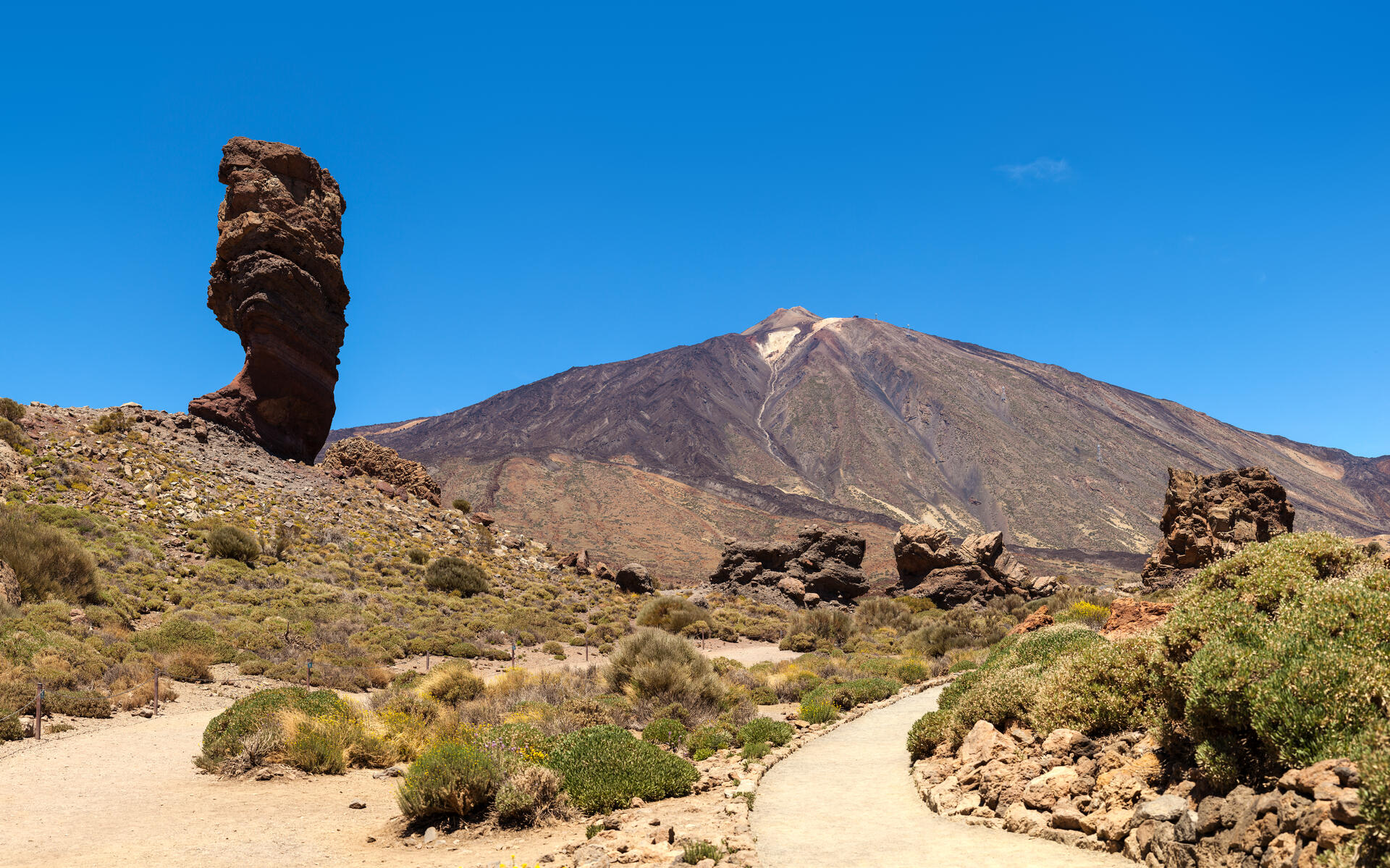
© Thomas Wolf, www.foto-tw.de, CC BY-SA 3.0 de Resized from original. (This derivative is under the same CC BY-SA license.)