World Heritage Identification Number: 753
World Heritage since: 2001
Category: Cultural Heritage
WHE Type: Historic Cities & Urban Areas
Transboundary Heritage: No
Endangered Heritage: No
Country: 🇲🇦 Morocco
Continent: Africa
UNESCO World Region: Arab States
Map
The Medina of Essaouira (Formerly Mogador): A Unique Blend of European and African Architecture
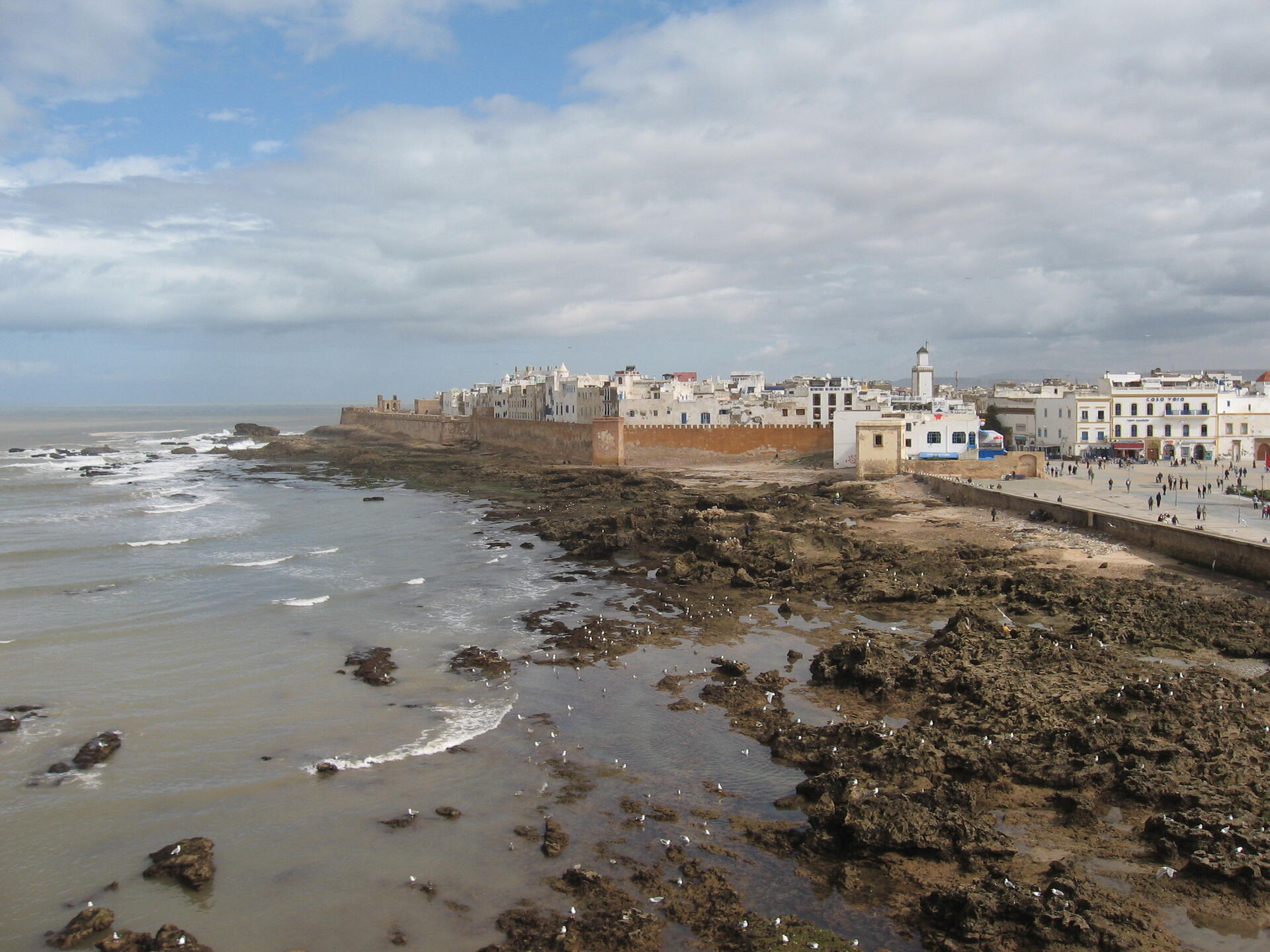
The Medina of Essaouira, previously known as Mogador, is a captivating example of a well-preserved late-18th-century fortified town located along the Atlantic coast of Morocco. Inscribed as a UNESCO World Heritage Site in 2001, this enchanting city offers a unique blend of European and North African architectural influences that have shaped its rich history and culture.
More to come…UNESCO Description of the World Heritage Site
Essaouira is an exceptional example of a late-18th-century fortified town, built according to the principles of contemporary European military architecture in a North African context. Since its foundation, it has been a major international trading seaport, linking Morocco and its Saharan hinterland with Europe and the rest of the world.
UNESCO Justification of the World Heritage Site
Criterion (ii): Essaouira is an outstanding and well preserved example of a mid-18th century fortified seaport town, with a strong European influence translated to a North African context.
Criterion (iv): With the opening of Morocco to the rest of the world at the end of the 17th century, the Medina of Essaouira was laid out by a French architect who had been profoundly influenced by the work of the military engineer Vauban at Saint Malo. For the most part, it has retained its appearance of a European town.
Encyclopedia Record: Essaouira
Essaouira, known until the 1960s as Mogador, is a port city in the western Moroccan region of Marrakesh-Safi, on the Atlantic coast. It has 77,966 inhabitants as of 2014.Additional Site Details
Area: 56.7 hectares
Number of Components: 2
(iv) — Outstanding example of a type of building or landscape
Coordinates: 31.5141111111 , -9.7703055556
World Heritage Research
Discover scientific research and academic studies that deepen our understanding of Medina of Essaouira (formerly Mogador) from its history and significance to its conservation, management, and contemporary challenges.
-
The Kasbah of Essaouira. A fortified naval base on the Atlantic coast of Morocco (18th century)
Essaouira, originally known as Amogdoul or Mogdoul, emerged as a strategically significant fortified naval base on Morocco's Atlantic coast during the 18th century. Its transformation from a Phoenician and Roman dye production site to a planned port city under Alawite Sultan Sidi Mohammed Ben Abdallah in 1765 reflects a blend of Arab-Moroccan Cherifian and European (Vauban, Manueline) military architectural styles. Designed by French engineer Nicolas Théodore Cornut, Essaouira's quadrilateral layout and fortified structures—including walls with bastions, gates, a kasbah, and two cannon batteries—served as both a commercial hub linking Morocco to Europe and a strategic stronghold to suppress the Souss revolt. This study highlights Essaouira's dual role in international trade and military defense during the 18th–19th centuries.
Hadda, L. (2026). The Kasbah of Essaouira. A fortified naval base on the Atlantic coast of Morocco (18th century). PROCEEDINGS of the International Conference on Fortifications of the Mediterranean Coast FORTMED 2026. Vol. 22. https://doi.org/10.4995/fortmed2026.2026.21358
View Publication Record | Read Publication -
Valorization of the Geological Heritage of the Western High Atlas Coast (Agadir, Morocco)
The Western Coastal High Atlas in southwest Morocco, including the Medina of Essaouira, harbors significant geological and paleontological heritage spanning from the Triassic to the Plio-Quaternary periods. This study identifies and evaluates key geosites—stratigraphic, tectonic, sedimentological, and paleontological—for their potential to promote conservation, education, and sustainable tourism. Using a multi-criteria approach (e.g., site integrity, accessibility, representativeness), researchers assessed 38 geosites between Agadir and the Haha–Essaouira Plateau, highlighting their scientific value and tourist appeal. The findings underscore the region's untapped potential for geotourism while emphasizing the need for integrated preservation strategies to balance heritage valorization with sustainable development.
Abderrahmane, BARGACH, K., & AMZIL, L. (2026). Valorization of the Geological Heritage of the Western High Atlas Coast (Agadir, Morocco). The Iraqi Geological Journal, 204–220. https://doi.org/10.46717/igj.2026.59.1c.15
View Publication Record | Read Publication -
Balancing ecotourism and biodiversity conservation in a fragile territory: The case of Mogador Island
Ecotourism in fragile environments like Mogador Island, part of the Medina of Essaouira, is more a contested arena shaped by differing values and power dynamics than a universally accepted solution for conservation and development. A qualitative study involving 22 stakeholders revealed that while institutions and economic players prioritize regulated access and funding to drive regional diversification, community groups and environmental experts emphasize the risks of habitat damage and the commodification of nature. The research highlights the need for participatory governance, regulated use, and respect for ecological boundaries to balance ecotourism's potential with biodiversity conservation. This study also sheds light on the challenges faced by rare species like Eleonora's falcon, contributing to broader debates on sustainable tourism management in fragile territories.
El Housni, K., Uyar, Ç., Benmassoud, J., Mouhibi, K., & Osly, M. M. (2026). Balancing ecotourism and biodiversity conservation in a fragile territory: The case of Mogador Island. Anadolu Orman Araştırmaları Dergisi, (13), 11884298. https://doi.org/10.53516/ajfr.1884299
View Publication Record | Read Publication -
Palynostratigraphic study (dinoflagellate cysts) of the Callovian–Oxfordian in Essaouira-Agadir Basin, Morocco
A palynostratigraphic study of the Essaouira-Agadir Basin, Morocco, reveals high-resolution stratigraphic markers based on dinoflagellate cysts, enabling precise dating of the Callovian–Oxfordian stages. The research identifies distinct dinoflagellate assemblages that mark the upper Callovian and Upper Oxfordian, including key species such as Ctenidodinium ornatum, Systematophora areolata, and Endoscrinium galeritum. This study contributes to a refined stratigraphic scale for the Tethyan and Atlantic realms, bridging correlations with the NW European (subboreal) realm. The findings are based on a 75-meter-thick section from Iggi N’Tarhzout, north of Agadir, where well-preserved dinoflagellate cysts provide critical insights into the geological history of this UNESCO World Heritage Site.
Jaydawi, S., Hssaida, T., Afenzar, A., Mhamdi, H. S., Chakir, S., Chafai, K., & Khaffou, H. (2025). Palynostratigraphic study (dinoflagellate cysts) of the Callovian–Oxfordian in Essaouira-Agadir Basin, Morocco. Swiss Journal of Palaeontology, 144(1). https://doi.org/10.1186/s13358-025-00361-w
View Publication Record | Read Publication -
Systematic Review of Air Pollution in Morocco: Status, Impacts, and Future Directions
Road traffic and industrial activities are the primary contributors to air pollution in Morocco, with significant variations in pollutant levels across cities. Casablanca, Kenitra, and Essaouira face higher pollution due to transportation and industrial emissions, while altitude influences air quality, generally leading to lower concentrations at higher elevations. This systematic review of 64 original studies highlights adverse health impacts such as mortality, respiratory disorders, and cardiovascular diseases linked to exposure. It also underscores the need for broader research on pollution's economic effects, improved modeling, and a more comprehensive focus on pollutants beyond regulated ones.
Sekmoudi, I., Tanarhte, M., Bouzghiba, H., Khomsi, K., Idrissi, L., El jarmouni, M., & Géczi, G. (2024). Systematic Review of Air Pollution in Morocco: Status, Impacts, and Future Directions. Advanced Sustainable Systems, 8(9). Portico. https://doi.org/10.1002/adsu.202400006
View Publication Record | Read Publication -
Dimensões da castelologia portuguesa no Norte de África entre Quatrocentos e meados de Quinhentos
Portuguese castles in North Africa, built between the 15th and mid-16th centuries, served as key tools for territorial appropriation. This study reveals that, except for Azamor, all Portuguese settlements on Muslim medinas involved at least one independent castle. The research analyzes these structures as integral parts of new urban landscapes or autonomous entities, examining their evolution across three phases: medieval, early modernization, and Manueline maturity. By revisiting sites like Alcácer Ceguer, Arzila, Tânger, Safim, and Mogador (Essaouira), the study highlights how these castles adapted to emerging pyrotechnic challenges, marking a turning point in North African fortification history by mid-16th century. The approach combines historical analysis with architectural investigation, focusing on visible vestiges and their significance.
Correia, J. (2008). Dimensões da castelologia portuguesa no Norte de África entre Quatrocentos e meados de Quinhentos. Anais De História De Além-Mar, 9(Anais de História de Além-Mar, Vol. 9 (2008), 9–36. https://doi.org/10.57759/AHAM2008.37362
View Publication Record | Read Publication -
Evaluation of the Geothermal Potential of the Essaouira Basin in the Western High Atlas, Morocco
Areas of high geothermal potential are primarily located in the southern part of the Essaouira basin, as revealed by a comprehensive study combining Geographic Information Systems (GIS), remote sensing, hydrogeochemical data analysis, and geophysics. This research identifies elevated heat sources and assesses subsurface lithological variations, providing valuable insights for future geothermal energy development in the region. The study employed advanced techniques such as lineament extraction, surface temperature calculations, and hydrothermal alteration assessments to pinpoint prospective zones for geothermal exploration.
(Ed.). (2023). Evaluation of the Geothermal Potential of the Essaouira Basin in the Western High Atlas, Morocco. Proceeding Book of 4th International Conference on Engineering and Applied Natural Sciences ICEANS 2023. https://doi.org/10.59287/as-proceedings.315
View Publication Record | Read Publication