World Heritage Identification Number: 1179
World Heritage since: 2008
Category: Natural Heritage
WHE Type: Natural Landscapes & Geographic Features
Transboundary Heritage: No
Endangered Heritage: No
Country: 🇨🇭 Switzerland
Continent: Europe
UNESCO World Region: Europe and North America
Map
Swiss Tectonic Arena Sardona: A Geological Marvel in Eastern Switzerland
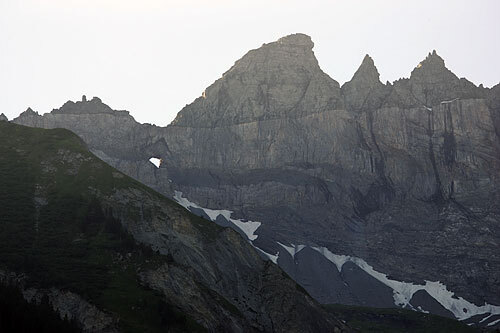
The Swiss Tectonic Arena Sardona, inscribed as a UNESCO World Heritage Site in 2008, offers a unique insight into the intricate workings of continental collision and mountain building. Situated in the northeastern part of Switzerland, the site spans an expansive area of approximately 32,850 hectares, featuring seven peaks that tower above 3,000 meters.
More to come…UNESCO Description of the World Heritage Site
The Swiss Tectonic Arena Sardona in the north-eastern part of the country covers a mountainous area of 32,850 ha which features seven peaks that rise above 3,000 m. The area displays an exceptional example of mountain building through continental collision and features .excellent geological sections through tectonic thrust, i.e. the process whereby older, deeper rocks are carried onto younger, shallower rocks. The site is distinguished by the clear three-dimensional exposure of the structures and processes that characterize this phenomenon and has been a key site for the geological sciences since the 18th century. The Glarus Alps are glaciated mountains rising dramatically above narrow river valleys and are the site of the largest post-glacial landslide in the Central Alpine region.
UNESCO Justification of the World Heritage Site
Criterion (viii): Earth’s history, geological and geomorphic features and processes: The Swiss Tectonic Arena Sardona provides an exceptional display of mountain building tectonics and has been recognised as a key site for geological sciences since the 18th century. The clear exposure of the Glarus Overthrust is a key, but not the only significant, feature. The exposures of the rocks below and above this feature are visible in three dimensions and, taken together, have made substantial contributions to the understanding of mountain building tectonics. Its geological features can be readily appreciated by all visitors. The property can be differentiated from other similar sites by the combination of the clear exposure of the phenomenon in a mountain setting, its history of study, and its ongoing contribution to geological sciences.
Encyclopedia Record: Glarus thrust
The Glarus thrust is a major thrust fault in the Alps of eastern Switzerland. Along the thrust the Helvetic nappes were thrust more than 100 km to the north over the external Aarmassif and Infrahelvetic complex. The thrust forms the contact between older (Helvetic) Permo-Triassic rock layers of the Verrucano group and younger (external) Jurassic and Cretaceous limestones and Paleogene flysch and molasse.Additional Site Details
Area: 32,850 hectares
Number of Components: 1
Coordinates: 46.9166666667 , 9.25
IUCN World Heritage Outlook
The 2025 Conservation Outlook on Swiss Tectonic Arena Sardona reports the following assessment:
Source: International Union for Conservation of Nature (IUCN) · View assessment
Image
© 
World Heritage Research
Discover scientific research and academic studies that deepen our understanding of Swiss Tectonic Arena Sardona from its history and significance to its conservation, management, and contemporary challenges.
-
Tracing wedge-internal deformation by means of strontium isotope systematics of vein carbonates
Vein carbonates from the Swiss Tectonic Arena Sardona, part of the North Alpine fold-and-thrust belt, reveal critical insights into the tectonometamorphic evolution during continental collision. The study demonstrates that strontium isotope ratios (87Sr/86Sr) in these vein carbonates shift from an initial seawater-like signature to match the host rock's composition as metamorphic grade increases. This isotopic progression reflects the progressive equilibration of pore fluids with the host rock, providing a novel method to constrain deformation events such as bedding-parallel shearing, imbricate thrusting, folding, cleavage development, and mélange formation under diagenetic to low-grade metamorphic conditions. The findings enhance understanding of the prograde to early retrograde tectonic evolution in accretionary wedges.
Dielforder, A., Villa, I. M., Berger, A., & Herwegh, M. (2022). Tracing wedge-internal deformation by means of strontium isotope systematics of vein carbonates. Geological Magazine, 159(11-12), 2191–2205. https://doi.org/10.1017/s0016756821001357
View Publication Record | Read Publication -
Earthquakes in Switzerland and surrounding regions during 2017 and 2018
A system of sub-parallel strike-slip faults, likely within the uppermost crystalline basement of the eastern Aar Massif, was identified through analysis of the 2017 M L 4.6 Urnerboden earthquake and its aftershocks in Switzerland's Swiss Tectonic Arena Sardona region. The study, published in the Swiss Journal of Geosciences, detected and located 1227 earthquakes in 2017 and 955 in 2018, with the Urnerboden event being the strongest since the M L 5.0 Vaz earthquake of 1991. Focal mechanisms and hypocentre relocations revealed a NNW–SSE striking sinistral strike-slip fault system. Additionally, the research highlighted NE–SW oriented extensional to transtensional deformation along the Alpine Front between Lake Geneva and the Fribourg Fault, as well as rare shallow thrust faulting in the Jura fold-and-thrust belt, indicating contraction in Switzerland's northwestern Alpine foreland.
Diehl, T., Clinton, J., Cauzzi, C., Kraft, T., Kästli, P., Deichmann, N., Massin, F., Grigoli, F., Molinari, I., Bӧse, M., Hobiger, M., Haslinger, F., Fäh, D., & Wiemer, S. (2021). Earthquakes in Switzerland and surrounding regions during 2017 and 2018. Swiss Journal of Geosciences, 114(1). https://doi.org/10.1186/s00015-020-00382-2
View Publication Record | Read Publication -
Control of 3-D tectonic inheritance on fold-and-thrust belts: insights from 3-D numerical models and application to the Helvetic nappe system
Three-dimensional tectonic inheritance plays a fundamental role in the evolution of fold-and-thrust belts, significantly influencing nappe formation and deformation patterns. This study demonstrates that initial basement horst and graben structures, along with laterally variable sedimentary layer strengths, control the detachment, folding, and horizontal transport of sedimentary units. Deeper half-grabens generate thicker nappes and more intense deformation in adjacent horsts, while shallower ones produce thinner nappes and less deformation. Mechanically weaker basements favor fold nappes, whereas stronger basements promote thrust sheets. The research applies 3-D thermo-mechanical numerical simulations to the Helvetic nappe system of the Central Alps, reproducing key features such as the closure of half-grabens, overthrusting, and nappe stacking, aligning with observed finite strain patterns, temperature distributions, and timing data. Strain localization and nappe transport are driven by initial geometrical and mechanical heterogeneities, highlighting the critical importance of tectonic inheritance in fold-and-thrust belt dynamics.
Spitz, R., Bauville, A., Epard, J.-L., Kaus, B. J. P., Popov, A. A., & Schmalholz, S. M. (2020). Control of 3-D tectonic inheritance on fold-and-thrust belts: insights from 3-D numerical models and application to the Helvetic nappe system. Solid Earth, 11(3), 999–1026. https://doi.org/10.5194/se-11-999-2020
View Publication Record | Read Publication -
3D structural model and kinematic interpretation of the Panixer Pass Transverse Zone (Infrahelvetic Complex, eastern Switzerland)
A groundbreaking 3D structural model of the Panixer Pass Transverse Zone in eastern Switzerland reveals that the SSE-trending Crena-Martin Fold, a key feature of the Infrahelvetic Complex, was formed by multiple lateral ramps and fault-bend folds during an early thrust-dominated deformation phase (Cavistrau Phase). Contrary to previous hypotheses, this study demonstrates that ENE-WSW-directed shortening did not play a role in its formation. The model also shows that the final geometry of the zone resulted from a low-angle dextral strike-slip fault cutting across it. Field data indicates continuous NNW-directed shearing and transport, except for an early phase of north-directed shearing linked to foliation development in the Helvetic Nappes. This kinematic block model integrates seamlessly with established deformation sequences, providing a comprehensive understanding of the region's complex tectonic evolution.
von Däniken, P. A., & Frehner, M. (2016). 3D structural model and kinematic interpretation of the Panixer Pass Transverse Zone (Infrahelvetic Complex, eastern Switzerland). Swiss Journal of Geosciences, 110(2), 653–675. https://doi.org/10.1007/s00015-016-0230-7
View Publication Record | Read Publication -
Modeling episodic fluid‐release events in the ductile carbonates of the Glarus thrust
Research on the Swiss Tectonic Arena Sardona reveals that episodic fluid-release events, driven by carbonate decomposition and shear heating, are key to the movement of the Glarus thrust. This midcrustal deformation structure, characterized by tens of kilometers of displacement on an ultrathin layer (the principal slip zone), exhibits periodic stick-slip behavior due to overpressured fluids. The study demonstrates that slow ductile creep deformation raises temperatures through shear heating, triggering carbonate decomposition and the subsequent release of highly pressurized fluids. These fluids lubricate the principal slip zone, enabling significant movement along millimeter-thick bands. This model identifies carbonate decomposition as a critical process for thrust motion and explains the source of overpressured fluids accessing the slip zone.
Poulet, T., Veveakis, M., Herwegh, M., Buckingham, T., & Regenauer‐Lieb, K. (2014). Modeling episodic fluid‐release events in the ductile carbonates of the Glarus thrust. Geophysical Research Letters, 41(20), 7121–7128. Portico. https://doi.org/10.1002/2014gl061715
View Publication Record | Read Publication -
The Glarus Double Fold: a serious scientific advance in mid nineteenth century Alpine Geology
The Glarus Double Fold, once dismissed as a flawed tectonic model, is re-evaluated here as a significant scientific advance in mid-19th century Alpine geology. This study challenges the traditional view that Arnold Escher and Albert Heim's recumbent fold concept hindered progress by demonstrating its role as an early application of global contraction theory to the Alps. By contextualizing Swiss Alpine geology between 1800 and 1850, the research shows how the Double Fold model marked a paradigm shift from earlier vertical uplift theories—rooted in metamorphic processes—to large-scale horizontal displacements. This reinterpretation positions the Double Fold as a precursor to the nappe tectonic revolution, highlighting its importance in shaping modern understanding of Alpine orogeny.
Letsch, D. (2014). The Glarus Double Fold: a serious scientific advance in mid nineteenth century Alpine Geology. Swiss Journal of Geosciences, 107(1), 65–80. https://doi.org/10.1007/s00015-014-0158-8
View Publication Record | Read Publication -
Multiscale coupling and multiphysics approaches in earth sciences: Applications
Research reveals that the Glarus thrust, a seminal geological structure in the Swiss Alps, represents a complex interplay of thermal (T), hydraulic (H), mechanical (M), and chemical (C) processes (THMC coupling). This km-scale rock package, pushed 40 km over its footwall as a solid body, exhibits a m-wide ductile shear zone with an ultralocalized central slip zone experiencing periodic extreme deformation akin to stick-slip events. The study demonstrates that such large-scale geological features emerge from non-conservative thermodynamic forces and can be characterized by the modified Gruntfest number (Gr), which measures dissipative processes reaching quasi-steady states. These findings highlight the importance of considering time and microstructure in THMC feedback simulations, providing a multiscale theoretical framework to understand earth's instabilities, including faults, folds, and convective patterns.
Regenauer-Lieb, K., Veveakis, M., Poulet, T., Wellmann, F., Karrech, A., Liu, J., Hauser, J., Schrank, C., Gaede, O., Fusseis, F., & Trefry, M. (2013). Multiscale coupling and multiphysics approaches in earth sciences: Applications. Journal of Coupled Systems and Multiscale Dynamics, 1(3), 281–323. https://doi.org/10.1166/jcsmd.2013.1021
View Publication Record | Read Publication