World Heritage Identification Number: 1131
World Heritage since: 2004
Category: Cultural Heritage
WHE Type: Buildings & Architectural Ensembles
Transboundary Heritage: No
Endangered Heritage: No
Country: 🇦🇺 Australia
Continent: Oceania
UNESCO World Region: Asia and the Pacific
Map
The Royal Exhibition Building and Carlton Gardens: A Testament to International Progress and Australian Culture
The Royal Exhibition Building and Carlton Gardens, situated on the northeastern edge of Melbourne's Central Business District, stand as a significant testament to the international exhibition movement that swept across the globe during the latter half of the 19th century. Inscribed as a UNESCO World Heritage Site in 2004, this remarkable complex embodies the spirit of innovation, cultural exchange, and material progress that characterized these grand events.
More to come…UNESCO Description of the World Heritage Site
The Royal Exhibition Building and its surrounding Carlton Gardens were designed for the great international exhibitions of 1880 and 1888 in Melbourne. The building and grounds were designed by Joseph Reed. The building is constructed of brick and timber, steel and slate. It combines elements from the Byzantine, Romanesque, Lombardic and Italian Renaissance styles. The property is typical of the international exhibition movement which saw over 50 exhibitions staged between 1851 and 1915 in venues including Paris, New York, Vienna, Calcutta, Kingston (Jamaica) and Santiago (Chile). All shared a common theme and aims: to chart material and moral progress through displays of industry from all nations.
UNESCO Justification of the World Heritage Site
Criterion (ii): The Royal Exhibition Building and the surrounding Carlton Gardens, as the main extant survivors of a Palace of Industry and its setting, together reflect the global influence of the international exhibition movement of the 19th and early 20th centuries. The movement showcased technological innovation and change, which helped promote a rapid increase in industrialisation and international trade through the exchange of knowledge and ideas.
Encyclopedia Record: Carlton Gardens
The Carlton Gardens is a UNESCO World Heritage Site located on the northeastern edge of the Central Business District in the suburb of Carlton, Melbourne, in the state of Victoria, Australia. The gardens are a popular picnic and barbecue area, and are home to an array of wildlife, including brushtail possums.Additional Site Details
Area: 26 hectares
Number of Components: 1
Coordinates: -37.80611111 , 144.9702778
Image
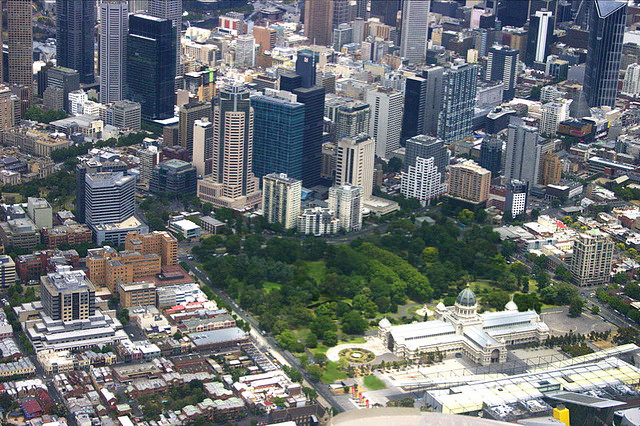
© Andrew Lukaris, CC BY-SA 2.0 Resized from original. (This derivative is under the same CC BY-SA license.)
World Heritage Research
Discover scientific research and academic studies that deepen our understanding of Royal Exhibition Building and Carlton Gardens from its history and significance to its conservation, management, and contemporary challenges.
-
‘Marvellous Melbourne’: Making the world’s most liveable city
'Marvellous Melbourne' captures the essence of a city that once stood as a symbol of opulence and ambition, reflecting its inhabitants' pride during the 1880s. This period saw Melbourne's rapid growth, with grand architectural marvels like the Royal Exhibition Building being erected to showcase its wealth and energy. The term encapsulates both the boom and subsequent bust, highlighting how speculative development shaped urban expansion. Historical analysis reveals that while nonresidential buildings flourished in the city center, housing spread outward, laying the foundation for modern Melbourne's urban landscape. The study leverages historical records and research to dissect this transformative era, offering insights into the economic and architectural dynamics of a pivotal moment in Australian history.
Blomkamp, E., & Lewis, J. M. (2019). ‘Marvellous Melbourne’: Making the world’s most liveable city. Successful Public Policy: Lessons from Australia and New Zealand, 113–137. https://doi.org/10.22459/spp.2019.05
View Publication Record | Read Publication -
Ashley Jackson. Buildings of Empire.
Ashley Jackson's 'Buildings of Empire' offers a unique perspective on British colonial architecture through twelve case studies, distinguished by its focus on individual buildings and their surrounding settlements rather than broader topics. This approach reveals the intricate relationship between architectural design and colonial governance, urban planning, and cultural identity across five continents. Unlike conventional studies that emphasize iconic structures like the Victoria Memorial or Baker's Union Buildings, Jackson's selection—ranging from the Viceregal Lodge in Simla to the Royal Exhibition Building in Melbourne—highlights lesser-known yet significant sites. The book employs a visual and narrative analysis, supported by high-quality color photography, though some black-and-white images suffer from clarity issues. This idiosyncratic assortment challenges conventional narratives of British colonial architecture, offering fresh insights into its global impact.
Herbert, E. W. (2015). Ashley Jackson. Buildings of Empire. The American Historical Review, 120(2), 575–576. https://doi.org/10.1093/ahr/120.2.575
View Publication Record | Read Publication -
Introduction: Global change and tourism in national capitals
Even after losing their political significance, former national capitals continue to attract tourists due to their cultural heritage, architectural grandeur, and role in commemorative events. This study highlights how Melbourne, Australia's first capital (1901–1927), leverages its intact heritage gems—such as the Royal Exhibition Building, now a UNESCO World Heritage Site—for tourism and historical celebrations. The research proposes three key factors driving this appeal: cultural significance, built structure preservation, and commemorative event staging. For instance, Melbourne's status as Australia’s first capital was celebrated during the 2001 Centenary of Federation, leading to the creation of Federation Square, a dedicated events precinct. This case study offers insights into how former capitals adapt to global change by repurposing their heritage for tourism and cultural identity.
(Ed.). (2014). Introduction: Global change and tourism in national capitals. Tourism in National Capitals and Global Change, 9–10. https://doi.org/10.4324/9781315829500-5
View Publication Record | Read Publication -
Coffee Palaces in Australia: A Pub with No Beer
Coffee palaces, unique temperance hotels built in late 19th-century Australia, emerged as grand architectural marvels designed to promote sobriety and family values. These structures, adorned with High Victorian ornamentation, were a response to the temperance movement's peak during the 1880s, reflecting the economic boom fueled by the gold rush and the demand for ostentatious display. While their lifespan was short-lived, coffee palaces significantly influenced Australia's cultural landscape, drawing parallels to Enlightenment-era European coffee houses that fostered intellectual discourse and progress. This study examines the rise and decline of coffee palaces, arguing that they were modeled on historical coffee houses, which symbolized modernity and reason. The research approach involves historical analysis, architectural context, and social implications, providing insights into the temperance movement's legacy and its impact on Australian society.
Noyce, D. C. (2012). Coffee Palaces in Australia: A Pub with No Beer. M/C Journal, 15(2). https://doi.org/10.5204/mcj.464
View Publication Record | Read Publication -
Commemorative events and heritage in former capitals: a case study of Melbourne
Former capitals, despite losing their political and administrative functions, continue to attract tourists due to their cultural heritage, architectural integrity, and role in commemorative events. This study highlights Melbourne's enduring appeal as Australia's first capital (1901–1927), showcasing its grand public buildings—such as the UNESCO-listed Royal Exhibition Building—as key sites for heritage tourism and significant historical celebrations. The research proposes three explanatory frameworks: cultural heritage, built structure preservation, and commemorative event staging. Melbourne's Centenary of Federation (2001) exemplified this, with major recreations and the establishment of Federation Square, a precinct dedicated to celebrating its former capital status. The findings underscore how former capitals leverage their historical significance to sustain tourism and cultural identity.
Frost, W. (2012). Commemorative events and heritage in former capitals: a case study of Melbourne. Current Issues in Tourism, 15(1-2), 51–60. https://doi.org/10.1080/13683500.2011.634894
View Publication Record | Read Publication -
Modeling Cultures: 19th Century Indian Clay Figures
A hidden history of 19th-century Indian clay figures, known as 'Poonah' figures, has been uncovered through a research project examining collections from the Royal Exhibition Building (REB) and Carlton Gardens. The study reveals that these figures were part of the 1880 Melbourne International Exhibition and provides new insights into the cultural significance and provenance of this collection. The research relied on rudimentary documentation, highlighting the challenges in preserving and understanding such historical artifacts. This work contributes to a deeper understanding of the REB's role as a custodian of global exhibition legacies.
H.F. Smith, C., & Stevenson, M. (2010). MODELING CULTURES: 19th Century Indian Clay Figures. Museum Anthropology, 33(1), 37–48. https://doi.org/10.1111/j.1548-1379.2010.01074.x
View Publication Record | Read Publication