World Heritage Identification Number: 449
World Heritage since: 1987
Category: Cultural Heritage
WHE Type: Archaeological Sites
Transboundary Heritage: No
Endangered Heritage: No
Country: 🇨🇳 China
Continent: Asia
UNESCO World Region: Asia and the Pacific
Map
Discovering Human Evolution: The Peking Man Site at Zhoukoudian
The Peking Man Site at Zhoukoudian, located approximately 42 kilometers southwest of Beijing, China, stands as a testament to the rich history and evolution of the human species. Inscribed as a UNESCO World Heritage Site in 1987, this significant archaeological location continues to captivate archaeologists and paleoanthropologists worldwide due to its extensive findings that illuminate prehistoric human societies across Asia.
The site comprises a series of caves within the Zhoukoudian area, specifically in suburban Fangshan District. These caves have been instrumental in unearthing valuable artifacts and fossils, most notably of Homo erectus (historically referred to as Sinanthropus pekinensis), dating to the Middle Pleistocene era. This species provides critical evidence of early hominid development and the evolutionary lineage leading toward modern humans, with recent aluminum-beryllium dating suggesting the remains may be as old as 770,000 years.
While the site was first identified in 1921 by Swedish paleontologist Johan Gunnar Andersson, it was the Chinese scientist Pei Wenzhong who made the breakthrough discovery of the first nearly complete skullcap in 1929. Over time, more than 400 fossil fragments were uncovered, revealing insights into the physical characteristics, diet, and behavior of this early hominid species.
Dental and jawbone analysis indicates a diet primarily composed of plants, with occasional consumption of meat. The discovery of stone tools near the fossils also suggests that these hominids were capable of toolmaking and possibly the controlled use of fire, though the extent of their fire mastery remains a subject of intense scientific debate.
A pivotal and tragic chapter in the site's history is the disappearance of the original fossils in 1941. During the turmoil of World War II, the remains were packed for shipment to the United States for safekeeping but vanished en route to the port of Qinhuangdao. To this day, their whereabouts remain one of archaeology’s greatest mysteries. Consequently, modern research relies largely on the high-quality casts and meticulous descriptions prepared by the German anatomist Franz Weidenreich before the loss.
Beyond the Peking Man discoveries, the "Upper Cave" at Zhoukoudian has yielded evidence of later Homo sapiens populations dating from approximately 30,000 to 10,000 years ago. The Upper Cave also contained stone tools, ornaments, and animal remains, offering a glimpse into the lifeways of early Homo sapiens in the region. These findings further underscore the importance of the site in understanding the development and migration patterns of early human populations across Asia.
By examining these fossil records, scientists can trace the gradual changes in anatomy and behavior that led to the emergence of modern humans. The Peking Man Site at Zhoukoudian thus provides invaluable evidence of human evolutionary development and serves as a crucial piece in unraveling the complex story of human evolution.
What makes the Peking Man site truly unique compared to other Homo erectus discoveries, such as Java Man, is the unprecedented scale and continuity of the fossil record found in a single location. Zhoukoudian yielded the remains of approximately 40 individuals, including six nearly complete skullcaps, providing scientists with a rare opportunity to study an entire population's biological variations rather than just a solitary specimen.
In addition to its scientific importance, the Peking Man Site at Zhoukoudian has become a symbol of China’s rich prehistoric heritage. Casts of the fossils and reproductions of the caves are displayed in museums across the country, allowing visitors to engage directly with this ancient history. The site also hosts educational programs and guided tours that illustrate the lives and behaviors of early humans, bridging the gap between rigorous scientific research and public understanding. In this way, Zhoukoudian not only advances knowledge of human evolution but also fosters cultural appreciation and a sense of connection to humanity’s deep past.
To sum it up, the Peking Man Site at Zhoukoudian holds immense significance for understanding the evolution and history of humankind. As ongoing excavations continue to reveal new insights, this UNESCO World Heritage Site will undoubtedly remain a focal point for archaeologists and paleoanthropologists seeking to uncover the mysteries of our origins.
UNESCO Description of the World Heritage Site
Scientific work at the site, which lies 42 km south-west of Beijing, is still underway. So far, it has led to the discovery of the remains of Sinanthropus pekinensis, who lived in the Middle Pleistocene, along with various objects, and remains of Homo sapiens sapiens dating as far back as 18,000–11,000 B.C. The site is not only an exceptional reminder of the prehistorical human societies of the Asian continent, but also illustrates the process of evolution.
UNESCO Justification of the World Heritage Site
Criterion (iii): The Zhoukoudian site bears witness to the human communities of the Asian continent from the Middle Pleistocene Period to the Palaeolithic, illustrating the process of evolution.
Criterion (vi): The discovery of hominid remains at Zhoukoudian and subsequent research in the 1920s and ‘30s excited universal interest, overthrowing the chronology of Man’s history that had been generally accepted up to that time. The excavations and scientific work at the Zhoukoudian site are thus of significant value in the history of world archaeology, and have played an important role in the world history of science.
Encyclopedia Record: Zhoukoudian Peking Man Site
Zhoukoudian Peking Man Site (周口店北京人遗址), also romanized as Choukoutien, is a cave system in suburban Fangshan District, Beijing. It has yielded many archaeological discoveries, including one of the first specimens of Homo erectus, dubbed Peking Man, and a fine assemblage of bones of the giant short-faced hyena Pachycrocuta brevirostris.Additional Site Details
Area: 480 hectares
Number of Components: 1
(vi) — Directly associated with events or living traditions
Coordinates: 39.689449 , 115.922702
Image
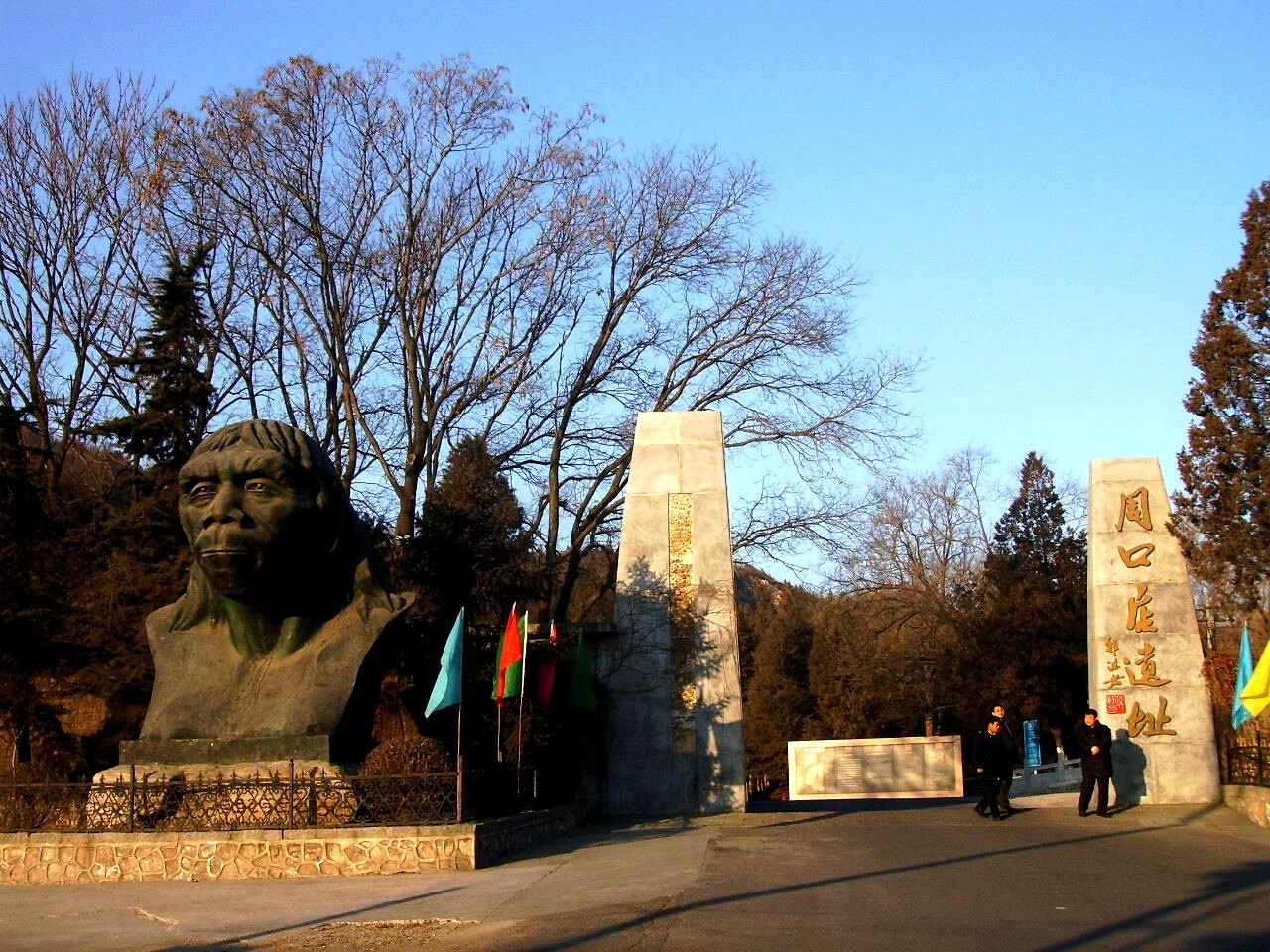
© Mutt, CC BY-SA 4.0 Resized from original. (This derivative is under the same CC BY-SA license.)
World Heritage Research
Discover scientific research and academic studies that deepen our understanding of Peking Man Site at Zhoukoudian from its history and significance to its conservation, management, and contemporary challenges.
-
Innovative Digital Technology in Education about Paleolithic Sites: A Case Study of the Peking Man Site at Zhoukoudian
Location-based entertainment virtual reality (LBE VR) significantly enhances adolescents' engagement with Paleolithic heritage, as demonstrated by a study at the Peking Man Site at Zhoukoudian. The research found that LBE VR facilitates deeper learning about early human history and culture through immersive, interactive experiences. Using semi-structured interviews with 57 secondary-school students (aged 15–17) who participated in an LBE VR program titled I Am Ape-man: A Day into the Life of Peking Man, the study employed a multiple-case qualitative design to assess the technology's educational impact. The findings provide empirical support for integrating LBE VR into Paleolithic site education, offering valuable insights for designing innovative educational applications and pedagogical strategies.
Wei, J., Li, W., Zhou, S., Zhang, Y., Yu, T., Peng, D., & Ma, Y. (2025). Innovative Digital Technology in Education about Paleolithic Sites: A Case Study of the Peking Man Site at Zhoukoudian. The International Archives of the Photogrammetry, Remote Sensing and Spatial Information Sciences, XLVIII-M-9-2025, 1599–1606. https://doi.org/10.5194/isprs-archives-xlviii-m-9-2025-1599-2025
View Publication Record | Read Publication -
Johan Gunnar Andersson: Archaeological Geologist and Pioneer
Johan Gunnar Andersson, a Swedish economic geologist, made groundbreaking discoveries during his time in China that significantly advanced the fields of archaeology and palaeontology. His most notable achievement was the discovery of the 'Peking Man' site at Zhoukoudian, which provided crucial insights into early human evolution in Asia. Through meticulous excavations and analysis, Andersson not only uncovered evidence of Homo erectus but also defined the prehistoric Chinese Neolithic Period based on his findings at the Yangshao site in Henan Province. His work, conducted without formal archaeological training, laid the foundation for modern archaeological methods in China and contributed to the establishment of the Museum of Far Eastern Antiquities in Stockholm, which houses many unique artifacts from his expeditions.
Rapp, G. (2014). Johan Gunnar Andersson: Archaeological Geologist and Pioneer. Earth Sciences History, 33(1), 59–66. https://doi.org/10.17704/eshi.33.1.h480243822118q62
View Publication Record | Read Publication