World Heritage Identification Number: 1279
World Heritage since: 2009
Category: Cultural Heritage
WHE Type: Natural Landscapes & Geographic Features
Transboundary Heritage: No
Endangered Heritage: No
Country: 🇨🇳 China
Continent: Asia
UNESCO World Region: Asia and the Pacific
Map
Sacred Buddhist Mountain: An Exploration of Mount Wutai
Mount Wutai, officially named Wutaishan and colloquially referred to as Mount Qingliang, is a significant cultural landscape located in the Shanxi Province of China. This sacred Buddhist mountain stands out as the highest in Northern China, boasting a unique morphology characterized by steep, treeless peaks arranged in a cardinal direction pattern. The central area of Mount Wutai is encompassed by a cluster of these flat-topped peaks or mesas.
More to come…UNESCO Description of the World Heritage Site
With its five flat peaks, Mount Wutai is a sacred Buddhist mountain. The cultural landscape is home to forty-one monasteries and includes the East Main Hall of Foguang Temple, the highest surviving timber building of the Tang dynasty, with life-size clay sculptures. It also features the Ming dynasty Shuxiang Temple with a huge complex of 500 statues representing Buddhist stories woven into three-dimensional pictures of mountains and water. Overall, the buildings on the site catalogue the way in which Buddhist architecture developed and influenced palace building in China for over a millennium. Mount Wutai, literally, 'the five terrace mountain', is the highest in Northern China and is remarkable for its morphology of precipitous slopes with five open treeless peaks. Temples have been built on this site from the 1st century AD to the early 20th century.
UNESCO Justification of the World Heritage Site
Criterion (ii): The overall religious temple landscape of Mount Wutai, with its Buddhist architecture, statues and pagodas reflects a profound interchange of ideas, in terms of the way the mountain became a sacred Buddhist place, endowed with temples that reflected ideas from Nepal and Mongolia and which then influenced Buddhist temples across China.
Criterion (iii): Mount Wutai is an exceptional testimony to the cultural tradition of religious mountains that are developed with monasteries. It became the focus of pilgrimages from across a wide area of Asia, a cultural tradition that is still living.
Criterion (iv): The landscape and building ensemble of Mount Wutai as a whole illustrates the exceptional effect of imperial patronage over a 1,000 years in the way the mountain landscape was adorned with buildings, statuary, paintings and steles to celebrate its sanctity for Buddhists.
Criterion (vi): Mount Wutai reflects perfectly the fusion between the natural landscape and Buddhist culture, religious belief in the natural landscape and Chinese philosophical thinking on the harmony between man and nature. The mountain has had far-reaching influence: mountains similar to Wutai were named after it in Korea and Japan, and also in other parts of China such as Gansu, Shanxi, Hebei and Guandong provinces.
Encyclopedia Record: Mount Wutai
Mount Wutai, also known by its Chinese name Wutaishan and as Mount Qingliang, is a sacred Buddhist site at the headwaters of the Qingshui in Shanxi Province, China. Its central area is surrounded by a cluster of flat-topped peaks or mesas roughly corresponding to the cardinal directions. The north peak is the highest and is also the highest point in North China.Additional Site Details
Area: 18,415 hectares
Number of Components: 2
(iii) — Unique or exceptional testimony to a cultural tradition
(iv) — Outstanding example of a type of building or landscape
(vi) — Directly associated with events or living traditions
Coordinates: 39.0305555556 , 113.5633333333
Image
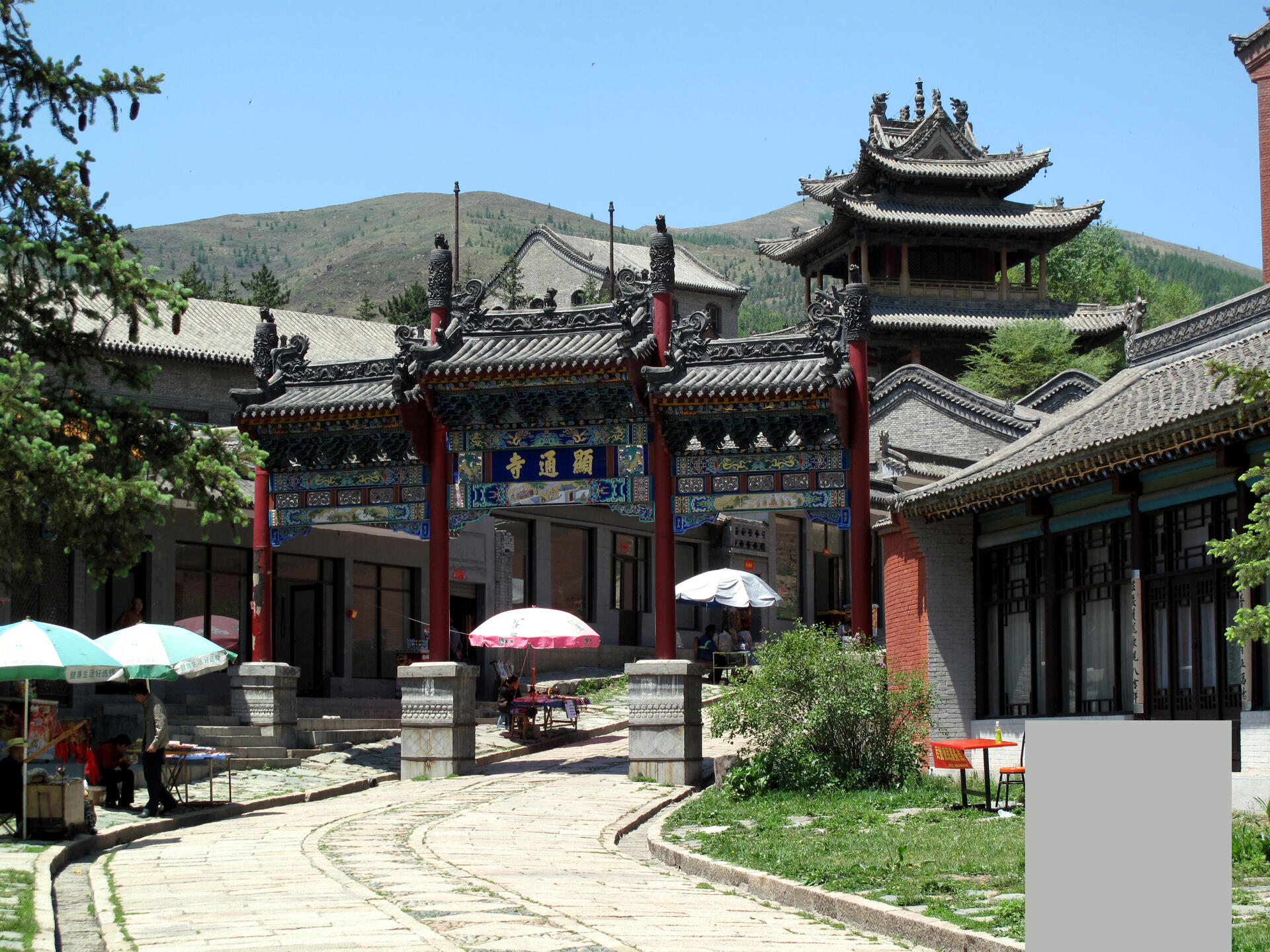
© G41rn8, CC BY-SA 4.0 Resized from original. (This derivative is under the same CC BY-SA license.)