
World Heritage Identification Number: 532
World Heritage since: 1990
Category: Cultural Heritage
WHE Type: Buildings & Architectural Ensembles
Transboundary Heritage: No
Endangered Heritage: No
Country: 🇩🇪 Germany
Continent: Europe
UNESCO World Region: Europe and North America
Map
Palaces and Parks of Potsdam and Berlin: A Unique Landscape Design Masterpiece
The Palaces and Parks of Potsdam and Berlin, inscribed as a UNESCO World Heritage Site in 1990 (with later extensions in 1992 and 1999), are a remarkable ensemble of palace complexes and extended landscaped gardens situated along the Havel River landscape surrounding the town of Potsdam in the federal state of Brandenburg and extending into the southwest of the German capital Berlin. This cultural ensemble offers a unique example of landscape design that reflects the monarchic ideas, artistic ambitions, and cultural aspirations of the Prussian state.
The Palaces and Parks of Potsdam and Berlin span over 2,000 hectares, featuring approximately 150 buildings constructed between 1730 and 1916. The architectural styles range from Baroque and Rococo to Neoclassical and Historicist forms, each structure contributing to the ensemble's eclectic character that enhances its overall distinctiveness. The complex extends into the district of Berlin-Zehlendorf (today part of Steglitz-Zehlendorf), with the palaces and parks lining the banks of the River Havel and Lake Glienicke.
One of the most notable structures within this ensemble is Sanssouci Palace, built under Frederick the Great between 1745 and 1747. The name Sanssouci translates to "without worry," reflecting Frederick II's desire for a peaceful retreat away from the formalities of court life. The palace is renowned for its ornate interiors, designed by architects such as Georg Wenzeslaus von Knobelsdorff, and its stunning gardens, which feature terraced walkways, cascades, and fountains.
Another significant palace within the ensemble is the New Palace, commissioned in 1763 during the reign of Frederick the Great following the Seven Years’ War, and completed in 1769. The New Palace is one of the largest palaces in Germany and serves as a testament to the power and wealth of the Prussian monarchy during the 18th century. Its grandeur is further emphasized by the extensive parkland that surrounds it, developed by architects including Johann Gottfried Büring, Carl von Gontard, and Jean Laurent Le Geay.
In addition to these masterpieces, the ensemble includes several other notable structures such as Cecilienhof Palace (site of the Potsdam Conference), Glienicke Palace, and the neo-Gothic Babelsberg Palace. While Charlottenburg Palace is a major Prussian residence, it is not part of this specific UNESCO World Heritage site; instead, the designation includes Berlin-based sites like Peacock Island (Pfaueninsel) and the Sacrow estate.
A defining chapter in the ensemble's history is its role during the Cold War. For decades, the Berlin Wall ran directly through these historic grounds, cutting through Babelsberg Park and the New Garden and separating the parks of Potsdam from those in West Berlin. The Glienicke Bridge, situated in the heart of this landscape, became the famous "Bridge of Spies" for Cold War prisoner exchanges. The 1990 UNESCO inscription was one of the first major cultural acts of a reunited Germany, symbolizing the physical and symbolic restoration of a landscape that had been divided by the Iron Curtain.
The parks associated with these palaces play an equally important role in the overall design. They were carefully planned to provide settings for courtly leisure and landscape aesthetics inspired by Enlightenment ideals. Beyond its architectural splendor, the ensemble represents a masterpiece of landscape planning shaped by the most influential designers of the 19th century, particularly Peter Joseph Lenné and Hermann von Pückler-Muskau. Their work transformed earlier layouts into expansive, naturalistic compositions inspired by the English landscape garden. Sweeping meadows, carefully framed sightlines, and subtle visual axes harmonize architecture, water, and vegetation into a unified artistic whole.
Today, the Palaces and Parks of Potsdam and Berlin stand as a testament to the artistic vision and political ambitions of the Prussian monarchy. They offer visitors a glimpse into the past, allowing them to appreciate the beauty and complexity of this unique landscape design masterpiece. The ensemble continues to attract tourists from around the world, who come to marvel at the palaces, explore the parks, and immerse themselves in the rich history of this remarkable cultural ensemble.
UNESCO Description of the World Heritage Site
With 500 ha of parks and 150 buildings constructed between 1730 and 1916, Potsdam's complex of palaces and parks forms an artistic whole, whose eclectic nature reinforces its sense of uniqueness. It extends into the district of Berlin-Zehlendorf, with the palaces and parks lining the banks of the River Havel and Lake Glienicke. Voltaire stayed at the Sans-Souci Palace, built under Frederick II between 1745 and 1747.
UNESCO Justification of the World Heritage Site
Criterion (i): The ensemble of the Palaces and Parks of Potsdam is an exceptional artistic achievement whose eclectic and evolutive features reinforce its uniqueness: from Knobelsdorff to Schinkel and from Eyserbeck to Lenné, a series of architectural and landscaping masterpieces have been built within a single space, illustrating opposing and reputedly irreconcilable styles without detracting from the harmony of a general composition that has been designed progressively over time. The beginning of the construction of Friedenskirche in 1845 is a symbol of deliberate historicism: this Nazarene pastiche of San Clemente Basilica in Rome commemorates the laying, on 14 April 1745, of the first stone for Sanssouci, the Rococo palace par excellence.
Criterion (ii): Potsdam-Sanssouci - frequently called the Prussian Versailles - is the crystallization of a great number of influences from Italy, England, Flanders, Paris, and Dresden. A synthesis of art trends in European cities and courts in the 18th century, the castle and the park offer new models that have greatly influenced the development of the monumental arts and the organization of space east of the Oder.
Criterion (iv): Potsdam-Sanssouci is an outstanding example of architectural creations and Landscaping development associated with the monarchic concept of power within Europe. By the vastness of the program, these royal ensembles belong to the very distinct category of princely residences, such as Würzburg and Blenheim (included on the World Heritage List in 1981 and 1987 respectively). The bombing of 14 April 1945 has made it impossible to nominate to the World Heritage List the urban ensemble developed by Frederick William I in two stages: the first new town, from 1721 to 1725, and the second new town, beginning in 1733.
Encyclopedia Record: Palaces and Parks of Potsdam and Berlin
Palaces and Parks of Potsdam and Berlin are a group of palace complexes and extended landscaped gardens located in the Havelland region around Potsdam and the German capital of Berlin. The term was used upon the designation of the cultural ensemble as a World Heritage Site by UNESCO in 1990. It was recognized for the historic unity of its landscape—a unique example of landscape design against the background of monarchic ideas of the Prussian state and common efforts of emancipation.Additional Site Details
Area: 2,064 hectares
Number of Components: 1
(ii) — Significant interchange of human values
(iv) — Outstanding example of a type of building or landscape
Coordinates: 52.4 , 13.03333333
Image
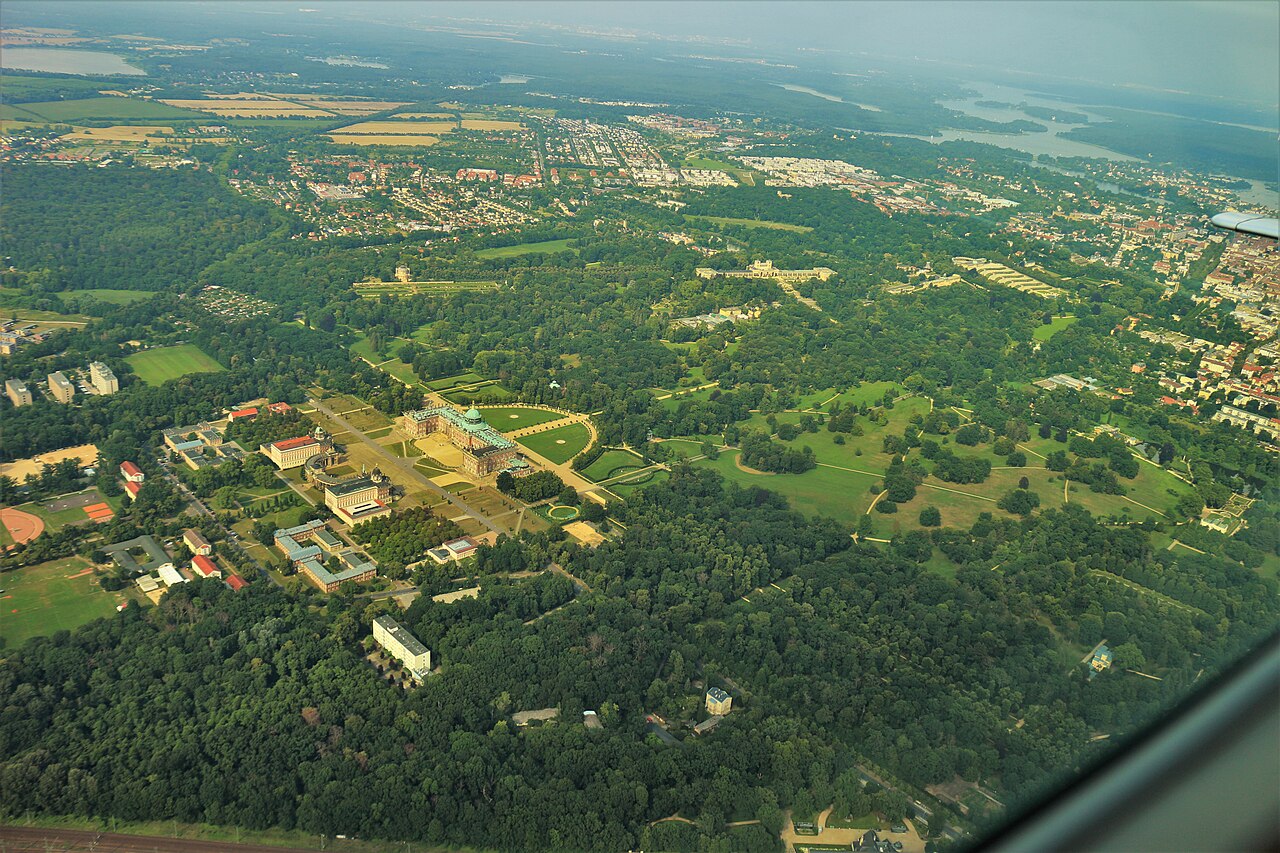
© Angel Miklashevsky, CC BY-SA 4.0 Resized from original. (This derivative is under the same CC BY-SA license.)