World Heritage Identification Number: 783
World Heritage since: 1996
Category: Cultural Heritage
WHE Type: Religious Sites & Sacred Architecture
Transboundary Heritage: No
Endangered Heritage: No
Country: 🇩🇪 Germany
Continent: Europe
UNESCO World Region: Europe and North America
Map
Luther Memorials in Eisleben and Wittenberg: A Journey Through the Birthplace and Burial Place of Martin Luther
The Luther Memorials in Eisleben and Wittenberg, inscribed as a UNESCO World Heritage Site in 1996, offer a unique opportunity to explore the life and legacy of one of the most significant figures in Western religious and political history – Martin Luther. This article provides an overview of the key sites associated with Luther and his contemporary, Philip Melanchthon, in these two towns located in the German state of Saxony-Anhalt.
More to come…UNESCO Description of the World Heritage Site
These places in Saxony-Anhalt are all associated with the lives of Martin Luther and his fellow-reformer Melanchthon. They include Melanchthon's house in Wittenberg, the houses in Eisleben where Luther was born in 1483 and died in 1546, his room in Wittenberg, the local church and the castle church where, on 31 October 1517, Luther posted his famous '95 Theses', which launched the Reformation and a new era in the religious and political history of the Western world.
UNESCO Justification of the World Heritage Site
Criterion (iv): The Luther Memorials in Wittenberg and Eisleben are artistic monuments of high quality, with their furnishings conveying a vivid picture of a historic era of world and ecclesiastical importance.
Criterion (vi): The Luther Memorials in Wittenberg and Eisleben are of Outstanding Universal Value bearing unique testimony to the Protestant Reformation, one of the most significant events in the religious and political history of the world, and constitute exceptional examples of 19th-century historicism.
Encyclopedia Record: Eisleben
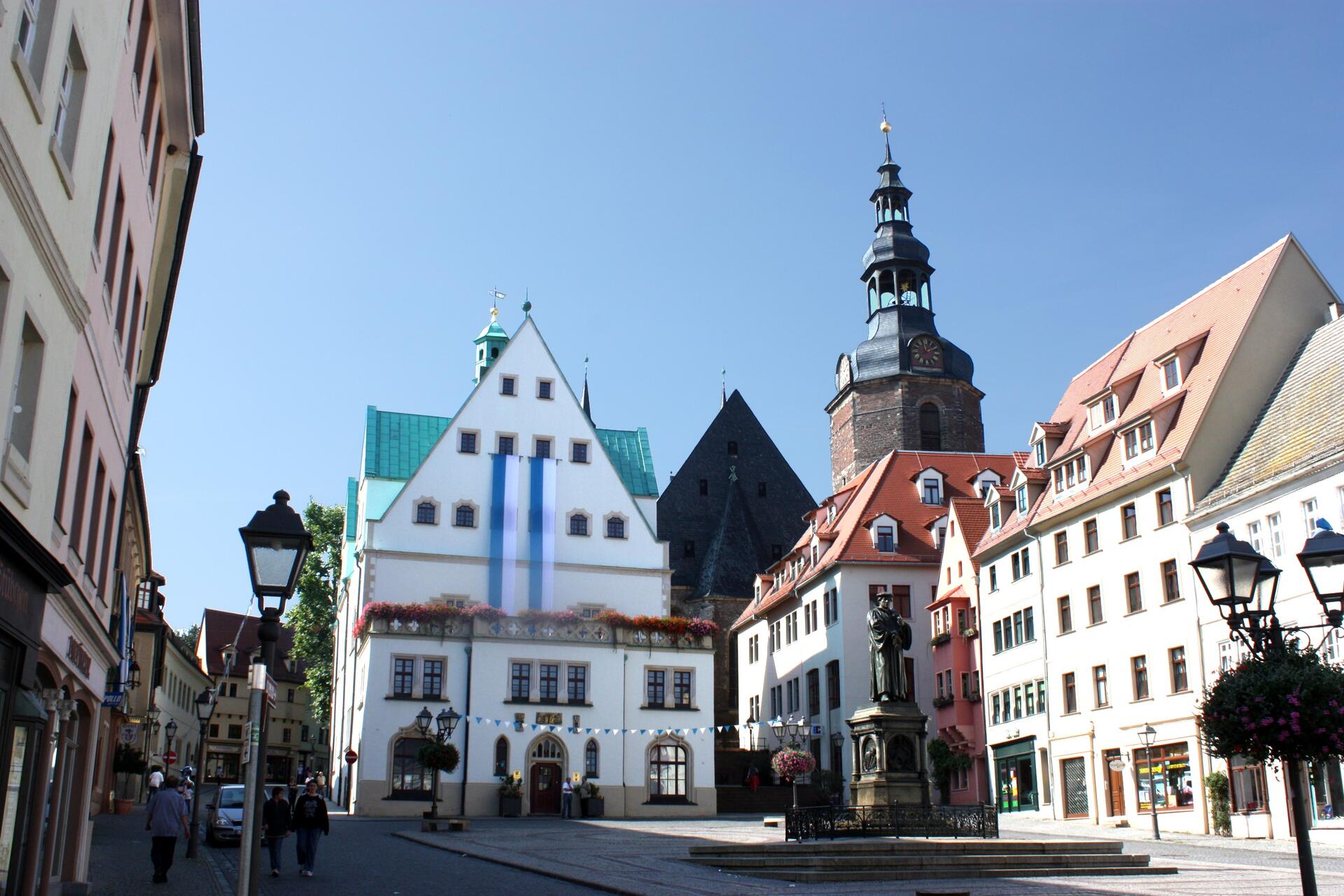
Eisleben is a town in Saxony-Anhalt, Germany. It is famous as both the hometown of the influential theologian Martin Luther and the place where he died; hence, its official name is Lutherstadt Eisleben.Additional Site Details
Area: 0.83 hectares
Number of Components: 6
(vi) — Directly associated with events or living traditions
Coordinates: 51.86472 , 12.65278
World Heritage Research
Discover scientific research and academic studies that deepen our understanding of Luther Memorials in Eisleben and Wittenberg from its history and significance to its conservation, management, and contemporary challenges.
-
Philipp Melanchthon’s Era in Wittenberg: Exploring Verse Inscriptions within a Multimedia Culture of Commemoration
Almost half of the known dedications to the deceased in Wittenberg during Philipp Melanchthon's era featured verse inscriptions, predominantly in Latin, revealing their significant role in 16th-century multimedia commemoration culture. These poems, often blending historical events with topical and ancient literary references, were disseminated through printed materials like funeral sermons or university announcements, as well as on monuments. They served both to honor the deceased and to impart moral lessons to future generations, merging literary and material memorials. The study highlights Melanchthon's influence in promoting sepulchral poetry and underscores the interaction between print and inscription in commemorative practices, providing insights into the social and cultural dynamics of the time.
Borchert-Pickenhan, J. (2025). Philipp Melanchthon’s Era in Wittenberg: Exploring Verse Inscriptions within a Multimedia Culture of Commemoration. Funerary Inscriptions in Early Modern Europe, 97–124. https://doi.org/10.1163/9789004711709_006
View Publication Record | Read Publication -
Living I Was Your Plague: Martin Luther's World and Legacy by Lyndal Roper
Lyndal Roper's collection of essays, 'Living I Was Your Plague: Martin Luther's World and Legacy,' offers a nuanced exploration of Martin Luther's life, thought, and enduring influence on material culture. The work employs psychoanalytic theory to interpret Luther's dreams and anti-Semitic writings, providing unique insights into his psyche and the broader impact of Lutheranism. Roper examines how Luther's image was shaped by Reformation-era portraits, such as those by Lucas Cranach, and traces its evolution through contemporary depictions, including a Playmobil figure that sparked controversy for perceived anti-Semitism. The study also highlights Luther's virulent anti-Semitism, which surpassed norms of his time, and contrasts it with his humorous critiques of the pope. Additionally, Roper analyzes 20th- and 21st-century representations of Luther, including a WWI postcard featuring Luther alongside Bismarck and a problematic depiction in Berlin's Luther Memorial Church, where swastikas appear near the Luther Rose. This interdisciplinary approach enriches our understanding of Luther's legacy and its complex manifestations in visual and material culture.
Klink, A. (2022). Living I Was Your Plague: Martin Luther’s World and Legacy by Lyndal Roper. Lutheran Quarterly, 36(2), 219–221. https://doi.org/10.1353/lut.2022.0049
View Publication Record | Read Publication -
Luthers Tod. Ereignis und Wirkung ed. by Armin Kohnle
Martin Luther's death on February 18, 1546, had profound and lasting impacts on the German empire and beyond, shaping both positive and negative perceptions of his reformist legacy. The edited volume 'Luthers Tod: Ereignis und Wirkung' explores various perspectives on Luther's death, including its cultural, theological, and historical implications. It examines how Luther's final days and the memory of his passing have been documented and interpreted over nearly five centuries, addressing controversies such as the myth of his suicide and the symbolic significance of his death. The collection also delves into Luther's pastoral approach to death, his testament's legal and familial radicality, and the reactions of those closest to him, including his wife Katherine von Bora and colleague Philipp Melanchthon. Additionally, it traces the evolution of published accounts of his death from eyewitness reports to later legends, while analyzing poetic tributes and material culture associated with his memory.
Kolb, R. (2020). Luthers Tod. Ereignis und Wirkung ed. by Armin Kohnle. Lutheran Quarterly, 34(2), 242–244. https://doi.org/10.1353/lut.2020.0044
View Publication Record | Read Publication -
2017: Dokumentation von literarischen Lutherbildern zwischen 1517 und 2017 in fünf Reihen
A unique series of facsimile publications documents the extensive literary treatment and transformation of Martin Luther from 1520 to the present, revealing his multifaceted portrayal across five centuries. The project, guided by Hans-Gert Roloff, aims to preserve largely forgotten or neglected works—including dramas, novels, and poems—highlighting diverse interpretations of Luther's life and ideology. Unlike traditional scholarship, which often overlooks these texts, this series seeks to fill a critical gap, presenting 17 volumes (several multivolume) with new introductions and notes by specialists. Initial publications include memorial texts from the 16th century and Levin Schücking’s 19th-century novel Luther in Rom, which portrays Luther as both a German prototype and a refined intellectual figure. This endeavor underscores Luther's unprecedented literary afterlife, offering valuable insights into his cultural legacy.
Hardin, J. (2019). 2017: Dokumentation von literarischen Lutherbildern zwischen 1517 und 2017 in fünf Reihen. Goethe Yearbook, 26(1), 305–306. https://doi.org/10.1353/gyr.2019.0010
View Publication Record | Read Publication -
1517: Martin Luther and the Invention of the Reformation by Peter Marshall
A myth about the Reformation's origins—the nailing of Martin Luther's 95 Theses to Wittenberg's church door—was likely invented by a later biographer, not an event that occurred in 1517. This conclusion emerges from Peter Marshall's cultural history analysis, which examines how the symbolic significance of this moment evolved over five centuries. By analyzing diverse artifacts (paintings, sermons, coins) and centennial commemorations (1617, 1817, 1917), Marshall reveals that the 'nailing' myth shaped later interpretations of Luther's role in the Reformation. The study also traces how 1517 became an iconic event tied to German nationalism and enlightenment before its historical veracity was challenged post-World War II. This work offers a unique lens on the intersection of history, memory, and cultural imagination.
Jordon, S. (2019). 1517: Martin Luther and the Invention of the Reformation by Peter Marshall. Lutheran Quarterly, 33(2), 218–220. https://doi.org/10.1353/lut.2019.0032
View Publication Record | Read Publication -
Mapping the Memory of Luther: Place and Confessional Identity in the Later Reformation*
A 1571 map of Mansfeld, Luther’s birthplace, created by Johannes Mellinger and Tilemann Stella, serves as more than a geographical representation—it functions as a tool for memory-making and the memorialization of Lutheran identity during a critical period in Reformation history. The map integrates historical details, quotations, and references to Luther’s life, reimagining space to validate Lutheranism while addressing tensions between tradition and novelty. This composite approach historicized and reconceptualized landscapes, offering an alternative narrative for second-generation Lutherans to grapple with the loss of the Wittenberg reformer and secure their confessional future. The study highlights how spatial representation in early modern Europe was instrumental in shaping collective memory and validating religious identity.
Hill, K. (2020). Mapping the Memory of Luther: Place and Confessional Identity in the Later Reformation*. German History, 38(2), 187–210. https://doi.org/10.1093/gerhis/ghz098
View Publication Record | Read Publication -
Philipp Melanchthon: Zur populären Rezeption des Reformators ed. by Stefan Rhein and Martin Treu
A collection of essays offers a balanced examination of the popular reception of Philipp Melanchthon, one of the Reformation's most influential figures, across literary and artistic forms. Contrasting with earlier negative portrayals, the volume analyzes diverse sources to illustrate how later generations perceived Melanchthon, revealing his enduring resonance in early-modern Europe—even surpassing that of Martin Luther. The essays explore twentieth-century German literature, edification literature, school textbooks, graphic art, film, and memorials, highlighting shifts in historical memory, particularly during Nazi rule and post-war periods. They also examine cultural contexts influencing Melanchthon's image, such as his home in Wittenberg, birthplace in Bretten, and connections in Nuremberg. The study underscores the complex interplay of Romanticism, theological debates, and cultural values in shaping Melanchthon's legacy over centuries.
Wengert, T. J. (2018). Philipp Melanchthon: Zur populären Rezeption des Reformators ed. by Stefan Rhein and Martin Treu. Lutheran Quarterly, 32(1), 89–90. https://doi.org/10.1353/lut.2018.0017
View Publication Record | Read Publication