World Heritage Identification Number: 1470
World Heritage since: 2018
Category: Cultural Heritage
WHE Type: Religious Sites & Sacred Architecture
Transboundary Heritage: No
Endangered Heritage: No
Country: 🇩🇪 Germany
Continent: Europe
UNESCO World Region: Europe and North America
Map
Naumburg Cathedral: A Testament to Medieval Art and Architecture
The Naumburg Cathedral, nestled in the picturesque town of Naumburg in central Germany, stands as a testament to the rich artistic and architectural heritage of the Middle Ages. Inscribed as a UNESCO World Heritage Site in 2018, this remarkable structure offers a unique insight into the evolution of European architecture during the transitional period from Romanesque to Gothic styles.
More to come…UNESCO Description of the World Heritage Site
Located in the eastern part of the Thuringian Basin, the Cathedral of Naumburg, whose construction began in 1028, is an outstanding testimony to medieval art and architecture. Its Romanesque structure, flanked by two Gothic choirs, demonstrates the stylistic transition from late Romanesque to early Gothic. The west choir, dating to the first half of the 13th century, reflects changes in religious practice and the appearance of science and nature in the figurative arts. The choir and life-size sculptures of the founders of the Cathedral are masterpieces of the workshop known as the ‘Naumburg Master’.
UNESCO Justification of the World Heritage Site
Criterion (i): The episcopal church of Naumburg is unique among the medieval cathedrals due to the west choir conceptualized and designed by a brilliant sculptor – the “Naumburg Master” – and his workshop. The organic combination of architecture, sculpture and glass paintings created an extraordinary synthesis of the arts. The twelve life-sized, colored founder figures in the west choir, the passion reliefs of the west rood screen, the crucifixion group on its portal and the numerous capitals are outstanding examples of the architectural sculpture of the Middle Ages. One of the founder figures – Uta of Ballenstedt – is considered as one of the icons of Gothic sculpture. They are sculpted from the same blocks of stone as the pillar strips, and the various media are integrated in the fabric of the architecture and its manner of construction. A single intelligence stood behind the integrated conception of the architecture, sculpture, and stained glass and merged them into one integral piece of work.
Criterion (ii): The workshop organization of sculptors and stonemasons was established in the early 13th century and is known under the name Naumburg Master. It constitutes one of the decisive conveyors and pioneers of the ground-breaking innovations in architecture and sculpture in the second half of the 13th century. The migration of the workshop of the Naumburg Master, from northeastern France through the Middle Rhine areas to the eastern boundaries of the Holy Roman Empire and further to southwestern Europe, gives testimony to the extensive European cultural exchange during the High Middle Ages.
Encyclopedia Record: Naumburg Cathedral
Naumburg Cathedral, located in Naumburg, Germany, is the former cathedral of the Bishopric of Naumburg-Zeitz. The church building, most of which dates back to the 13th century, is a renowned landmark of the German late Romanesque and was recognised as a UNESCO World Heritage Site in 2018. The west choir with the famous donor portrait statues of the twelve cathedral founders (Stifterfiguren) and the Lettner, works of the Naumburg Master, is one of the most significant early Gothic monuments.Additional Site Details
Area: 1.82 hectares
Number of Components: 1
(ii) — Significant interchange of human values
Coordinates: 51.1548055556 , 11.804
Image
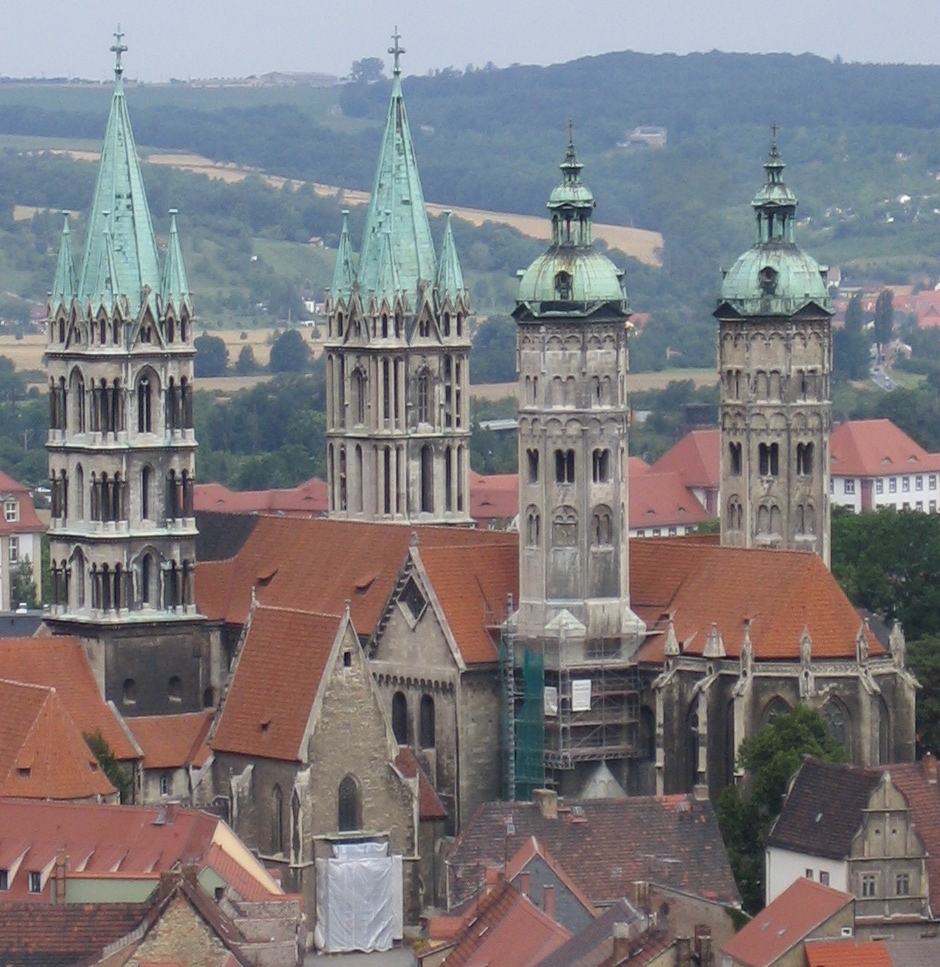
© Wst at German Wikipedia, CC BY-SA 3.0 Resized from original. (This derivative is under the same CC BY-SA license.)
World Heritage Research
Discover scientific research and academic studies that deepen our understanding of Naumburg Cathedral from its history and significance to its conservation, management, and contemporary challenges.
-
Evaluation of the Composition, Thermal and Mechanical Behavior, and Color Changes of Artificially and Naturally Aged Polymers for the Conservation of Stained Glass Windows
A study on the stained glass windows of Naumburg Cathedral, Germany, reveals that acrylate resins were predominantly used for conservation, with notable lamination materials from the 1940s and isolated cases of epoxy resins. Artificial aging experiments demonstrated that UV radiation and extreme temperatures had a stronger impact on material properties than humidity. Naturally aged samples showed less degradation compared to artificially aged ones, providing insights into the long-term effects of environmental exposure. The research used spectroscopy (FTIR, Raman), thermal analysis, PY-GC/MS, and SEC to characterize historical conservation materials and derive recommendations for the preservation of these cultural artifacts.
Brandt, J., Kanaki, E., Fischer, D., & Herm, C. (2023). Evaluation of the Composition, Thermal and Mechanical Behavior, and Color Changes of Artificially and Naturally Aged Polymers for the Conservation of Stained Glass Windows. Polymers, 15(12), 2595. https://doi.org/10.3390/polym15122595
View Publication Record | Read Publication -
Naumburg Cathedral (Naumburger Dom)
Naumburg Cathedral, a renowned late Romanesque and early Gothic church in Germany, reveals significant architectural insights through archaeological excavations conducted between 1961 and 1965. These excavations uncovered remnants of an earlier Romanesque structure, predating the cathedral's main construction phase from approximately 1210 to 1260. The study highlights the cathedral's intricate design, including the west rood screen by the Naumburg Master, which separates the west choir from the nave, and notable works such as the tomb of Bishop Dietrich II and a deacon-shaped lectern in the east choir. This research provides a deeper understanding of the cathedral's historical layers and the craftsmanship involved in its creation.
Sobott, R. (2021). Naumburg Cathedral (Naumburger Dom). Natural Stone and World Heritage, 35–41. https://doi.org/10.1201/9780367823061-8
View Publication Record | Read Publication -
Memories of Border : The Statue of Uta in Naumburg Cathedral
A 13th-century statue of Uta, located at Naumburg Cathedralchallenges nationalist narratives by revealing a complex, hybridized border culture that defies modern interpretations. Originally forgotten, Uta's memory was politically instrumentalized during the 20th century as a symbol of German identity, obscuring her actual life in the 11th-century Polish-German borderlands, where her family embodied cultural and political fluidity. The study critiques how ideological framing distorts historical realities while highlighting Naumburg Cathedral’s significance as a transnational cultural site, shaped by an anonymous master craftsman who merged Romanesque and Gothic styles. This work underscores the cathedral's role in redefining border histories beyond conquest narratives.
CHA, Y. K., & SON, J. K. (2019). Memories of Border : The Statue of Uta in Naumburg Cathedral. Journal of Western Medieval History, 44, 3–37. https://doi.org/10.21591/jwmh.2019.44.2.003
View Publication Record | Read Publication -
Seigneurial Power and the Development of Towns in the Holy Roman Empire
Feudal powers, including princes and ecclesiastical leaders, were pivotal in driving the urbanization of central Europe during the Middle Ages. A key example is Naumburg Cathedral, where seigneurial power closely intertwined with the merchant class to shape early town development. The study reveals that medieval town laws evolved through statutes issued by town councils, interpretations by judges, and later by Roman law-trained lawyers. This dynamic process reflected broader territorial competition among princes, dynasts, bishops, and abbots in the Holy Roman Empire, highlighting the complex interplay between political power and urban growth.
Johanek, P. (2017). Seigneurial Power and the Development of Towns in the Holy Roman Empire. Lords and Towns in Medieval Europe, 117–154. https://doi.org/10.4324/9781315250182-7
View Publication Record | Read Publication -
Sculpting Simulacra in Medieval Germany, 1250–1380 by Assaf Pinkus
Assaf Pinkus's Sculpting Simulacra in Medieval Germany, 1250–1380 challenges traditional scholarly interpretations of Gothic sculptures by arguing that these works, particularly those at Naumburg Cathedral and other sites, function as simulacra—inviting diverse emotional and imaginative responses from lay viewers. Unlike previous analyses that focused on religious or mystical experiences, Pinkus contends that such interpretations may overlook the broader cultural impact of these artworks. His study draws on extensive German scholarship but assumes familiarity with this body of work, leaving room for further exploration. While Pinkus provides compelling examples to support his thesis, the book could have benefited from deeper comparisons with French Gothic precedents and more focused discussions on specific monuments.
Collard, J. (2016). Sculpting Simulacra in Medieval Germany, 1250–1380 by Assaf Pinkus. Parergon, 33(1), 273–274. https://doi.org/10.1353/pgn.2016.0064
View Publication Record | Read Publication -
”At præsentere sig selv” – Stifterfigurerne i Naumburg og psykehistorie
A novel interpretation of the Naumburg Cathedral's founder statues reveals their stylistic and psychological significance within medieval art. The study proposes that these lifelike yet historically inaccurate sculptures reflect a psychogenetic dialectic, shaped by courtly culture's educational ideals and its interplay with religious thought. By reidentifying the Sizzo figure and analyzing the Naumburg Master's rhetorical techniques, the research situates this ensemble as a visual representation of emerging Gothic style, blending medieval and ancient influences. This approach suggests that the statues' expressions and relationships symbolize a new 'mental architecture,' marking a shift in artistic and cultural paradigms during the 12th century.
Kaspersen, S. (2016). ”At præsentere sig selv” – Stifterfigurerne i Naumburg og psykehistorie. ICO Iconographisk Post. Nordisk Tidskrift För Bildtolkning – Nordic Review of Iconography, (2), 4–52. https://doi.org/10.69945/ico.vi2.25614
View Publication Record | Read Publication -
„Der Naumburger Dom und die hochmittelalterliche Herrschaftslandschaft an Saale und Unstrut“. Das ICOMOS-Gutachten zum Naumburger UNESCO-Welterbeantrag. - [Rezension]
A critical review of the ICOMOS evaluation report for Naumburg Cathedral's UNESCO World Heritage bid reveals significant methodological and conceptual flaws. The report, which recommended against inscription due to perceived shortcomings in integrity and authenticity, was found to rely on distorted interpretations of the application, misleading historical claims, and an exclusionary approach that could reinforce regressive nationalism. Instead of providing a robust justification for rejection, ICOMOS's assessment was criticized for its abstract, unhistorical application of key criteria and its failure to align with modern, globally inclusive standards for World Heritage recognition. The review outlines potential pathways for a more contemporary and contextually appropriate approach to preserving cultural heritage in an era of globalization.
Straehle, G. (2015). „Der Naumburger Dom und die hochmittelalterliche Herrschaftslandschaft an Saale und Unstrut“. Das ICOMOS-Gutachten zum Naumburger UNESCO-Welterbeantrag. - [Rezension]. Heidelberg University Library. https://doi.org/10.11588/ARTDOK.00003475
View Publication Record | Read Publication