World Heritage Identification Number: 384
World Heritage since: 1986
Category: Cultural Heritage
WHE Type: Historic Cities & Urban Areas
Transboundary Heritage: No
Endangered Heritage: No
Country: 🇪🇸 Spain
Continent: Europe
UNESCO World Region: Europe and North America
Map
The Historic Walled City of Cáceres: A Blend of Cultures and Architectural Styles
The Old Town of Cáceres, located in the heart of Extremadura, Spain, stands as a testament to the rich cultural tapestry that has unfolded over centuries within its ancient walls. Inscribed as a UNESCO World Heritage Site in 1986, this historic city offers visitors a unique opportunity to explore the architectural fusion of Roman, Islamic, Northern Gothic, and Italian Renaissance influences.
More to come…UNESCO Description of the World Heritage Site
The city's history of battles between Moors and Christians is reflected in its architecture, which is a blend of Roman, Islamic, Northern Gothic and Italian Renaissance styles. Of the 30 or so towers from the Muslim period, the Torre del Bujaco is the most famous.
UNESCO Justification of the World Heritage Site
Criterion (iii): The walls of Cáceres bear exceptional testimony to the fortifications built in Spain by the Almohades. Frequently compared to Torre de Espantaperros in Badajoz and to Torre del Oro in Seville, Torre Mochada in Cáceres is part of an ensemble of walls and towers, which has been largely conserved and which is representative of a civilisation.
Criterion (iv): Cáceres is an outstanding example of a city ruled during the 14th to 16th centuries by powerful rival factions, so that fortified houses, palaces and towers dominate its spatial configuration. This city in Extremadura is unique because of its historic features, which - from the Middle Ages to the classical period - bear the traces of highly diverse and contradictory influences, such as Northern Gothic, Islamic, Italian Renaissance and arts of the New World.
Encyclopedia Record: Old Town of Cáceres
Old Town of Cáceres is a historic walled city in Cáceres, Spain.Additional Site Details
Area: 9 hectares
Number of Components: 1
(iv) — Outstanding example of a type of building or landscape
Coordinates: 39.47444 , -6.37
Image
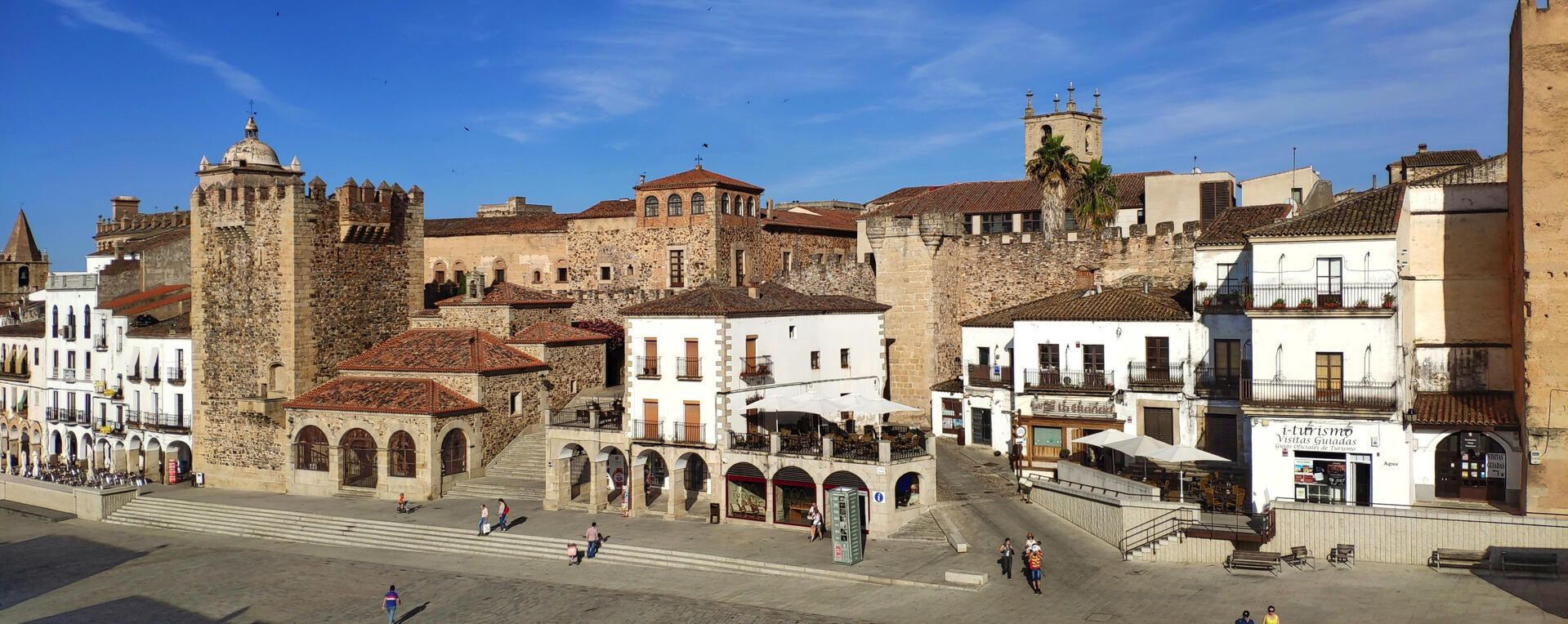
© Alonso de Mendoza, CC BY-SA 4.0 Resized from original. (This derivative is under the same CC BY-SA license.)
World Heritage Research
Discover scientific research and academic studies that deepen our understanding of Old Town of Cáceres from its history and significance to its conservation, management, and contemporary challenges.
-
Onomastics and mobility of the population in Cáceres (13th century-1525)
Cáceres' population growth from the 13th to early 16th centuries was driven by diverse immigration, shifting from repopulation needs after Christian conquest to economic and social mobility. Initially dominated by settlers from León, Galicia, and Castile—evident in local toponymy—the later period saw increased diversity, including arrivals from New Castile, Extremadura, Andalusia, and Portugal. While migration no longer structurally benefited the town's population balance, continuous newcomers reinforced Cáceres' prominence in late-medieval Extremadura. The study leverages onomastic analysis to trace demographic mobility patterns, revealing how economic opportunities, noble service, and artisan labor shaped the region's urban development.
Clemente Ramos, J. (2026). Onomastics and mobility of the population in Cáceres (13th century-1525). Cuadernos Del CEMyR, (34), 169–188. https://doi.org/10.25145/j.cemyr.2026.34.07
View Publication Record | Read Publication -
Regla 3–30–300: enfoque metodológico SIG–LiDAR para el diagnóstico urbano en Cáceres, España
Urban areas in the Mediterranean face significant environmental risks that necessitate renaturalization efforts. A new study introduces the 'Regla 3-30-300' methodology, which uses LiDAR data and advanced GIS analysis to evaluate urban green infrastructure in Cáceres, Spain. This approach calculates three key indicators: the visibility of greenery between buildings (3), the structure and coverage of vegetation per neighborhood (30), and real pedestrian accessibility to green spaces (300). These indicators are combined into a composite index (0-100) that highlights neighborhoods with higher green coverage and better access, while identifying areas like the historic center and peripheral growth zones as priorities for intervention. This methodology offers a reproducible framework for urban planning and environmental assessment.
Gil Martín, C., & Chapinal Cervantes, L. (2026). Regla 3–30–300: enfoque metodológico SIG–LiDAR para el diagnóstico urbano en Cáceres, España. Congresos UEx, Actas de Congresos, (2). https://doi.org/10.17398/3101-7177.2.192
View Publication Record | Read Publication -
Residents’ perceptions of tourism and sustainable tourism management: planning to prevent future problems in destination management - The case of Cáceres, Spain
A balanced approach to tourism management can mitigate negative impacts such as gentrification and socio-cultural tensions in UNESCO World Heritage Sites. This study reveals that while residents of Cáceres, Spain, recognize the economic and cultural benefits of tourism, they also express significant concerns about its socio-economic and cultural consequences. Using principal component analysis (PCA) and cluster analysis, researchers correlated these perceptions with socio-demographic factors to propose targeted measures for sustainable urban tourist accommodation. The findings highlight the need for proactive regulation to address community concerns and prevent gentrification, offering insights for responsible integration of short-term rentals in historic urban areas.
Caro-Carretero, R., & Monroy-Rodríguez, S. (2025). Residents’ perceptions of tourism and sustainable tourism management: planning to prevent future problems in destination management - The case of Cáceres, Spain. Cogent Social Sciences, 11(1). https://doi.org/10.1080/23311886.2024.2447398
View Publication Record | Read Publication -
The boom of tourist apartments (2019 ‑2024) as a strategy for World Heritage preservation and economic growth in Cáceres (Spain)
Cáceres demonstrates how tourist apartments (TAs) can serve as both custodians of cultural heritage and catalysts for economic growth, offering a model for UNESCO World Heritage Sites. The study reveals that the strategic location of TAs within the historic town enhances their economic viability while simultaneously promoting the city's global reputation through architectural features that draw tourists. By analyzing regulations, collecting visual data, and reviewing literature, researchers found that TAs contribute to economic activity by granting local business licenses while showcasing Cáceres' heritage. This synergy between preservation and prosperity positions the city as an exemplary case study for balancing tourism development with cultural conservation.
Sánchez González, M. G., Capel-Davies, G.,. (2025). The boom of tourist apartments (2019 ‑2024) as a strategy for World Heritage preservation and economic growth in Cáceres (Spain). PASOS. Revista de Turismo Y Patrimonio Cultural, 23(3), 775–793. https://doi.org/10.25145/j.pasos.2025.23.049
View Publication Record | Read Publication -
The Legacy of Helga de Alvear: The Gallery, the Collection, the Museum—A Curatorial and Museographic Approach
Helga de Alvear's legacy, encapsulated in her vast art collection and the establishment of the Helga de Alvear Museum in Cáceres, significantly shaped the Spanish and international contemporary art landscape. Her collection, comprising over 3000 works with a notable focus on international minimalist art, reflects her personal and professional journey. The study delves into the institutionalization of her legacy, from the creation of the Helga de Alvear Foundation to the development of the museum, highlighting its innovative architecture and museography. This research provides insights into how such initiatives can foster exhibition, research, conservation, and education while transforming urban landscapes.
Perez-Ibanez, M. (2025). The Legacy of Helga de Alvear: The Gallery, the Collection, the Museum—A Curatorial and Museographic Approach. Arts, 14(4), 92. https://doi.org/10.3390/arts14040092
View Publication Record | Read Publication -
El ocio rural durante el siglo XX. El cine San Ildefonso de Salorino (Cáceres) como paradigma de arquitectura de uso modular
A century-old cinema, San Ildefonso in Salorino (Cáceres), exemplifies the evolution of rural leisure through its modular architecture, characterized by superimposed functions reflected in two adjoining spaces with double fronts. The study analyzes the interplay between traditional and refurbished façades and their interior impacts while incorporating documentary and anthropological perspectives. This architectural paradigm offers insights into how rural entertainment adapted over the 20th century, providing a unique lens to understand social and cultural transformations in UNESCO World Heritage Sites like Cáceres.
García-Manso, A., & Díaz Mayordomo, A. (2025). Rural leisure during the 20th century. San Ildefonso movie-theater in Salorino (Cáceres) as a paradigm of modular architecture. Studia Humanitatis Journal, 5(2), 1–20. https://doi.org/10.33732/shj.v5i2.150
View Publication Record | Read Publication -
Acoustic Environment and Urban Sustainable Development in the City of Cáceres
Research on the Old Town of Cáceres reveals that acoustic environment significantly influences the perception and satisfaction of urban green spaces, despite noise levels being lower than other evaluated features. The study found a strong correlation between noise satisfaction—primarily from road traffic—and overall satisfaction with these areas. This insight underscores the importance of considering environmental noise in sustainable urban development projects, such as expanding green spaces like Parque del Príncipe and connecting them to the Old Town via Paseo de Canovas. The findings suggest that neglecting noise management could hinder achieving sustainable development goals, even in cities with high green area per capita and aesthetic value.
REY-GOZALO, G., BARRIGÓN-MORILLAS, J.-M., MONTES-GONZÁLEZ, D., VENEGAS-JIMÉNEZ, C., BONILLA-MEDINA, D., CASAS-ESCUDERO, G., MÉNDEZ-SIERRA, J.-A., VÍLCHEZ-GÓMEZ, R., & ATANASIO-MORAGA, P. (2024). ACOUSTIC ENVIRONMENT AND URBAN SUSTAINABLE DEVELOPMENT IN THE CITY OF CÁCERES. 24th International Conference on Sound and Vibration 2017, London Calling. https://doi.org/10.25144/24050
View Publication Record | Read Publication