World Heritage Identification Number: 442
World Heritage since: 1987
Category: Cultural Heritage
WHE Type: Buildings & Architectural Ensembles
Transboundary Heritage: No
Endangered Heritage: No
Country: 🇺🇸 United States of America
Continent: Americas
UNESCO World Region: Europe and North America
Map
Monticello and the University of Virginia in Charlottesville: Architectural Masterpieces of Thomas Jefferson
Monticello and the University of Virginia in Charlottesville represent two significant architectural masterpieces designed by Thomas Jefferson, a founding father, statesman, and architect of the United States. These sites, inscribed as a UNESCO World Heritage Site in 1987, showcase Jefferson's unique blend of classical architecture and innovative design principles.
More to come…UNESCO Description of the World Heritage Site
Thomas Jefferson (1743–1826), author of the American Declaration of Independence and third president of the United States, was also a talented architect of neoclassical buildings. He designed Monticello (1769–1809), his plantation home, and his ideal 'academical village' (1817–26), which is still the heart of the University of Virginia. Jefferson's use of an architectural vocabulary based upon classical antiquity symbolizes both the aspirations of the new American republic as the inheritor of European tradition and the cultural experimentation that could be expected as the country matured.
UNESCO Justification of the World Heritage Site
Criterion (i): Both Monticello and the University of Virginia reflect Jefferson’s wide reading of classical and later works on architecture and design and also his careful study of the architecture of late 18th-century Europe. As such they illustrate his wide diversity of interests.
Criterion (iv): With these buildings Thomas Jefferson made a significant contribution to Neoclassicism, the 18th-century movement that adapted the forms and details of classical architecture to contemporary buildings.
Criterion (vi): Monticello and the key buildings of the University of Virginia are directly and materially associated with the ideas and ideals of Thomas Jefferson. Both the University buildings and Monticello were directly inspired by principles derived from his deep knowledge of classical architecture and philosophy.
Encyclopedia Record: Monticello
Monticello was the primary residence and plantation of Thomas Jefferson, a Founding Father, author of the Declaration of Independence, and the third president of the United States. Jefferson began designing Monticello after inheriting land from his father at the age of 14. Located just outside Charlottesville, Virginia, in the Piedmont region, the plantation was originally 5,000 acres (20 km2), with Jefferson using the forced labor of enslaved black people for extensive cultivation of tobacco and mixed crops, later shifting from tobacco cultivation to wheat in response to changing markets. Due to its architectural and historic significance, the property has been designated a National Historic Landmark. In 1987, Monticello and the nearby University of Virginia, also designed by Jefferson, were together designated a UNESCO World Heritage Site. The United States nickel has featured a depiction of Monticello on its reverse every year since 1938 with the exception of 2004-05.Additional Site Details
Area: 795.96 hectares
Number of Components: 2
(iv) — Outstanding example of a type of building or landscape
(vi) — Directly associated with events or living traditions
Coordinates: 38.03277778 , -78.50388889
Image
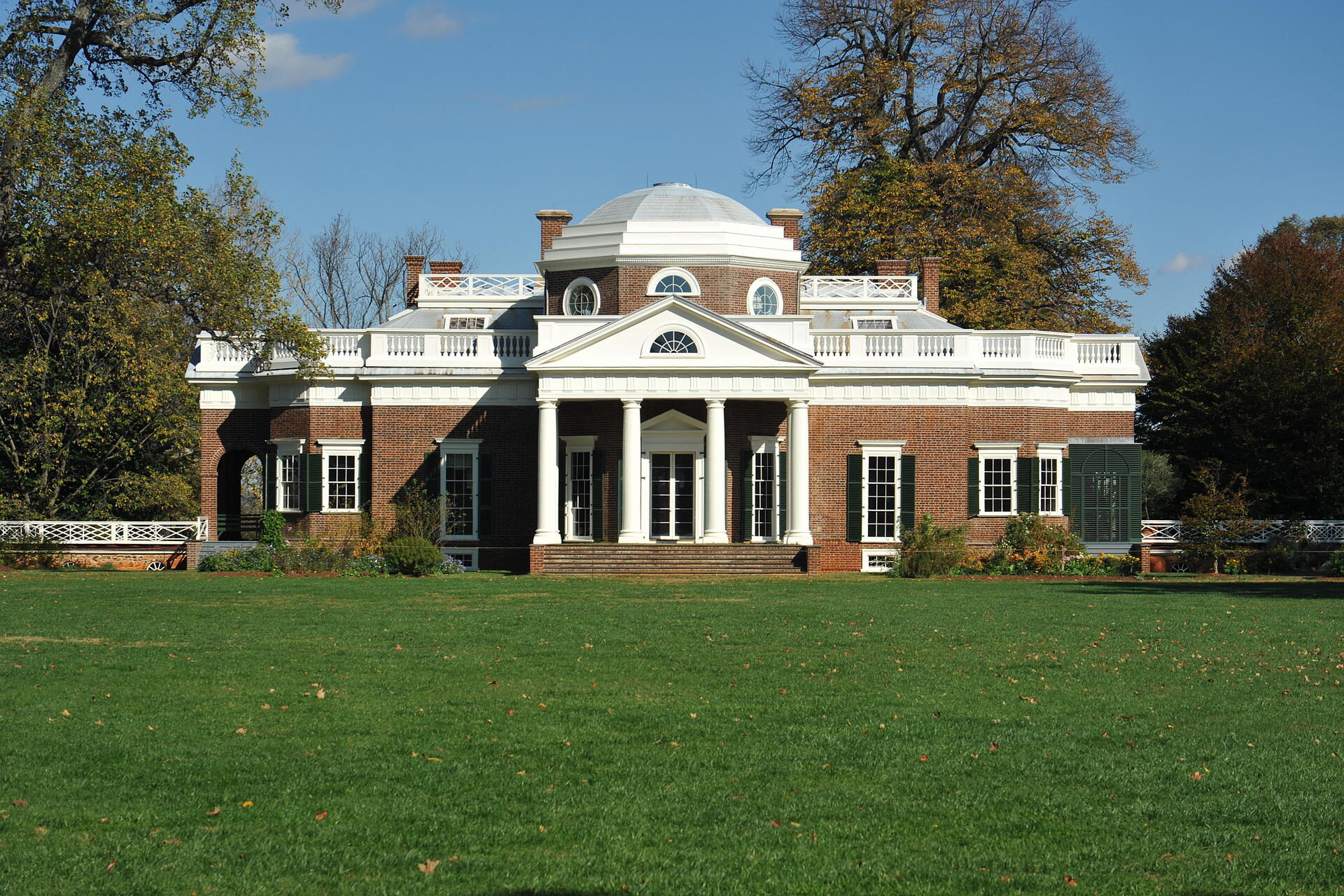
© YF12s, CC BY-SA 3.0 Resized from original. (This derivative is under the same CC BY-SA license.)