World Heritage Identification Number: 78
World Heritage since: 1979
Category: Cultural Heritage
WHE Type: Memorial Sites
Transboundary Heritage: No
Endangered Heritage: No
Country: 🇺🇸 United States of America
Continent: Americas
UNESCO World Region: Europe and North America
Map
A Historic Landmark: Independence Hall
Independence Hall, located in Philadelphia, Pennsylvania, is a significant historical landmark that holds immense importance not only for the United States but also for the global community. This iconic building, completed in 1753, serves as a testament to the birthplace of American democracy and the principles of freedom and self-governance it embodies. Inscribed as a UNESCO World Heritage Site in 1979, Independence Hall stands as a symbol of the universal values of liberty and democracy that have influenced lawmakers worldwide.
The hall's historical significance stems from two pivotal events that took place within its walls. On July 4, 1776, the Second Continental Congress convened in the building, and after much deliberation, approved and formally adopted the Declaration of Independence, following an earlier vote for independence on July 2. Drafted primarily by Thomas Jefferson, the document proclaimed the thirteen American colonies to be free and independent states, asserting their right to self-governance and directly challenging the authority of the British monarchy.
Nearly a decade later, in 1787, Independence Hall served as the meeting place for the Constitutional Convention. Delegates from most of the states—Rhode Island did not send delegates—gathered to address the weaknesses of the Articles of Confederation, the nation’s first governing framework. Over the course of four months, they debated and drafted the United States Constitution, which was signed on September 17, 1787. The document established a federal system of government with a stronger central authority and a bicameral legislature, laying the foundation for the modern American political system.
Architecturally, Independence Hall exemplifies American Georgian architecture, characterized by symmetry, balanced proportions, and exposed brick with stone masonry accents. The building's design reflects the ideals of the Enlightenment, emphasizing reason, order, and rationality—ideas that that strongly influenced the Founding Fathers as they shaped the nation’s political institutions.
Despite its role as the cradle of American liberty, the legacy of Independence Hall is deeply intertwined with the paradoxes of the founding era. While the Assembly Room saw the birth of the phrase “all men are created equal,” the building also later housed courtrooms where the Fugitive Slave Act of 1850 was enforced, determining the fate of individuals seeking freedom from bondage.
Furthermore, the site’s proximity to the President’s House—where George Washington held enslaved people during his residency—serves as a poignant reminder that the “universal” rights articulated within the hall did not initially extend to African Americans, women, or Indigenous peoples.
Today, Independence Hall remains an essential part of Independence National Historical Park, which attracts millions of visitors annually. The building serves as a museum, offering guided tours that provide insight into the events that transpired within its walls and the broader historical context of the American Revolution and the formation of the United States. As a UNESCO World Heritage Site, Independence Hall continues to inspire and educate people around the world about the enduring principles of freedom, democracy, and self-governance that were born in this hallowed hall.
UNESCO Description of the World Heritage Site
The Declaration of Independence (1776) and the Constitution of the United States (1787) were both signed in this building in Philadelphia. The universal principles of freedom and democracy set forth in these documents are of fundamental importance to American history and have also had a profound impact on law-makers around the world.
UNESCO Justification of the World Heritage Site
Criterion (vi) : The universal principles of the right to revolution and self-government, as expressed in the United States of America’s Declaration of Independence (1776) and Constitution (1787), which were debated, adopted, and signed in Independence Hall, have profoundly influenced lawmakers and politicians around the world. The fundamental concepts, format, and even substantive elements of the two documents have influenced governmental charters in many nations and even the United Nations Charter.
Encyclopedia Record: Independence Hall
Independence Hall is a historic civic building in Philadelphia, Pennsylvania, where both the Declaration of Independence and the Constitution of the United States were debated and adopted by the Founding Fathers of the United States. The building, which is the centerpiece of Independence National Historical Park, was designated a World Heritage Site in 1979. It is an example of American Georgian architecture, which is characterized by symmetry, classical proportions, and exposed brick with stone masonry accents.Additional Site Details
Area: 2 hectares
Number of Components: 1
Coordinates: 39.94861111 , -75.15
Image
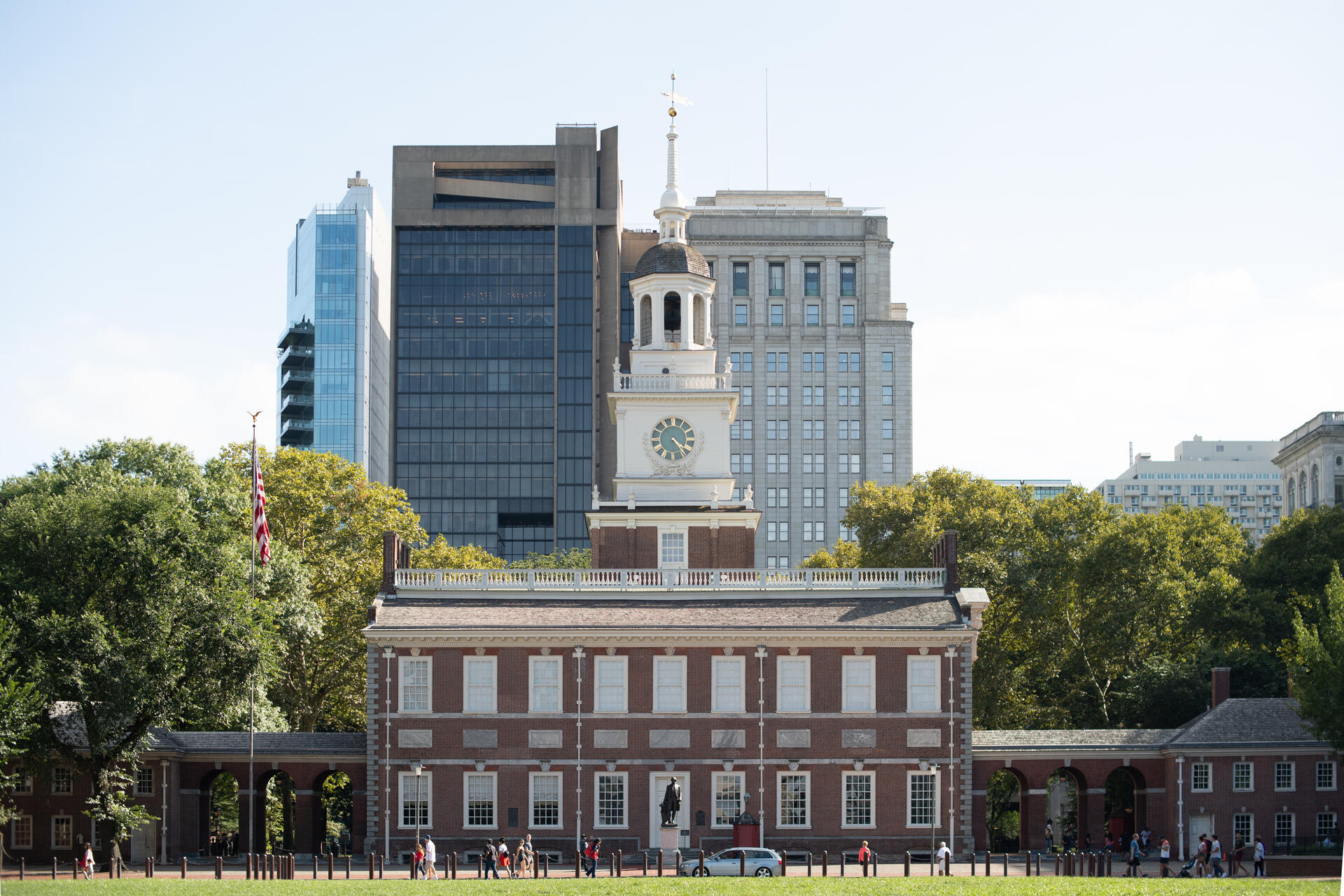
© Mys 721tx, CC BY-SA 3.0 Resized from original. (This derivative is under the same CC BY-SA license.)