World Heritage Identification Number: 599
World Heritage since: 1991
Category: Cultural Heritage
WHE Type: Buildings & Architectural Ensembles
Transboundary Heritage: No
Endangered Heritage: No
Country: 🇲🇿 Mozambique
Continent: Africa
UNESCO World Region: Africa
Map
The Island of Mozambique: A Unique Blend of African and European Architecture
The Island of Mozambique, situated off the northeastern coast of modern-day Mozambique, offers a captivating fusion of African and European architectural styles that has earned it a place on the UNESCO World Heritage List since 1991. This small island, nestled between the Mozambique Channel and Mossuril Bay within Nampula Province, boasts a rich history dating back to the 1500s when it served as a significant Portuguese trading post en route to India.
More to come…UNESCO Description of the World Heritage Site
The fortified city of Mozambique is located on this island, a former Portuguese trading-post on the route to India. Its remarkable architectural unity is due to the consistent use, since the 16th century, of the same building techniques, building materials (stone or macuti) and decorative principles.
UNESCO Justification of the World Heritage Site
Criterion (iv): The town and the fortifications on the Island of Mozambique are an outstanding example of an architecture in which local traditions, Portuguese influences and, to a somewhat lesser extent, Indian and Arab influences are all interwoven.
Criterion (vi): The Island of Mozambique bears important witness to the establishment and development of the Portuguese maritime routes between Western Europe and the Indian sub-continent and thence all of Asia.
Encyclopedia Record: Island of Mozambique
The Island of Mozambique lies off northern Mozambique, between the Mozambique Channel and Mossuril Bay, and is part of Nampula Province. Prior to 1898, it was the capital of colonial Portuguese East Africa.Additional Site Details
Area: 95.7 hectares
Number of Components: 2
(vi) — Directly associated with events or living traditions
Coordinates: -15.03417 , 40.73583
Image
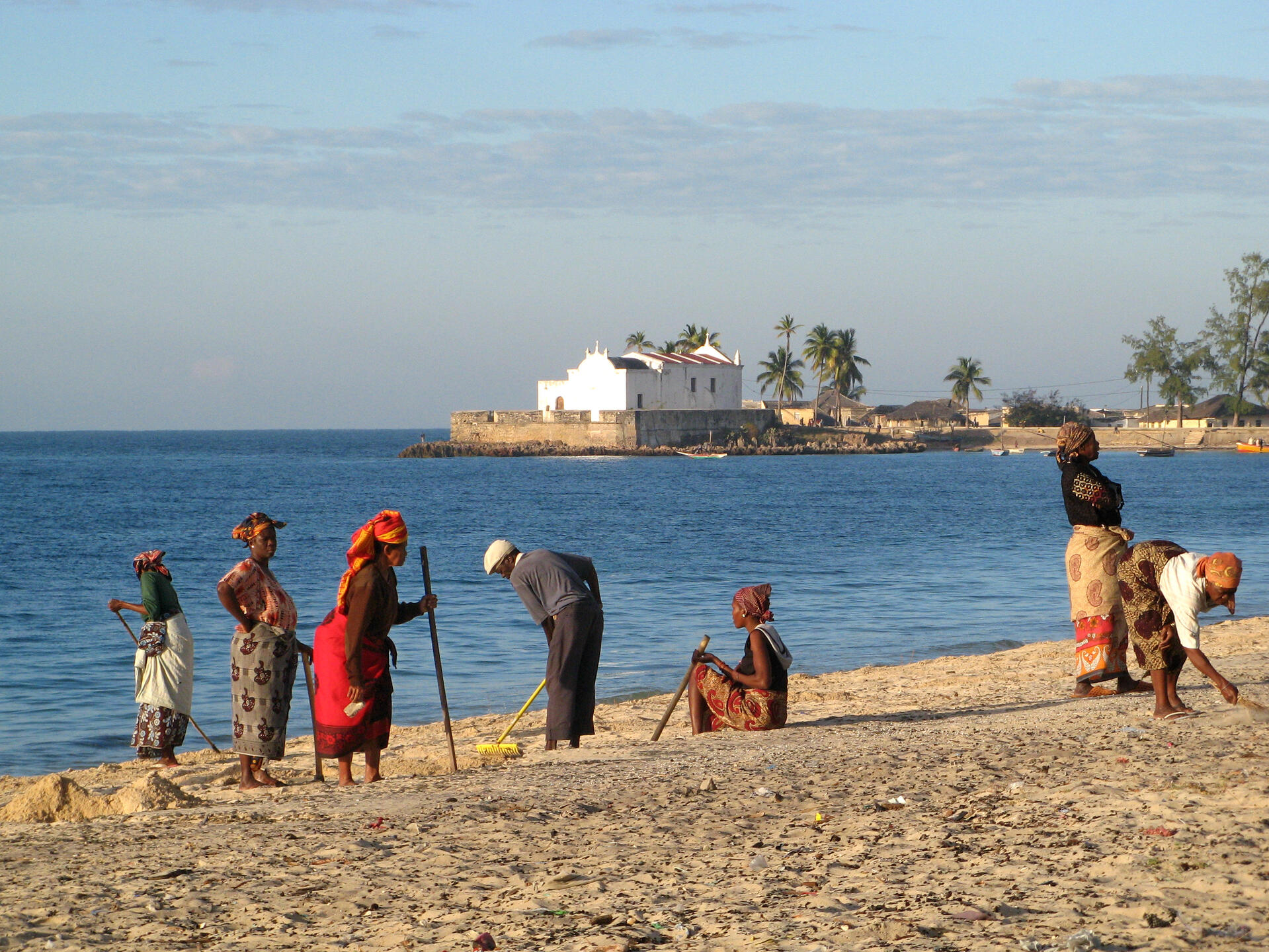
© Rosino, CC BY-SA 2.0 Resized from original. (This derivative is under the same CC BY-SA license.)
World Heritage Research
Discover scientific research and academic studies that deepen our understanding of Island of Mozambique from its history and significance to its conservation, management, and contemporary challenges.
-
Spatial and temporal variability of fouling communities on oyster spat collectors at Inhaca Island Southern Mozambique: Exploring the influence on recruitment of the oysters Pinctada capensis and Saccostrea cucullata
A study on Inhaca Island, Mozambique, reveals that fouling communities significantly influence oyster recruitment, with barnacles dominating in both rocky and seagrass habitats. While the rock oyster Saccostrea cucullata thrives in rocky areas and the pearl oyster Pinctada capensis in seagrass, other taxa show higher relative abundance where oysters and barnacles are less dense. The research, conducted over two seasons using oyster collectors deployed for four months, found that competitive interactions between fouling fauna and oysters remain modest within this timeframe. This work enhances understanding of environmental processes shaping intertidal invertebrate colonization in the southwestern Indian Ocean.
Mafambissa, M., Lindegarth, M., & Macia, A. (2024). Spatial and temporal variability of fouling communities on oyster spat collectors at Inhaca Island Southern Mozambique: Exploring the influence on recruitment of the oysters Pinctada capensis and Saccostrea cucullata. Heliyon, 10(15), e35420. https://doi.org/10.1016/j.heliyon.2024.e35420
View Publication Record | Read Publication -
Contrast in larval sensitivity to low pH in sea urchins from neighbouring seagrass meadows at Inhaca Island, Mozambique
Sea urchin larvae from intertidal seagrass meadows at Inhaca Island, Mozambique, exhibit greater sensitivity to low pH conditions compared to their subtidal counterparts. This contrast suggests that local adaptation to pH variability may differ between intertidal and subtidal environments, challenging the assumption that physiological tipping points universally correlate with the lowest experienced pH in an organism's range. Researchers exposed larvae of Tripneustes gratilla from two neighboring seagrass habitats—one subtidal (EBMI) and one intertidal (Banguá)—to four pH treatments (ranging from 8.04 to 7.29) for seven days, observing declines in survival, growth, and symmetry under lower pH conditions. The findings imply that subtidal urchins, which experience more stable pH, may possess distinct mechanisms for pH tolerance, highlighting potential vulnerabilities as ocean acidification intensifies.
Duvane, J., Cossa, D., de Abreu, D., Mafambissa, M., Scarlet, M., Macia, A., & Dupont, S. (2024). Contrast in larval sensitivity to low pH in sea urchins from neighbouring seagrass meadows at Inhaca Island, Mozambique. African Journal of Marine Science, 46(3), 217–226. https://doi.org/10.2989/1814232x.2024.2387062
View Publication Record | Read Publication -
A world of beads from the Island of Mozambique (16th–20th centuries)
Beads recovered from the shores of the Island of Mozambique, spanning from the 16th to the 20th century, serve as a cultural palimpsest reflecting transoceanic trade and historical exchanges. These beads, originating from Europe, Asia, and Africa, are not only significant archaeological artifacts but also play a crucial role in the island's local economy today. The study highlights the island's strategic geographical position, which facilitated its role as a logistical hub for European monarchies trading in the Indian Ocean. By analyzing these beads, researchers uncover layers of historical trade, cultural interaction, and economic significance that persist into modern times.
Casimiro, T. M., Duarte, Y., & Iglésias, J. (2023). A world of beads from the Island of Mozambique (16th–20th centuries). World Archaeology, 55(5), 526–539. https://doi.org/10.1080/00438243.2024.2425277
View Publication Record | Read Publication -
Distribution and abundance of humpback whales, Megaptera novaeangliae, off the coast of Mozambique, 2003
A line-transect survey conducted off the coast of Mozambique in 2003 estimated the population of humpback whales (Megaptera novaeangliae) and unidentified large whales to be approximately 6,808 individuals within a surveyed area of 14,029.5 square nautical miles. This estimate suggests a potential increase from earlier surveys in the early 1990s. The survey, spanning from Cabo Inhaca to north of Mozambique Island, revealed higher sighting densities between Cabo Inhaca and Xai-Xai, as well as around the Pantaloon and David Shoals northeast of Quelimane, with lower densities over the Sofala Banks. Whales were predominantly found in waters with higher salinity, possibly due to turbidity from river input. Cow-calf pairs were distributed across the entire region. The study utilized 951.8 nautical miles of search effort, primarily in passing mode due to high whale densities.
Findlay, K., Meyer, M., Elwen, S., Kotze, D., Johnson, R., Truter, P., Uamasse, C., Sitoe, S., Wilke, C., Kerwath, S., Swanson, S., Staverees, L., & Derwesthuizen, J. V. (2020). Distribution and abundance of humpback whales, Megaptera novaeangliae, off the coast of Mozambique, 2003. J. Cetacean Res. Manage., 163–174. https://doi.org/10.47536/jcrm.vi3.327
View Publication Record | Read Publication -
Mozambique Island, Cabaceira Pequena and the Wider Swahili World: An Archaeological Perspective
Recent archaeological excavations on the northern coast of Mozambique, including Mozambique Island and Cabaceira Pequena, reveal insights into the cosmopolitan nature of Swahili society at the time of Portuguese first contact. The study suggests that Swahili culture in this region was deeply integrated within a broader maritime cultural landscape centered around oceanic connections in the Indian Ocean Trade Network. While Swahili archaeology is well-established in Tanzania and Kenya, this research begins to address gaps in understanding northern Mozambique's role in the Swahili world. Preliminary findings highlight the diversity of communities, arts, cultures, and beliefs that characterized Swahili society, incorporating influences from Africa, India, the Middle East, and the Far East.
Oliveira, D. V. (2020). Mozambique Island, Cabaceira Pequena and the Wider Swahili World: An Archaeological Perspective. Eastern African Literary and Cultural Studies, 6(4), 219–236. https://doi.org/10.1080/23277408.2020.1792627
View Publication Record | Read Publication -
Phylogenetics of the freshwater crab (Potamonautes MacLeay, 1838) fauna from ‘sky islands’ in Mozambique with the description of a new species (Brachyura: Potamoidea: Potamonautidae)
Researchers have identified a new species of freshwater crab, Potamonautes licoensis, from Mount Lico, a 'sky island' in Mozambique. Phylogenetic analysis using mitochondrial DNA sequences revealed that this species diverged during the Miocene to Pleistocene era and is closely related to Potamonautes choloensis. The study suggests that the diversity of freshwater crabs in Mozambique is significantly underrepresented, highlighting the need for further systematic surveys. Additionally, it underscores the importance of conserving these mountainous 'sky islands' as they harbor unique biodiversity.
Daniels, S. R., Bittencourt-Silva, G. B., Muianga, V., & Bayliss, J. (2020). Phylogenetics of the freshwater crab (Potamonautes MacLeay, 1838) fauna from ‘sky islands’ in Mozambique with the description of a new species (Brachyura: Potamoidea: Potamonautidae). European Journal of Taxonomy, (716). https://doi.org/10.5852/ejt.2020.716
View Publication Record | Read Publication -
Multi-trace-element sea surface temperature coral reconstruction for the southern Mozambique Channel reveals teleconnections with the tropical Atlantic
A coral-based sea surface temperature (SST) reconstruction for the southern Mozambique Channel reveals significant warming trends and teleconnections with distant ocean regions. Using Sr/Ca ratios from Porites sp. corals, researchers documented a 0.58°C warming trend from 1970 to 2013, aligning closely with instrumental data. While Li/Mg proxies showed unrealistic warming due to calibration uncertainties, combined Sr/Ca and Li/Mg records correlated strongly with local climate variability in the Mozambique Channel and distant regions like the tropical Atlantic, where surface wind patterns dominated SST variability. The study identifies the Pacific–North American (PNA) atmospheric pattern and tropical North Atlantic SST as key drivers of these teleconnections, offering insights into large-scale climate dynamics.
Zinke, J., D’Olivo, J. P., Gey, C. J., McCulloch, M. T., Bruggemann, J. H., Lough, J. M., & Guillaume, M. M. M. (2019). Multi-trace-element sea surface temperature coral reconstruction for the southern Mozambique Channel reveals teleconnections with the tropical Atlantic. Biogeosciences, 16(3), 695–712. https://doi.org/10.5194/bg-16-695-2019
View Publication Record | Read Publication