World Heritage Identification Number: 1322
World Heritage since: 2012
Category: Cultural Heritage
WHE Type: Historic Cities & Urban Areas
Transboundary Heritage: No
Endangered Heritage: No
Country: 🇨🇮 Côte d'Ivoire
Continent: Africa
UNESCO World Region: Africa
Map
The Historic Town of Grand-Bassam: A Testimony of Colonial Past and African Resilience
The Historic Town of Grand-Bassam, located on the Atlantic coast of Côte d'Ivoire, stands as a unique testament to the intertwined histories of Africa and Europe during the colonial era. Inscribed as a UNESCO World Heritage Site in 2012, this historic town offers a rich tapestry of architectural, cultural, and historical significance that reflects the complex social dynamics between European colonizers and indigenous African societies.
More to come…UNESCO Description of the World Heritage Site
The first capital of Côte d’Ivoire, the Historic Town of Grand-Bassam, is an example of a late 19th- and early 20th-century colonial town planned with quarters specializing in commerce, administration, housing for Europeans and for Africans. The site includes the N’zima African fishing village alongside colonial architecture marked by functional houses with galleries, verandas and gardens. Grand-Bassam was the most important port, economic and judicial centre of Côte d’Ivoire. It bears witness to the complex social relations between Europeans and Africans, and to the subsequent independence movement. As a vibrant centre of the territory of French trading posts in the Gulf of Guinea, which preceded modern Côte d’Ivoire, it attracted populations from all parts of Africa, Europe and the Mediterranean Levant.
UNESCO Justification of the World Heritage Site
Criterion (iii): Grand-Bassam bears witness, through its well preserved urban organisation, to an important cultural tradition linked to its role as a colonial capital, an administrative centre for the former AOF (Afrique occidentale française) and a regional commercial hub. From the 1880s to the 1950s, the town brought together various African, European and Middle Eastern populations. Cohabitation between them was harmonious but at the same time conflictual.
Criterion (iv): Grand-Bassam constitutes an outstanding example of rational colonial town planning, with its specialised quarters in an overall urban network in which vegetation has an important role. The colonial architecture is characterised by a sober and functional style, using principles of hygiene adapted to a tropical location. The organisation of the vernacular house in the N'zima village echoes this approach, expressing the permanency of indigenous values.
Encyclopedia Record: Historic Town of Grand-Bassam
The Historic Town of Grand-Bassam is the old part of the city of Grand-Bassam in Ivory Coast. It was listed as a UNESCO World Heritage Site in 2012.Additional Site Details
Area: 109.89 hectares
Number of Components: 2
(iv) — Outstanding example of a type of building or landscape
Coordinates: 5.1958333333 , -3.7363888889
Image
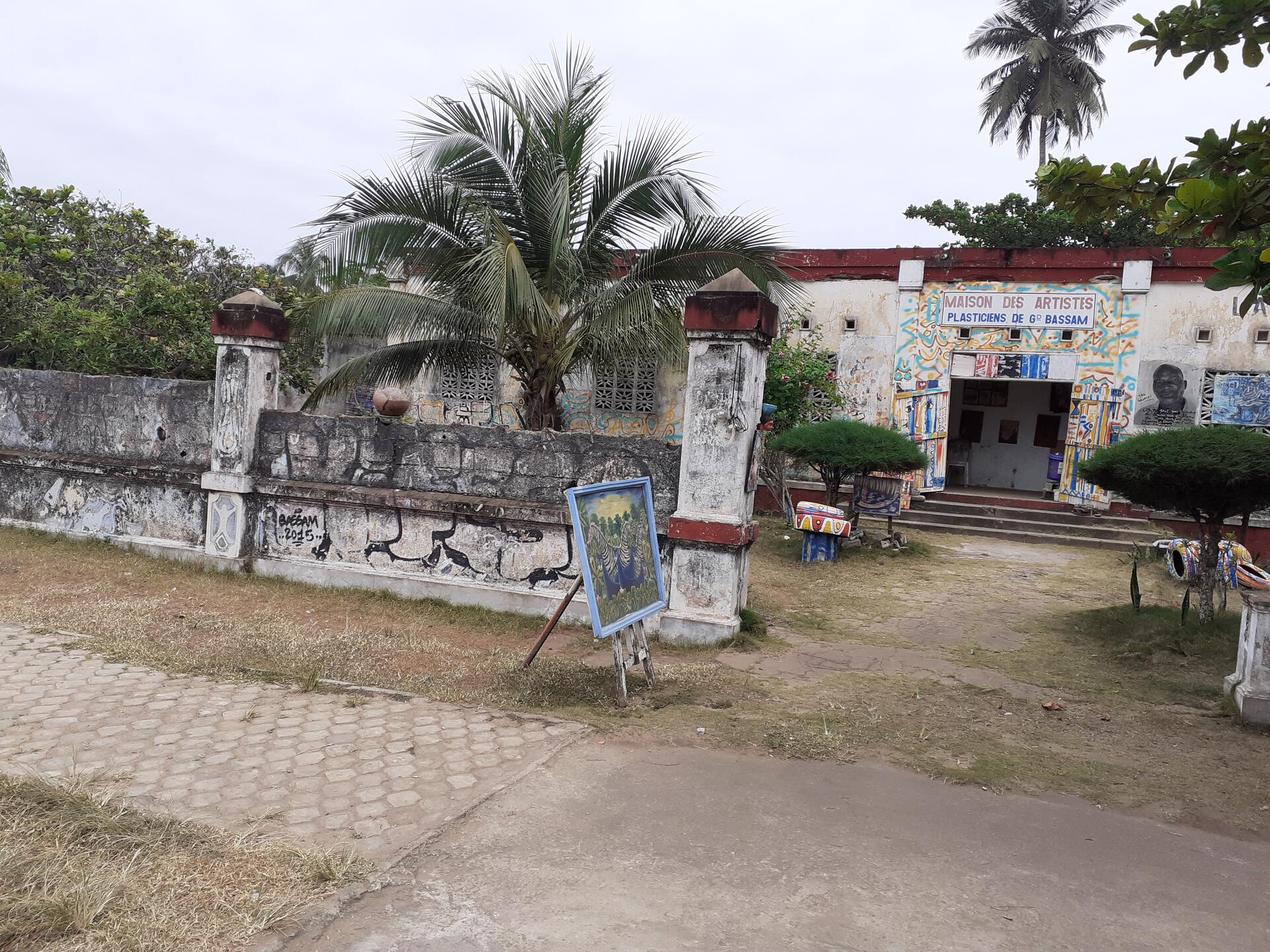
© Benoit Soubeyran, CC BY-SA 4.0 Resized from original. (This derivative is under the same CC BY-SA license.)
World Heritage Research
Discover scientific research and academic studies that deepen our understanding of Historic Town of Grand-Bassam from its history and significance to its conservation, management, and contemporary challenges.
-
Hidden in plain sight: reverification of citizen-science data unveils the widespread distribution of Tarentola parvicarinata Joger, 1980 (Squamata, Phyllodactylidae) in Côte d’Ivoire
Researchers have uncovered the widespread distribution of Tarentola parvicarinata, a phyllodactylid gecko, across Côte d’Ivoire by reverifying citizen-science photographs. Initially reported only from Grand-Bassam, 15 previously misidentified records were confirmed, revealing the species' presence in major towns from southern to northern regions of the country. This discovery highlights how citizen-science data, when re-evaluated, can significantly refine our understanding of species distribution and status. The study underscores the importance of leveraging public contributions for scientific research, particularly in understudied areas like Côte d’Ivoire.
Yeung, W. H. Y., Dezetter, M., Yebouet, C. K., Kouamé, K. J., & Koné, A. H. (2026). Hidden in plain sight: reverification of citizen-science data unveils the widespread distribution of Tarentola parvicarinata Joger, 1980 (Squamata, Phyllodactylidae) in Côte d’Ivoire. Check List, 22(4), 755–765. https://doi.org/10.15560/22.4.755
View Publication Record | Read Publication -
The historic town of Grand-Bassam as an example of transmodern heritage
The Historic Town of Grand-Bassam, inscribed on the UNESCO World Heritage list in 2012, exemplifies transmodern heritage—a decolonial framework that challenges conventional interpretations of colonial urban development. This approach reveals the distinct yet coexisting realities of Quartier France, the 19th-century colonial capital, and N'zima village, home to the N'zima kotoko people. By analyzing their planning, architecture, and spatial organization, the study highlights the social, economic, political, and cultural alterity of African communities in Grand-Bassam, moving beyond the core-periphery dynamic imposed by colonization. This perspective offers a nuanced understanding of how these two sections reflect divergent yet interwoven histories, enriching our comprehension of heritage sites shaped by colonial and postcolonial forces.
Human Sciences Research Council. (2025). The historic town of Grand-Bassam as an example of transmodern heritage. HSRC. https://doi.org/10.14749/30763163
View Publication Record | Read Publication -
Transmodern heritage as a space for imagining pluriversal relations—Insights from the African “periphery”
A new perspective on transmodern heritage challenges the binary narrative of colonial encounters, proposing that African urban spaces like N'zima village in Grand-Bassam and Abbashawel in Asmara offer a pluriversal alternative to Western modernity. This study shifts focus from center-periphery dynamics to decolonial ontologies, highlighting how these areas contest modernist binaries and enable pluralistic politics. By analyzing the structural, organizational, and ontological differences between colonial and African-planned urban entities, the research suggests that both could not exist without the other, yet their interdependence is better understood through transmodernity rather than Western onto-epistemologies.
Bialostocka, O. (2024). Transmodern heritage as a space for imagining pluriversal relations—Insights from the African “periphery”. Curator: The Museum Journal, 67(1), 269–282. Portico. https://doi.org/10.1111/cura.12595
View Publication Record | Read Publication -
Monitoring of Plastic Waste on the Beaches of Grand-Bassam, Ivory Coast
A significant accumulation of plastic waste on the beaches of Grand-Bassam, Ivory Coasthas been documented, with quantities ranging from 2.67 kg to 9.8 kg per 25-meter transect across three monitored sites and four seasons. Polypropylene (PP) and low-density polyethylene (LDPE) emerged as dominant components, constituting 33.35% and 23.43% of the collected waste, respectively. The study, conducted through eight sampling campaigns from March to October 2022, revealed variability in plastic waste distribution both spatially and seasonally, as confirmed by discriminant analysis and ANOVA testing. These findings underscore the urgent need for targeted interventions to mitigate environmental degradation in this culturally significant coastal area.
Téya Koffi Basile, Effebi Kokoh Rose, Niamké Kadio Hilaire, & Gbossou Koudou Christophe. (2023). Monitoring of Plastic Waste on the Beaches of Grand-Bassam, Ivory Coast. Zenodo. https://doi.org/10.5281/ZENODO.7680102
View Publication Record | Read Publication