World Heritage Identification Number: 821
World Heritage since: 1997
Category: Cultural Heritage
WHE Type: Historic Cities & Urban Areas
Transboundary Heritage: No
Endangered Heritage: No
Country: 🇧🇷 Brazil
Continent: Americas
UNESCO World Region: Latin America and the Caribbean
Map
The Historic Centre of São Luís: A Unique Iberian Colonial Town in Brazil
The Historic Centre of São Luís, inscribed as a UNESCO World Heritage Site in 1997, offers a captivating glimpse into the rich history and cultural heritage of Brazil. Located on Upaon-açu Island, in the Baía de São Marcos, the city serves as the capital and largest urban center of the state of Maranhão. With a population of over one million inhabitants, it boasts the second-largest maritime extension among Brazilian states, spanning an impressive 640 kilometers.
More to come…UNESCO Description of the World Heritage Site
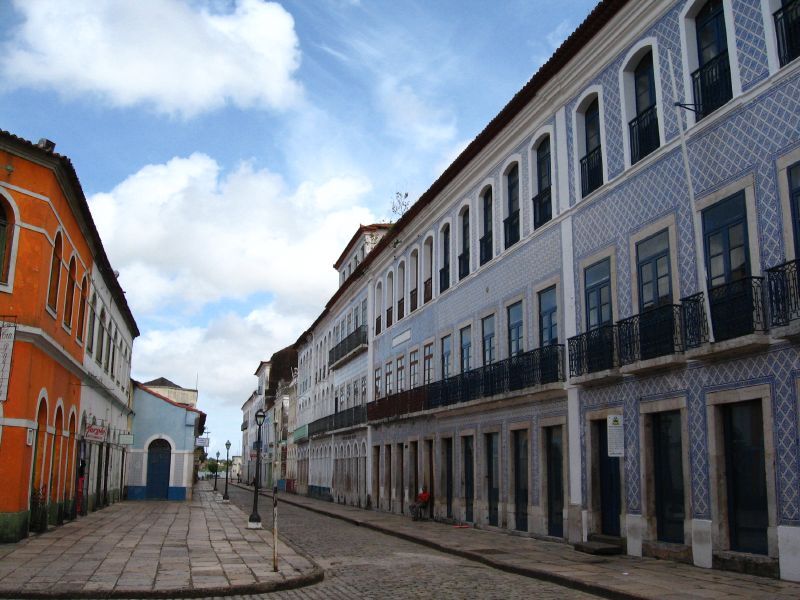
The late 17th-century core of this historic town, founded by the French and occupied by the Dutch before coming under Portuguese rule, has preserved the original rectangular street plan in its entirety. Thanks to a period of economic stagnation in the early 20th century, an exceptional number of fine historic buildings have survived, making this an outstanding example of an Iberian colonial town.
UNESCO Justification of the World Heritage Site
Criterion (iii): The Historic Centre of São Luís bears exceptional testimony to Portuguese colonial civilisation.
Criterion (iv): The Historic Centre of São Luís is an outstanding example of a Portuguese colonial town adapted to the climatic conditions of equatorial South America.
Criterion (v): The Historic Centre of São Luís is an outstanding example of a colonial town which has preserved its urban fabric, harmoniously integrated with its natural setting, to an exceptional degree.
Encyclopedia Record: Historic Centre of São Luís
The Historic Centre of São Luís is located on the Island of São Luis on the Bay of São Marcos in São Luís, the capital of Maranhão, Brazil. The historic center covers an area of 220 hectares, and has approximately 4,000 properties from the 18th and 19th centuries within protected state and federal zones. Part, but not all, of the Historic Center was declared a World Heritage Site in 1997. The Brazilian National Institute of Historic and Artistic Heritage (IPHAN) describes the Historic Center as "an exceptional example of a Portuguese colonial city adapted to the climatic conditions of equatorial South America, and which has preserved its urban fabric harmoniously integrated into its surrounding environment." Pedro Teotónio Pereira, ambassador to Brazil and first director of the Gulbenkian Foundation, described São Luís as "the most Portuguese city in Brazil".Additional Site Details
Area: 66.65 hectares
Number of Components: 1
(iv) — Outstanding example of a type of building or landscape
(v) — Outstanding example of traditional human settlement
Coordinates: -2.530054 , -44.303369
World Heritage Research
Discover scientific research and academic studies that deepen our understanding of Historic Centre of São Luís from its history and significance to its conservation, management, and contemporary challenges.
-
Vídeo mapping em Centros Históricos: Diretrizes para destinos turísticos inteligentes com base no caso de São Luís (MA), Brasil
Video mapping, when integrated with critical curation and community participation, can enhance the cultural value of historic centers while mitigating negative impacts such as light and noise pollution. This study, conducted through a multimethod approach including an integrative literature review (2020–2025) and a documentary case study of São Luís (MA), Brazil (2019–2025), identified key guidelines for its application in Smart Tourist Destinations (STD). These include aligning conservation efforts with urban accessibility, ensuring local authorship, and providing transparent metadata. The research concludes that video mapping projects, when anchored in social participation and impact assessment, can support policies promoting the right to the city and heritage preservation.
Mendes, C. S., & Porto, R. M. A. B. (2025). Video mapping en Centros Históricos: Directrices para destinos turísticos inteligentes a partir del caso de São Luís (MA), Brasil. Research, Society and Development, 14(10), e174141049885. https://doi.org/10.33448/rsd-v14i10.49885
View Publication Record | Read Publication -
Patrimônio histórico-cultural: casos e descasos do Centro de São Luís do Maranhão
The UNESCO-listed Historic Centre of São Luís, renowned for its eclectic, neocolonial, and Art Deco architecture, faces significant challenges to its preservation despite its cultural significance. Research reveals that the site suffers from delayed, incomplete, or disproportionate revitalization efforts, unmediated human interventions, and environmental degradation, exacerbating issues like marginalization, segregation, outdated commerce, and socioterritorial conflicts. These factors undermine the material value of the heritage site, necessitating a reevaluation of public policies for safeguarding and valorizing its patrimony. The study emphasizes the need to address these challenges to ensure the long-term conservation of this globally recognized landmark.
Freitas, A. R. d., & Melo, S. N. d. (2024). Patrimonio y gestión urbana: casos y abandono en el Centro Histórico de São Luís do Maranhão. Geographia Opportuno Tempore, 10(1), e50234. https://doi.org/10.5433/got.2024.v10.50234
View Publication Record | Read Publication -
A Grammar-Based Approach for Generating Spatial Layout Solutions for the Adaptive Reuse of Sobrado Buildings
Researchers have developed a shape grammar to generate spatial layout solutions for the adaptive reuse of sobrado buildings, a typology present in the historic center of São Luís, Brazil. This approach transforms single-family sobrados into multi-family apartments while considering spatial and structural requirements. The methodology prioritizes natural daylighting and supports multiple layout configurations for the same building, aiming to accelerate the repurposing of historic structures for contemporary housing needs. The study specifies a framework for allocating studios, one-bedroom, and two-bedroom apartments and applies this grammar to three case study buildings.
Paulino, D. M. S., Ligler, H., & Napolitano, R. (2023). A Grammar-Based Approach for Generating Spatial Layout Solutions for the Adaptive Reuse of Sobrado Buildings. Buildings, 13(3), 722. https://doi.org/10.3390/buildings13030722
View Publication Record | Read Publication -
The Reviver Grammar: transforming the historic center of São Luís through social housing
A novel approach using Shape Grammars demonstrates potential for the adaptive reuse of historic Sobrado buildings in São Luís, Brazil, into multi-family social housing. The proposed grammar provides a systematic framework to generate layout solutions that accommodate studios, one-bedroom, and two-bedroom apartments while preserving structural integrity and maximizing natural daylighting through strategic placement of windows and balconies. This methodology offers a scalable solution for repurposing historic buildings, addressing urban density challenges in heritage-rich areas without compromising architectural authenticity.
Paulino, D. M. S., Knapp, C. J., Ligler, H., & Napolitano, R. (2023). The Reviver Grammar: transforming the historic center of São Luís through social housing. Blucher Design Proceedings, 347–358. https://doi.org/10.5151/sigradi2022-sigradi2022_94
View Publication Record | Read Publication -
Automating the Adaptive Reuse of Cultural Heritage: A computational framework for reconfiguring historic masonry buildings
A computational framework leveraging Shape Grammars demonstrates the potential for automating adaptive reuse of historic masonry buildings, specifically Sobrado typologies in São Luís' UNESCO-listed center. This approach generates diverse spatial arrangements for converting single-family structures into multi-family apartments—studios, one-bedroom, and two-bedroom units—while preserving original architectural elements like windows and balconies to maintain natural daylighting and historical integrity. The methodology, implemented using RhinoScript syntax and Python, offers an interactive tool for designers, balancing structural constraints with heritage preservation requirements. By reconfiguring existing buildings without compromising their cultural value, the framework provides a scalable solution for urban densification in historic contexts.
Melo Santos Paulino, D., Lewis, K., Napolitano, R., & Ligler, H. (2023). Automating the Adaptive Reuse of Cultural Heritage: A computational framework for reconfiguring historic masonry buildings. Proceedings of the 41st International Conference on Education and Research in Computer Aided Architectural Design in Europe (eCAADe) [Volume 2], 2, 691–700. https://doi.org/10.52842/conf.ecaade.2023.2.691
View Publication Record | Read Publication -
Tipologia da Fissuração em Edificação da Arquitetura Luso-Maranhense: Estudo de Caso
A study on the Historic Centre of São Luís, Maranhão, reveals that cracks in masonry and concrete structures are primarily caused by the decay of internal wooden supports and the disintegration of coating grout. Additionally, porous plaster layers contribute to carbonation in concrete, accelerating structural deterioration. The research identifies preventive maintenance of wood as a key treatment for masonry and recomposition of carbonated layers with structural reinforcement for concrete. This study provides critical insights into the degradation mechanisms affecting Luso-Maranhense architecture, offering targeted solutions for preservation.
Vieira de Araújo, M., Rodrigues de Araújo Netto, R. N., & Silva de Oliveira, A. H. (2022). TIPOLOGIA DA FISSURAÇÃO EM EDIFICAÇÃO DA ARQUITETURA LUSO-MARANHENSE: ESTUDO DE CASO. Revista Científica Semana Acadêmica, 10(217), 1–15. https://doi.org/10.35265/2236-6717-217-9447
View Publication Record | Read Publication -
Transformations of the Heritage Landscape Induced by Urban and Tourist Public Policies in Public Spaces in the City of São Luís (Maranhão)
Tourism interventions have altered the dynamics of use and occupation of public spaces in São Luís, Brazil, despite preserving their historical landscape configurations. The study focuses on João Lisboa Square and Largo do Carmo, both located in the UNESCO-listed Historic Centre of São Luís, which retains its colonial-era patrimonial landscape. Researchers analyzed these transformations through bibliographic research, policy analysis, and field activities, revealing that tourism has reshaped how these spaces are utilized while maintaining their architectural integrity.
Santos, S. R. D., Ferreira, D. E. S., & Matheus Andrade Marques. (2022). Transformations of the Heritage Landscape Induced by Urban and Tourist Public Policies in Public Spaces in the City of São Luís (Maranhão). https://doi.org/10.5281/ZENODO.6632579
View Publication Record | Read Publication