World Heritage Identification Number: 617
World Heritage since: 1992
Category: Cultural Heritage
WHE Type: Historic Cities & Urban Areas
Transboundary Heritage: No
Endangered Heritage: No
Country: 🇨🇿 Czechia
Continent: Europe
UNESCO World Region: Europe and North America
Map
The Enchanting Historic Centre of Český Krumlov: A Medieval Gem in the Heart of Bohemia
Nestled within the verdant valley of the Vltava River, the picturesque town of Český Krumlov stands as a captivating testament to the rich tapestry of Central European history. This enchanting medieval settlement, with approximately 13,000 inhabitants, has earned itself a place among the most frequented destinations within the Czech Republic. In 1992, the Historic Centre of Český Krumlov was inscribed onto the prestigious UNESCO World Heritage List, recognizing its exceptional preservation of Gothic, Renaissance, and Baroque architectural styles that have endured for over five centuries.
More to come…UNESCO Description of the World Heritage Site
Situated on the banks of the Vltava river, the town was built around a 13th-century castle with Gothic, Renaissance and Baroque elements. It is an outstanding example of a small central European medieval town whose architectural heritage has remained intact thanks to its peaceful evolution over more than five centuries.
UNESCO Justification of the World Heritage Site
Criterion (iv): Český Krumlov is an outstanding example of a Central European small town dating from the Middle Ages which owes the structure and buildings of its historic core to its economic importance and relatively undisturbed organic development over some five centuries. Český Krumlov grew up within a meander of the Vltava River, which provides a natural setting of great beauty. Its evolution over time is evident with startling clarity from its buildings and its urban infrastructure.
Encyclopedia Record: Český Krumlov
Český Krumlov is a town in the South Bohemian Region of the Czech Republic. It has about 13,000 inhabitants. The town is located on the Vltava River in the Bohemian Forest Foothills.Additional Site Details
Area: 51.91 hectares
Number of Components: 1
Coordinates: 48.8106944444 , 14.3150277778
Image
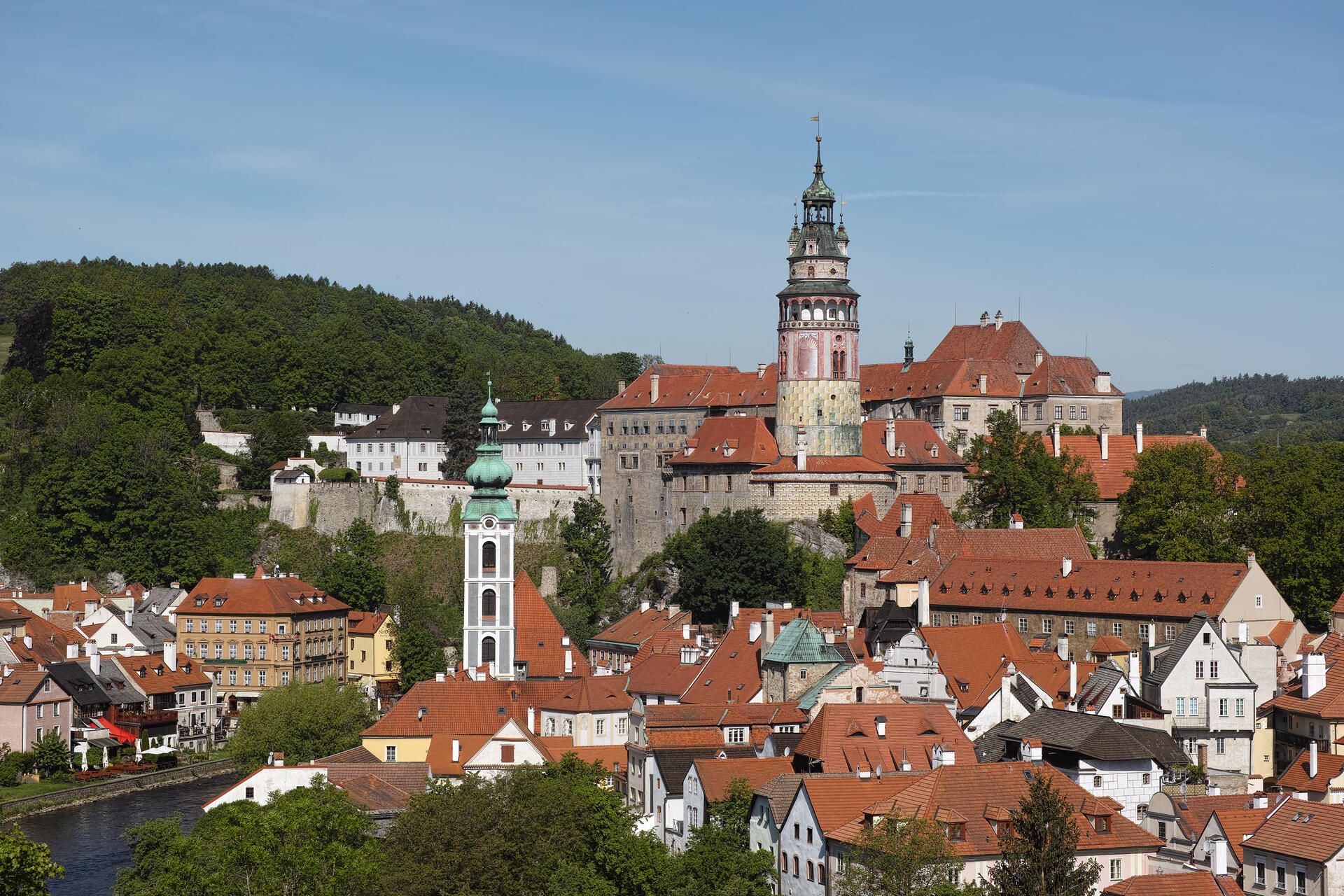
© Xth-Floor, CC BY-SA 4.0 Resized from original. (This derivative is under the same CC BY-SA license.)
World Heritage Research
Discover scientific research and academic studies that deepen our understanding of Historic Centre of Český Krumlov from its history and significance to its conservation, management, and contemporary challenges.
-
The Impact of the SARS COV-2 Pandemic on Visitor Numbers to UNESCO Sites in the Czech Republic from the Visitor's Point of View
A significant decline in visitor numbers to UNESCO World Heritage Sites, including the Historic Centre of Český Krumlov, was observed post-SARS-CoV-2 pandemic. This study reveals that while tourism resilience strategies were employed, anomalies such as the pandemic led to lasting impacts on visitation patterns. Conducted through an extensive questionnaire survey involving 377 respondents in 2023, the research analyzed visitor insights to propose measures aimed at enhancing the appeal of these heritage sites. Findings underscore the critical role of adaptive tourism practices and visitor engagement in mitigating adverse effects on cultural tourism.
Lněnička, L., Burda, T., But, T., Židová, V., Janečková, M., Kulhánková, S., & Lisa, J. (2024). The Impact of the SARS COV-2 Pandemic on Visitor Numbers to UNESCO Sites in the Czech Republic from the Visitor’s Point of View. Proceedings of the International Scientific Conference Hradec Economic Days 2024, 14, 293–304. https://doi.org/10.36689/uhk/hed/2024-01-025
View Publication Record | Read Publication -
Dopady pandemie SARS CoV-2 na návštěvnost památek UNESCO v Česku očima návštěvníků
A significant decline in visitor numbers to UNESCO World Heritage Sites in the Czech Republic, including Český Krumlov, was observed post-pandemic, with recovery remaining uneven. The study, based on a 2023 survey of 361 visitors, reveals that while some sites have rebounded, others face persistent challenges due to altered tourist behavior and economic constraints. Key factors affecting visitation include perceived safety concerns, changes in travel preferences, and the limited appeal of cultural heritage attractions post-pandemic. The research highlights the need for targeted strategies, such as enhanced digital marketing, improved visitor experiences, and sustainable tourism practices, to restore and boost attendance at these sites.
Lněnička, L., Burda, T., But, T., Kacetl, J., & Židová, V. (2024). Dopady pandemie SARS CoV-2 na návštěvnost památek UNESCO v Česku očima návštěvníků. Geografické Informácie, 28(1), 67–86. https://doi.org/10.17846/gi.2024.28.1.67-86
View Publication Record | Read Publication -
Approaches To Overtourism In The Area Of Destination Management Marketing
Destination Management Organizations (DMOs) employ diverse strategies to mitigate overtourism, with key approaches including innovation, collaboration, and leveraging technology. A study analyzing DMOs in Vannes, Colmar, Melaka, and Český Krumlov reveals that while no universal solution exists, insights from these case studies highlight the need for adaptive measures to address economic, socio-cultural, and environmental challenges. Semi-controlled interviews with marketing representatives underscored the complexity of overtourism and the potential of forward-thinking strategies to enhance destination resilience.
Vysušilová, P. (2024). Approaches To Overtourism In The Area Of Destination Management Marketing. Economics Working Papers, 8(4), 6–72. https://doi.org/10.32725/ewp.2024.004
View Publication Record | Read Publication -
The history and organization of the Workshop on Population and Speciation Genomics
A biennial workshop on population and speciation genomics, held in the UNESCO World Heritage town of Český Krumlov, Czech Republic, has successfully bridged gaps in bioinformatics training for evolutionary biology researchers. This extended course, part of a long-running series, combines intensive teaching with collaborative learning to foster scientific progress. The study highlights key organizational elements that contribute to its effectiveness, including structured routines and participant feedback mechanisms. A survey of past attendees quantifies the workshop's impact on knowledge acquisition and cross-disciplinary idea exchange. Lessons learned from this model aim to guide other institutions in developing similar extended bioinformatics training programs.
Barth, J. M. I., Handley, S. A., Kintzl, D., Leonard, G., Malinsky, M., Matschiner, M., Meyer, B. S., Salzburger, W., Stefka, J., & Trucchi, E. (2023). The history and organization of the Workshop on Population and Speciation Genomics. Evolution: Education and Outreach, 16(1). https://doi.org/10.1186/s12052-023-00182-w
View Publication Record | Read Publication -
Creating Strategies to Mitigate the Adverse Effects of Overtourism in Rural Destinations: Experience from the Czech Republic
A methodology for mitigating overtourism's adverse effects in rural destinations has been developed, offering a standardized approach to evaluate and implement strategies that ensure sustainable tourism development. This method identifies specific manifestations of overtourism and assesses the usability of various countermeasures, providing a comprehensive plan tailored to local conditions. Applied to 12 diverse rural sites in the Czech Republic—including UNESCO World Heritage Sites like Český Krumlov—the approach demonstrates how destinations can balance tourism growth with ecological and social sustainability, addressing challenges such as resistance to tourism, traffic congestion, and environmental damage.
Drápela, E. (2023). Creating Strategies to Mitigate the Adverse Effects of Overtourism in Rural Destinations: Experience from the Czech Republic. Sustainability, 15(24), 16958. https://doi.org/10.3390/su152416958
View Publication Record | Read Publication