World Heritage Identification Number: 1376
World Heritage since: 2011
Category: Cultural Heritage
WHE Type: Historic Cities & Urban Areas
Transboundary Heritage: No
Endangered Heritage: No
Country: 🇧🇧 Barbados
Continent: Americas
UNESCO World Region: Latin America and the Caribbean
Map
Historic Bridgetown and Its Garrison: A Unique Colonial Legacy in Barbados
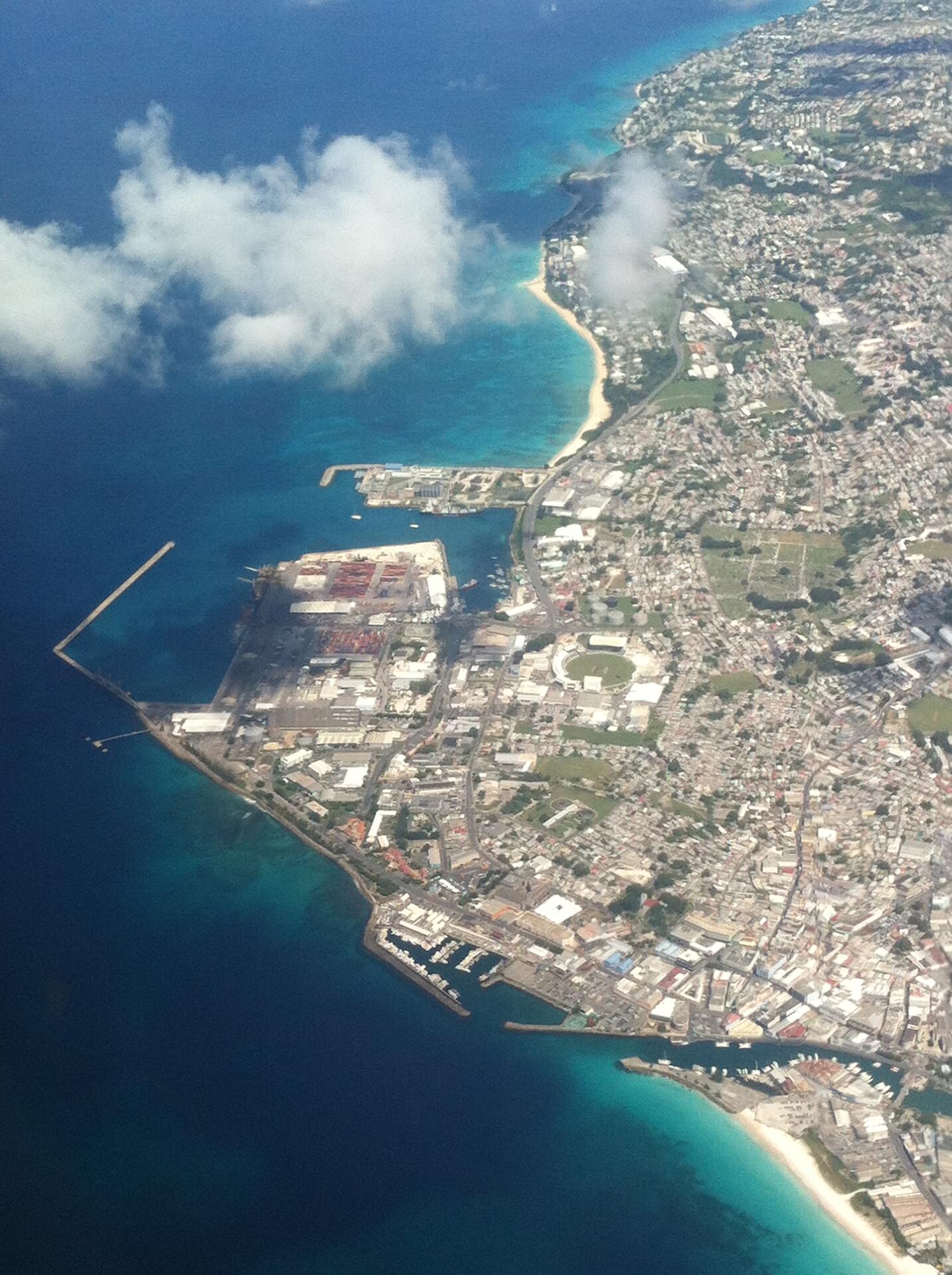
Historic Bridgetown and Its Garrison, inscribed as a UNESCO World Heritage Site in 2011, offers a unique insight into the architectural legacy of British colonialism in the Caribbean. Located in the parish of Saint Michael, Bridgetown, the capital and largest city of Barbados, presents a well-preserved urban landscape that dates back to the 17th, 18th, and 19th centuries. This site serves as a testament to the expansion of Great Britain's Atlantic colonial empire.
More to come…UNESCO Description of the World Heritage Site
Historic Bridgetown and its Garrison, an outstanding example of British colonial architecture consisting of a well-preserved old town built in the 17th, 18th and 19th centuries, which testifies to the spread of Great Britain's Atlantic colonial empire. The property also includes a nearby military garrison which consists of numerous historic buildings. With its serpentine urban lay-out the property testifies to a different approach to colonial town-planning compared to the Spanish and Dutch colonial cities of the region which were built along a grid plan.
UNESCO Justification of the World Heritage Site
Criterion (ii): Historic Bridgetown and its Garrison had a pivotal role in the development of the English colonies in the Atlantic World and was a centre for transmission of ideas concerning administration, trade, communications, science, culture and technology in the British Empire. While the Garrison can be said to have absorbed military ideas from Europe and transmitted them to other areas of the Caribbean, the social stratification of Bridgetown illustrates the interchange of several occupational, religious, ethnic, free and enslaved groups; a meeting of cultures, which created a hybridized Creole culture in the Anglophone Caribbean. This hybridized culture, which did not wholly abandon either European or African ways, lives on in the ways in which the urban space functions today.
Criterion (iii): Historic Bridgetown and its Garrison is an exceptional testimony of British colonial trade and defence in the Caribbean and the Americas. The historic town has retained its original footprint, based on its English medieval serpentine street layout, for almost 400 years, which bears exceptional testimony to British town layouts in foreign soil. St. Ann’s Garrison and its fortifications, which protected the town and its port, constitute the most complete complex of a 18th-19th century British garrison ensemble in the Atlantic World. As an integrated semi-planned urban landscape, with a strong brick architectural testimony, and a collection of colonial warehouses and dock facilities, it has remained essentially unchanged for 200 years, and provides an outstanding glimpse into a pivotal period of British imperial rule and culture.
Criterion (iv): St Ann’s Garrison is the earliest type of British navy and army base in the Caribbean and in its architectural layout and urban composition influenced later British presence in the region. The relation between the Historic Bridgetown and its Garrison is characterized by urban and architectural elements, which illustrate the continuous interaction between the commercial and military interests that dominated the evolution of functions in the colonial and post-colonial space. This is most evident in the tension between military order and economic resourcefulness, expressed among other by the Screw Dock, an outstanding but highly vulnerable structure, and the 18th and 19th century warehouses, built to withstand hurricanes and other threats in the tropical environment.
Encyclopedia Record: Bridgetown
Bridgetown is the capital and largest city of Barbados. Formerly The Town of Saint Michael, the Greater Bridgetown area is located within the parish of Saint Michael. Bridgetown is sometimes locally referred to as "The City", but the most common reference is simply "Town". As of 2014, its metropolitan population stands at roughly 110,000.Additional Site Details
Area: 187 hectares
Number of Components: 1
(iii) — Unique or exceptional testimony to a cultural tradition
(iv) — Outstanding example of a type of building or landscape
Coordinates: 13.0966666667 , -59.6138888889
World Heritage Research
Discover scientific research and academic studies that deepen our understanding of Historic Bridgetown and its Garrison from its history and significance to its conservation, management, and contemporary challenges.
-
Whose stories do we tell? Exploring narrative constructions of Bridgetown and its Garrison, Barbados’ UNESCO World Heritage Site
Research on Bridgetown and its Garrison, Barbados' UNESCO World Heritage Site, reveals that diverse narratives—ranging from official colonial heritage to lived experiences and intangible traditions—enrich the site's significance for both locals and visitors. The study, involving participatory workshops and stakeholder interviews, demonstrates that incorporating multiple storytelling perspectives can better reflect Barbadian identity while enhancing visitor engagement. This approach bridges tangible and intangible heritage, advocating for narrative plurality over a single coherent storyworld to create more inclusive and meaningful experiences at the site.
Simons, I., & de Waal, M. S. (2025). Whose stories do we tell? Exploring narrative constructions of Bridgetown and its Garrison, Barbados’ UNESCO World Heritage Site. Journal of Tourism and Cultural Change, 24(4), 604–627. https://doi.org/10.1080/14766825.2025.2584373
View Publication Record | Read Publication -
Whose stories do we tell?: Exploring narrative constructions of Bridgetown and its Garrison, Barbados’ UNESCO World Heritage Site
A diverse range of narratives, including both official and lesser-known stories, enrich the experience and value of Bridgetown and its Garrison, Barbados' UNESCO World Heritage Site. This study reveals that incorporating multiple storytelling perspectives can better reflect Barbadian identity and enhance visitor experiences, demonstrating a potential synergy between tangible and intangible heritage. While acknowledging the importance of a coherent storyworld, the research advocates for narrative plurality in destination storytelling to bridge these domains effectively.
Simons, I., & de Waal, M. S. (2025). Whose stories do we tell? Exploring narrative constructions of Bridgetown and its Garrison, Barbados’ UNESCO World Heritage Site. Journal of Tourism and Cultural Change, 24(4), 604–627. https://doi.org/10.1080/14766825.2025.2584373
View Publication Record | Read Publication -
Women and the affective domain of the Bridgetown Estate
A core of solidarity and interdependence persists among women living in Bridgetown's estate, countering the individualist pressures of neoliberalism. Despite harsh living conditions, long-standing practices of mutual support and care remain, though at a cost to physical and mental health. The study applies feminist theories of dependence and interdependence to analyze the lived experiences of working-class women, highlighting the unique challenges they face as an axis of inequality. This research underscores the need for targeted attention to these specific struggles within capitalist patriarchal structures.
Bissett, J. (2023). Women and the affective domain of the Bridgetown Estate. It’s Not Where You Live, It’s How You Live, 108–117. https://doi.org/10.1332/policypress/9781447368212.003.0012
View Publication Record | Read Publication -
Human Adaptation to Coastal Hazards in Greater Bridgetown, Barbados
Greater Bridgetown, Barbados, demonstrates significant capacity for resilience against coastal hazards such as sea-level rise and storm surges, but this potential is hindered by institutional neglect, limited stakeholder engagement, and insufficient investment. The study identifies that while historical urban development and governance structures shape vulnerability, proactive adaptation strategies—including infrastructure protection and cross-sector collaboration—could substantially reduce risks. Using a qualitative survey and an adaptive urban governance framework, researchers analyzed the interplay between national policies, urban morphology, and local stakeholder initiatives to assess how these factors either mitigate or exacerbate coastal vulnerabilities. The findings underscore the need for prioritization of climate adaptation in small island developing states, where urban resilience is critical yet often overlooked.
Mycoo, M., Robinson, S.-A., Nguyen, C., Nisbet, C., & Tonkel, R. (2021). Human Adaptation to Coastal Hazards in Greater Bridgetown, Barbados. Frontiers in Environmental Science, 9. https://doi.org/10.3389/fenvs.2021.647788
View Publication Record | Read Publication -
Rhodes Must Not Fall?
Public monuments, such as statues of historical figures like Lord Nelson and Cecil Rhodes, often serve as contested symbols of colonial power. This study argues that their continued presence in public spaces—despite demands for removal or remediation—represents a form of 'historical erasure,' silencing the original ideological intent behind these objects and their ongoing contestation. The research examines how such monuments were erected during periods of imperial dominance to reinforce pro-colonial narratives, yet their preservation today risks uncritically legitimizing those legacies. By analyzing cases in Barbados (Bridgetown) and England (Oxford), the study challenges the notion that age alone grants historical significance, instead advocating for a renegotiation of which pasts are prioritized in public memory. The approach combines critical analysis of monument placement, ideological motivations, and contemporary debates on heritage preservation.
Drayton, R. (2019). Rhodes Must Not Fall? Third Text, 33(4-5), 651–666. https://doi.org/10.1080/09528822.2019.1653073
View Publication Record | Read Publication -
Bridgetown, Barbados
Bridgetown, Barbados, the capital city nestled along Carlisle Bay's arc, stands as a significant trade hub and tourist destination. Originally constructed on reclaimed swampland, its strategic location has contributed to its prominence in regional commerce and tourism. The publication provides an overview of Bridgetown's historical development, emphasizing its transformation from marshland to a bustling urban center. Key insights include its role as a cultural and economic nexus, shaped by Barbados' colonial past and modern economic activities.
(Ed.). (2019). Bridgetown, Barbados. The Statesman’s Yearbook Companion, 471. https://doi.org/10.1057/978-1-349-95839-9_952
View Publication Record | Read Publication -
New ports of the New World: Angra, Funchal, Port Royal and Bridgetown
A comparative analysis of the port systems of the Portuguese and British Empires in the Atlantic during the 17th and 18th centuries reveals key factors influencing the development of four insular ports: Angra (Azores), Funchal (Madeira), Bridgetown (Barbados), and Port Royal (Jamaica). The study highlights how these ports evolved to meet trade demands, their significant challenges, and how their development aligned with or diverged from imperial expectations. By integrating landscape archaeology, nautical and underwater archaeology, historical documentation, and cartography, the research provides a multifaceted understanding of the geographical, economic, and social dynamics shaping these crucial Atlantic hubs.
Garcia, A. C. A. (2017). New ports of the New World: Angra, Funchal, Port Royal and Bridgetown. International Journal of Maritime History, 29(1), 155–174. https://doi.org/10.1177/0843871416677952
View Publication Record | Read Publication